
Jobs That Offer Relocation Assistance Pay You to Start Fresh Anywhere - Relocation
AI Workers Are the New Expats: Where Tech’s Hottest Talent Is Landing - Relocation
How to Find a Job in Miami and Thrive in the Sunshine State - Relocation
Athletic Trainers Relocation - Athletics
Doctor Relocation Timeline From Offer Letter to Hospital Onboarding - Medical
Top Cities for Female Physicians to Practice in the United States - Medical
Easy Relocation for Physicians - Medical
The Best Cities for Registered Nurses: Where Pay Meets Possibility - Medical
How Relocation Packages for Nurses Support Long-Term Career Moves - Medical
Relocating as a Traveling Nurse - Medical
10 Best Neobanks in the US That Fit Modern Financial Habits - Personal Finance
Corporate Credit Card vs. Business Credit Card: Which Option Is Appropriate for Business - Finance
Jobs That Offer Relocation Assistance Pay You to Start Fresh Anywhere - Relocation
AI Workers Are the New Expats: Where Tech’s Hottest Talent Is Landing - Relocation
How to Find a Job in Miami and Thrive in the Sunshine State - Relocation
Athletic Trainers Relocation - Athletics & Sports
Doctor Relocation Timeline From Offer Letter to Hospital Onboarding - Medical
Top Cities for Female Physicians to Practice in the United States - Medical
Easy Relocation for Physicians - Medical
The Best Cities for Registered Nurses: Where Pay Meets Possibility - Medical
How Relocation Packages for Nurses Support Long-Term Career Moves - Medical
Relocating as a Traveling Nurse - Medical
10 Best Neobanks in the US That Fit Modern Financial Habits - Personal Finance
Corporate Credit Card vs. Business Credit Card: Which Option Is Appropriate for Business - Finance
Jobs That Offer Relocation Assistance Pay You to Start Fresh Anywhere - Relocation
AI Workers Are the New Expats: Where Tech’s Hottest Talent Is Landing - Relocation
How to Find a Job in Miami and Thrive in the Sunshine State - Relocation
Athletic Trainers Relocation - Athletics & Sports
Doctor Relocation Timeline From Offer Letter to Hospital Onboarding - Medical
Top Cities for Female Physicians to Practice in the United States - Medical
Easy Relocation for Physicians - Medical
The Best Cities for Registered Nurses: Where Pay Meets Possibility - Medical
How Relocation Packages for Nurses Support Long-Term Career Moves - Medical
Relocating as a Traveling Nurse - Medical
10 Best Neobanks in the US That Fit Modern Financial Habits - Personal Finance
Corporate Credit Card vs. Business Credit Card: Which Option Is Appropriate for Business - Finance
Jobs That Offer Relocation Assistance Pay You to Start Fresh Anywhere - Relocation
AI Workers Are the New Expats: Where Tech’s Hottest Talent Is Landing - Relocation
How to Find a Job in Miami and Thrive in the Sunshine State - Relocation
Athletic Trainers Relocation - Athletics & Sports
Doctor Relocation Timeline From Offer Letter to Hospital Onboarding - Medical
Top Cities for Female Physicians to Practice in the United States - Medical
Easy Relocation for Physicians - Medical
The Best Cities for Registered Nurses: Where Pay Meets Possibility - Medical
How Relocation Packages for Nurses Support Long-Term Career Moves - Medical
Relocating as a Traveling Nurse - Medical
10 Best Neobanks in the US That Fit Modern Financial Habits - Personal Finance
Corporate Credit Card vs. Business Credit Card: Which Option Is Appropriate for Business - Finance


A move can look neat on a budget sheet and still go wrong in real life. Employees face movers, deposits, taxes, school dates, and a new commute all at once. Finance sees costs rising, while HR tries to protect both the person and the budget. Mobility cost control has to work. According to the U.S. Bureau of Labor Statistics, shelter costs were 3.2% higher year over year in September 2026. The goal is not to make every move cheap. It is to spend with purpose.
A good plan cuts waste, reduces surprise requests, and gives people enough support to start well in a new place. Tax treatment now makes that balance harder. IRS guidance says qualified moving expense reimbursements are taxable for most workers, with narrow exceptions for certain military and intelligence moves. That can raise the real cost of a relocation package for both the employer and the employee.
So the better question is simple. Which dollars lower real risk, and which dollars stay in the policy only because they have always been there?
Why Is Mobility Cost Control Harder in 2026?
At the same time, two forces are pulling move plans in opposite directions. Employers want tighter budgets, while employees face costs that can change fast. In September 2026, the Bureau of Labor Statistics Consumer Price Index said shelter prices were 3.2% higher than a year earlier. Transportation services were up 2.7%. Airline fares were up 22.4%.

THE RELO.AI DAILY NEWSLETTER
Daily Digest of Relocation News, Deals & Reviews
Subscribe for free and get proven relocation and travel strategies, personalized support, valuable rewards, and trusted reviews for every move.
Thank you for subscribing!
Your email has been added to our list.
Those numbers do not tell us what one move will cost. However, they show why a cap set two years ago may no longer fit the same trip, stay, or home search. A company can keep the old number, but the gap does not vanish. It moves to the employee, a manager exception, or a delayed start.
Housing adds more strain. The Federal Reserve July 2026 Monetary Policy Report said most home loans still had rates below 4%, while the common 30-year fixed rate was about 6.4%. That gap can make owners slow to sell. As a result, some moves need more time, short-term housing, or help with two homes.
As a result, mobility cost control cannot mean simple cuts. A $4,000 saving can disappear if the move causes missed work, a late start, or a rejected transfer.
Related – Why Global Talent Mobility is Essential for Your Business
Where Does the Relocation Budget Usually Go?
In practice, move cost depends on distance, home size, family needs, housing status, job level, tax rules, and the amount of help a company gives. A renter moving 500 miles has a very different cost map from a homeowner moving a family across the country. An overseas move adds visas, freight, tax work, and local setup.
The 2026 relocation package guide uses broad planning ranges of about $5,000 to $15,000 for many early-career renter moves. Many mid-level moves fall around $15,000 to $35,000. Senior homeowner moves can reach $55,000 to $90,000 or more. These are planning ranges, not vendor quotes.
Therefore, use ranges only to set a first budget for mobility cost control. Then replace them with live bids, local housing data, and the employee’s real dates before approval.
| Move profile | Planning range | Main cost drivers | Care to protect |
| Early-career renter | $5,000-$15,000 | Movers, travel, deposits, short stay | Fast payment, clear rules, move-day help |
| Mid-level household | $15,000-$35,000 | Larger shipment, family travel, storage, short-term housing | Housing help, tax clarity, family timing |
| Senior homeowner | $55,000-$90,000+ | Home sale, two homes, premium moving help, family needs | Home-sale plan, school timing, family support |
| International move | Varies widely | Visa, tax, freight, short-term housing, local setup | Compliance, local help, family and culture support |
Table note – These are broad planning ranges from the Relo.AI 2026 package guide. Live quotes, destination costs, tax treatment, household needs, and policy design can change the final cost.
Still, the useful point is not one perfect number. It is knowing which parts of the spend can be managed. Vendor choice, dates, policy limits, and approvals can be controlled. Local rents, mortgage rates, family needs, and many tax effects cannot.
How Should Housing Support Be Budgeted When Markets Move?
For example, housing is often where a controlled budget meets a problem the employee cannot solve with discipline alone. A low-rate mortgage, a slow home sale, or a tight rental market can force extra hotel nights and overlapping housing payments.
The Federal Reserve housing report found that homeowners who moved in 2024 or 2025 had a median monthly mortgage payment of $2,300, compared with $1,600 overall. That gap helps explain why a new location can change the economics of a transfer quickly.
Budget housing in stages. Set a reasonable temporary-housing window, then require a review before extending it. Price deposits, storage, commuting, and duplicate housing before the move starts. The cost of moving guide is useful for identifying the smaller line items that often sit outside the mover quote.
A cap still matters, but the cap should reflect the destination and the dates, not an old national average.

How Does Mobility Cost Control Protect Employee Care?
Start by separating core help from nice-to-have extras. Core help keeps the move from breaking. It can include safe transport of household goods, a fair short-term stay, clear travel rules, tax notes, and enough local help for the employee to report to work without chaos.
Next, build tiers. A renter, homeowner, new graduate, senior leader, and overseas assignee do not carry the same risk. Tiering stops a company from paying top-level benefits on every file. At the same time, it protects people whose move is harder and more costly.
Then give employees choice within set limits. For example, one person may value storage more than extra hotel nights. Another may need local housing help more than a second pre-move trip. Choice can improve the experience while preserving mobility cost control.
Finally, protect a few high-value benefits from quick cuts. Clear tax guidance, housing help, and one named point of contact can matter more than a long list of small perks. Employees remember uncertainty. They also remember who solved the problem when a mover was late or a lease fell through.
How Can Policy Design Cut Waste Before a Move Starts?
In practice, the cheapest exception is the one a clear policy prevents. Before a transfer is approved, define eligibility, benefit tiers, direct-pay items, reimbursement limits, required receipts, and the person who can approve an exception. A strong corporate relocation policy turns those decisions into rules that managers can apply consistently instead of rebuilding the package for every employee.
Then match the policy to the size of the company. A smaller employer may need tighter caps and fewer vendors, while a larger program can negotiate volume and centralize reporting.
The small business relocation package guide shows how leaner teams can still protect the high-value parts of a move. Clear rules save money because they reduce late approvals, duplicate spending, and uneven treatment.
Which Cost Controls Save Money Without Creating False Savings?
The best savings often come from process. First, define who qualifies for a move benefit and which tier applies. Also define who can approve an exception. A vague policy turns each file into a fresh negotiation. A clear policy makes unusual cases easy to see and track.
Next, use a small group of trusted vendors and compare bids. Volume can help with price, service, and reporting. Still, the cheapest quote should not win by default. A failed move can lead to hotel extensions, missed work, claims, and an upset employee. The first invoice is only part of the cost.
Tax design also matters. IRS Publication 15-B for 2026 says the income exclusion for qualified moving expense reimbursements is permanently removed for most workers. In practice, many move benefits can add taxable wages. Therefore, model the tax effect before a package is promised. Then decide where tax support fits the plan and the budget.
Timing can save money too. Earlier mover booking, better lease timing, and fewer days with two homes can cut spend without cutting care. A pre-move estimate also helps. Use the relocation calculator to test moving, storage, travel, and short-term housing costs before the final sign-off.
Finally, study exception data. Track the reason, dollar amount, and approver. If the same request appears every month, the policy may need a fix. If one manager creates most exceptions, the approval process may need one.
Also read – What is a Personal Mobility Policy? Essential Insights for HR Leaders
How Do Tax Gross-Ups Change the Employer’s Real Cost?
In addition, a benefit can cost more than the invoice when it becomes taxable wages. If an employer pays $10,000 of taxable moving support, the employee does not necessarily keep the full economic value. A gross-up can offset some of that tax burden, but it also increases the employer bill. The exact amount depends on payroll treatment, income, jurisdiction, and the benefits involved.
For that reason, tax support should be modeled before the offer is signed. The IRS moving-expense guidance explains the narrow circumstances in which moving reimbursements can still be excluded.
For practical planning, the moving expenses for job relocation guide can help teams separate visible move costs from the less obvious tax and setup costs that affect the final package.
What Does a Detailed Relocation Cost Example Look Like?
For example, consider a mid-level renter moving about 1,200 miles with a partner. The employee needs 21 nights of temporary housing, a short storage period, and modest destination setup help. This is a planning example, not a vendor quote. Its value is in showing how a reasonable package can grow once the full cost stack is visible.
The example also sits inside the broad mid-level planning range used in the 2026 package guide. For a deeper employer-side breakdown, see corporate relocation management costs.
Live mover bids, destination rents, payroll rules, and family needs should replace these sample figures before approval.
| Cost item | Amount | Cost-control lever | Employee-care guardrail |
| Household goods move | $8,500 | Compare qualified bids and book early | Do not choose on price alone; protect service quality and claims support |
| Travel to destination | $1,200 | Set fare and booking rules | Allow reasonable timing for the household, not only the employee |
| Temporary housing, 21 nights | $4,200 | Use a nightly cap and extension review | Keep enough time for a safe housing search |
| Storage | $900 | Limit duration and volume | Cover delays outside the employee’s control |
| Lease break and deposits | $2,000 | Require documentation and a defined cap | Avoid forcing a cash squeeze before the first paycheck |
| Destination setup | $1,200 | Use a fixed allowance | Prioritize utilities, local transport, and basic setup needs |
| Contingency reserve | $1,500 | Release only with approval | Use for verified delays or unavoidable changes |
| Tax-support reserve | $4,000 | Model payroll impact before approval | Explain taxable treatment before the employee commits |
| Total | $23,500 | Track forecast versus actual | Review both cost and employee outcome after arrival |
Cost example note – The tax-support reserve above is not a calculated gross-up. It is a placeholder for planning. Payroll and tax professionals should calculate the actual treatment for the employee and jurisdiction involved.
What Does Mobility Cost Control Look Like at a Glance?
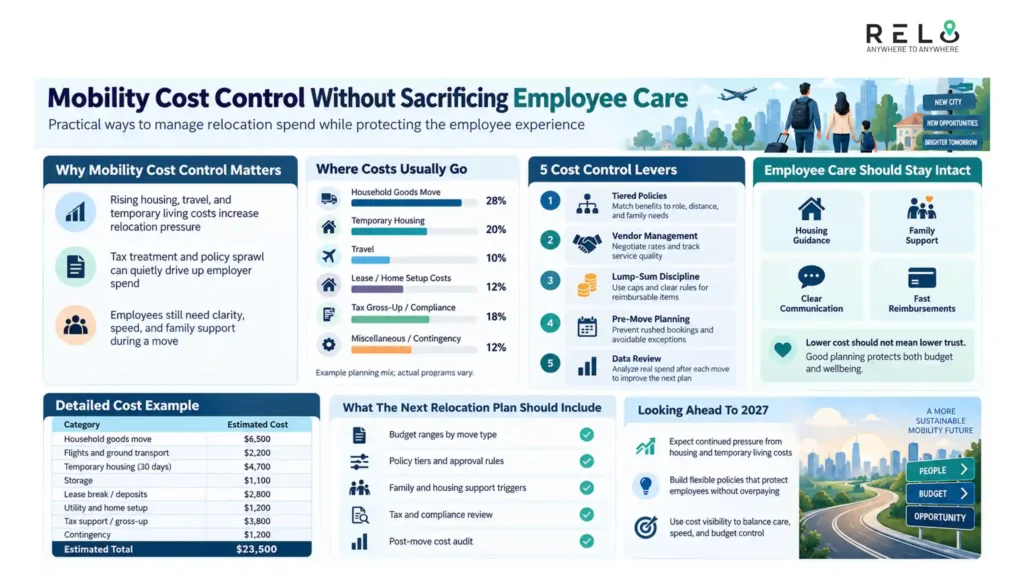
The infographic below brings the main cost pressures, control levers, employee-care priorities, and 2027 planning considerations into one view. It shows how employers can manage relocation spend more carefully while still protecting the support employees need during a move.
THE RELO.AI DAILY NEWSLETTER
Daily Digest of Relocation News, Deals & Reviews
Subscribe for free and get proven relocation and travel strategies, personalized support, valuable rewards, and trusted reviews for every move.
Thank you for subscribing!
Your email has been added to our list.
Download Now (High-Quality Image Version)
Which Mobility Cost Control Metrics Matter Most to Finance and HR?
Cost per move matters, but it cannot stand alone. A $70,000 move that gets a hard-to-hire leader in place on time can be a better result than a $20,000 move that ends in a resignation. The scorecard should tie spend to what happened.
Track forecast cost against final cost by move type to strengthen mobility cost control. In addition, track exception rate, extra hotel days, mover claims, payment speed, employee feedback, accepted transfers, delayed start dates, and early exits after a move. Those measures show where money leaks and where support works.
In addition, it separates costs the team can control from costs it cannot. Vendor prices and approval rules can be managed. Mortgage rates and local rents cannot. This keeps the review fair.
For finance, the report is more useful when it explains why the budget changed, not only how much it changed. For HR, the same data shows where people get stuck. One set of facts can serve both teams.
What Will Corporate Relocation Budgets Need to Solve in 2027?
By 2027, the strongest relocation programs will likely be judged less by a single average cost and more by how well they handle variation. Housing, temporary living, household-goods pricing, tax exposure, family needs, and destination timing can push two similar moves in very different directions.
Finance teams will need earlier cost forecasts and cleaner exception data to strengthen mobility cost control. HR teams will need policies that give employees choice without turning every move into a custom negotiation.
A practical approach is a tiered plan with clear caps, preferred vendors, realistic contingency funds, and post-move reviews. That structure gives employers tighter budget visibility while preserving support at the moments that matter most to the employee.
What Comes Next Once the Relocation Plan Is Approved?
Then, approval should start a clear sequence that supports mobility cost control. First, show the employee what is covered in plain language. Explain what the company pays directly, what gets paid back later, what needs approval, what may be taxed, and when money should arrive. This step can prevent many worried emails.
Next, build the move calendar around the job start, home dates, school dates, mover slots, and any home sale. Meanwhile, add a small buffer for delays. A plan that needs every date to go right is too fragile.
Then compare the approved package with the full expected cost. Use the Offer Analyzer to spot gaps, tax exposure, limits, and payback terms before they turn into stress. For a larger employer plan, corporate relocation services can help coordinate vendors, housing, move dates, and employee support.
Finally, after arrival, ask three short questions. What went wrong? What cost more than planned? Which support mattered most? Those answers should shape the next policy review and the next move.
How Should the Next Relocation Plan Improve After Each Move?
Afterwards, every completed move should make the next one easier to price. Within 30 days of arrival, compare forecast and actual spend, then record the reason for every exception. Also note delays, vendor problems, unused benefits, and the support the employee valued most. A simple relocation handover plan can connect move dates with work transition costs so finance does not measure only the household shipment.
Then set the next policy review date while the evidence is fresh to strengthen mobility cost control. If internal transfers create different patterns from new hires, separate those results instead of averaging them together.
The internal transfer relocation guide explains why same-company moves can carry different timing, housing, and employee-expectation pressures. The next plan should keep what worked, remove what did not, and price recurring exceptions before they become routine.
Recommended read – Corporate Relocation Will Transform Business Mobility Forever
How Can Relo.AI Support Mobility Cost Control?
Relo.AI helps employers turn relocation benefits into a clear, practical plan built around cost visibility and employee care. We start before the move, while there is still time to price risk, identify gaps, set sensible limits, and explain what the employee can expect.
For HR and mobility leaders, we connect budget planning with housing, moving logistics, local needs, and the employee’s first weeks in the new location. Our corporate relocation services bring these moving parts together so employers can manage costs without losing sight of the person behind the move.
We also keep each relocation organized from planning through arrival. As a result, we can help leaders see where spending delivers real value, where delays may increase costs, and where older policy rules may be creating unnecessary expense. Our Offer Analyzer reviews package gaps, while our relocation calculator helps you test likely costs before decisions are finalized.
Together, these tools support stronger mobility cost control by giving employers a clearer view of relocation spend, employee needs, and the choices that can keep both under control.
If your company is reviewing relocation spend, schedule a FREE consultation with us. You can also call us at +1-617-333-8453 to discuss your move plan, budget pressure, or employee-care goals.
What Should Mobility Teams Ask Before Changing a Policy?
THE RELO.AI DAILY NEWSLETTER
Daily Digest of Relocation News, Deals & Reviews
Subscribe for free and get proven relocation and travel strategies, personalized support, valuable rewards, and trusted reviews for every move.
Thank you for subscribing!
Your email has been added to our list.
1. How often should a relocation policy be reviewed?
First, review it at least once a year. In addition, check the data each quarter if vendor prices, tax rules, housing costs, or exception rates are moving fast. As a result, early review can stop a small issue from becoming a standard cost.
2. Should every employee receive the same relocation benefits?
No. Instead, a tiered plan can strengthen mobility cost control by matching support to role, move type, housing status, and business need. For example, different employee groups may need different levels of support. However, the rules should be clear and applied in the same way across similar cases.
3. Can a company cut move costs without lowering employee satisfaction?
Yes. For example, better timing, good vendor deals, clear rules, fast payments, and fewer avoidable exceptions can lower costs without removing care. At the same time, these measures can make the relocation process easier to manage. In contrast, cuts to high-value support can create more stress and, as a result, more last-minute requests.
4. Which relocation costs are often missed?
For example, short-term housing, storage, deposits, changed travel, two homes, tax effects, home-sale delays, and local setup can all surprise a budget. In addition, international moves can add visa, tax, freight, and compliance costs.
5. Why does tax treatment matter so much in 2026?
For most workers, IRS rules now make qualified moving expense reimbursements taxable. As a result, the employee may owe tax on benefits the company pays. In addition, the employer may face added payroll costs. Therefore, the tax impact should be priced before the package is approved.
6. What should employers review before approving a relocation exception?
First, check why the exception is needed and if the same issue has appeared before. Then compare the added cost with the employee impact and business need. In addition, review the policy rule, available alternatives, and approval history. As a result, exceptions can stay purposeful instead of becoming an automatic extra cost.
What Does Effective Mobility Cost Control Look Like?
In short, strong cost control is clear, measured, and humane. At the same time, it sets limits while protecting the parts of a move that keep an employee calm and productive. As a result, Finance can see where the money goes, while HR can see where people struggle. In turn, leaders can decide which exceptions are worth funding.
The best plans do not chase the lowest possible move cost. Instead, they cut waste, price risk early, and spend with care where failure would hurt most. Therefore, that is the point of mobility cost control. Ultimately, it gives the company discipline without forcing the employee to carry the mess.
Sources –
- IRS Publication 15-B (2026) – Employer’s Tax Guide to Fringe Benefits
- IRS Publication 15-A (2026) – Employer’s Supplemental Tax Guide
- Federal Reserve Monetary Policy Report – July 2026
- S. Bureau of Labor Statistics Consumer Price Index – September 2026
- Federal Reserve research on mortgage rate lock-in and mobility
- IRS Frequently Asked Questions for Moving Expenses
- Federal Reserve – Economic Well-Being of U.S. Households, Housing