
Jobs That Offer Relocation Assistance Pay You to Start Fresh Anywhere - Relocation
AI Workers Are the New Expats: Where Tech’s Hottest Talent Is Landing - Relocation
How to Find a Job in Miami and Thrive in the Sunshine State - Relocation
Athletic Trainers Relocation - Athletics
Doctor Relocation Timeline From Offer Letter to Hospital Onboarding - Medical
Top Cities for Female Physicians to Practice in the United States - Medical
Easy Relocation for Physicians - Medical
The Best Cities for Registered Nurses: Where Pay Meets Possibility - Medical
How Relocation Packages for Nurses Support Long-Term Career Moves - Medical
Relocating as a Traveling Nurse - Medical
10 Best Neobanks in the US That Fit Modern Financial Habits - Personal Finance
Corporate Credit Card vs. Business Credit Card: Which Option Is Appropriate for Business - Finance
Jobs That Offer Relocation Assistance Pay You to Start Fresh Anywhere - Relocation
AI Workers Are the New Expats: Where Tech’s Hottest Talent Is Landing - Relocation
How to Find a Job in Miami and Thrive in the Sunshine State - Relocation
Athletic Trainers Relocation - Athletics & Sports
Doctor Relocation Timeline From Offer Letter to Hospital Onboarding - Medical
Top Cities for Female Physicians to Practice in the United States - Medical
Easy Relocation for Physicians - Medical
The Best Cities for Registered Nurses: Where Pay Meets Possibility - Medical
How Relocation Packages for Nurses Support Long-Term Career Moves - Medical
Relocating as a Traveling Nurse - Medical
10 Best Neobanks in the US That Fit Modern Financial Habits - Personal Finance
Corporate Credit Card vs. Business Credit Card: Which Option Is Appropriate for Business - Finance


In the 1950s, about one in five people packed up and moved every year. Today it’s closer to one in nine.

THE RELO.AI DAILY NEWSLETTER
Daily Digest of Relocation News, Deals & Reviews
Subscribe for free and get proven relocation and travel strategies, personalized support, valuable rewards, and trusted reviews for every move.
Thank you for subscribing!
Your email has been added to our list.
That’s not a blip. It’s the lowest residential mobility rate since the federal government started counting in 1948 (Realtor.com via Yahoo Finance). And the forward-looking numbers are worse. When the New York Fed asked households this year whether they expect to move in the next three years, only 21.7% said yes, the lowest reading since the survey began in 2014 (CRE Daily, citing the NY Fed).
If you hire people who have to change zip codes, that’s your problem now. Fewer people are moving, which means the pool of candidates who will say yes to a move is shrinking every quarter. Here’s what’s driving it, who is still willing to go, and why your relocation package just became one of the strongest recruiting tools you have.
The Numbers Behind the Moving Slump
Start with the hard data.
- 11.2% of households moved in 2024, about 14.8 million in total. That’s the lowest rate on record in the Census Bureau’s annual survey. Within-state moves, the most common kind, also hit a record low of 8.6% (Harvard Joint Center for Housing Studies).
- The slide kept going in 2026. Bank of America Institute found that “mobility continued to decline in Q2 2026 across income groups, generations and move types,” with long-distance moves falling hardest (Bank of America Institute).
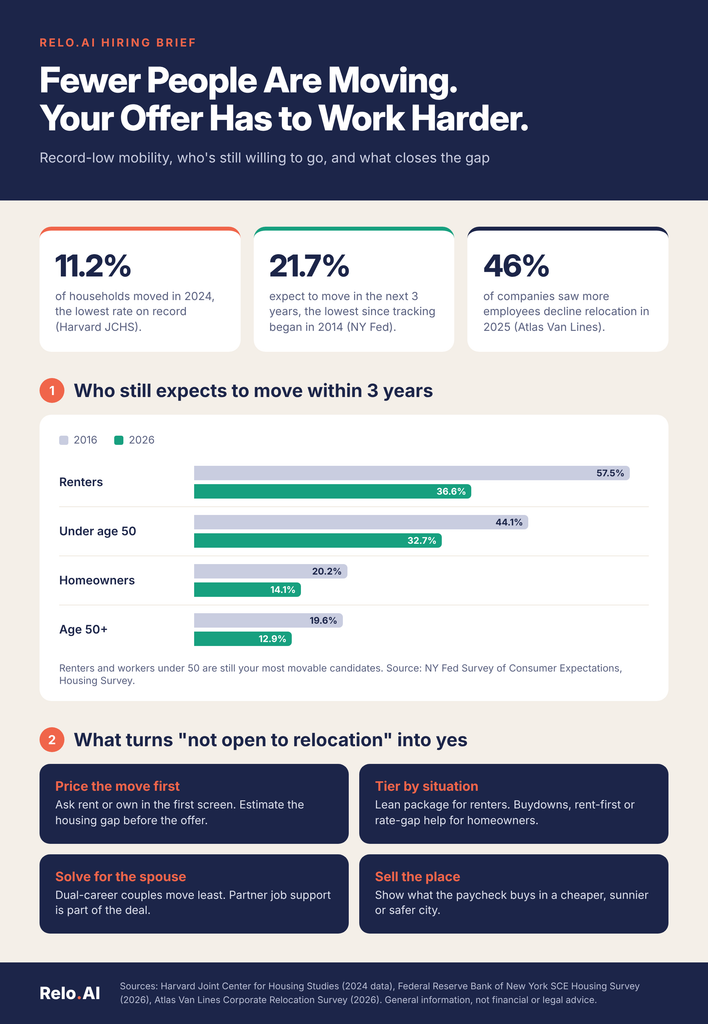
- The intent to move is collapsing too. In the NY Fed survey, renters expecting to move within three years fell from 57.5% in 2016 to 36.6% in 2026. Homeowners fell from 20.2% to 14.1%.
People are moving less, and “the slowdown is broad-based,” said Joe Wadford, an economist at Bank of America Institute.
This has been building for decades. Brookings demographer William Frey documented the first year on record when fewer than 10% of people changed residence, back in 2018-19 (Brookings). The pandemic briefly scrambled the picture. Then rates rose and the floor dropped out again.
Why People Stopped Moving
There isn’t one villain here. There are four, and they reinforce each other.
1. The mortgage they already have. About 80% of homeowners with a mortgage hold a rate below today’s levels, according to Redfin (Business Wire). Freddie Mac’s 30-year average was 7.18% on November 5, 2026, up from 6.22% a year earlier (WCAX/AP). Trading a 3% loan for a 7% one can add four figures to a monthly payment. Homeowners are “locked in place,” said Jessica Lautz, deputy chief economist at the National Association of Realtors (Newsweek). We broke down that exact math in our guide to mortgage lock-in relocation.
2. Affordability everywhere else. Harvard’s JCHS counted 43.5 million cost-burdened households in 2024, spending more than 30% of income on housing. That’s 6.4 million more than in 2019. The median single-family home sat near a record five times median household income. When the destination is expensive too, “upgrade” stops being a selling point.
3. They’re renovating instead. Redfin found 65% of recent renovators fixed up their current home rather than moving. Homeowners are “choosing to stay put and make the home they already have work for them,” said Chen Zhao, Redfin’s head of economics research. Every new kitchen is another anchor.
4. Two careers, not one. The Richmond Fed points out that married couples where both partners work have the lowest mobility of any group. Research it cites finds the shrinking wage gap between men and women explains over a third of the drop in family moves from 1981 to 2012 (Richmond Fed). Your offer doesn’t just have to beat your candidate’s current job. It has to beat their spouse’s too.
What It Means for Hiring
Here’s the uncomfortable part for recruiters. The people least likely to move are often the people you most want to hire.
Mid-career professionals who bought homes in 2020 and 2021 are now experienced, settled and sitting on cheap mortgages. Many have a working partner and kids in school. In the NY Fed data, only 12.9% of people 50 and older expect to move in the next three years.
The fallout is already showing up in offer acceptance. In the 2026 Atlas Corporate Relocation Survey, 46% of companies said more employees declined relocations in 2025 (Atlas Van Lines). Housing concerns at either the old home or the new one were a key reason in 49% of declines. Family ties topped the list at 34%.
Meanwhile, Atlas found that half of employers still want to increase relocations. So demand for movers is going up while supply goes down. Anyone who has tried to book a flight on the Wednesday before Thanksgiving knows how that market ends.
Who’s Still Packing Boxes
Low mobility doesn’t mean zero mobility. It means the movers who are left look different, and smart recruiters fish where they are.
- Renters. At 36.6%, renters are still more than twice as likely as homeowners to expect a move. No mortgage to protect, no house to sell.
- Younger workers. People under 50 expect to move at nearly triple the rate of those over 50 (32.7% vs. 12.9%). Early-career hires are the easiest relocations you’ll ever make.
- People chasing value. Bank of America found that those who do move “still favor smaller cities, especially those in the Midwest.” If your role is in a lower-cost metro, lead with it.
- People chasing lifestyle. In a May 2026 Redfin survey, better weather (22%) and climate risk (21%) beat a new job (19%) as reasons for out-of-state moves (Redfin). A job alone rarely moves someone anymore. The job plus the place does.
The takeaway: segment your candidates. A 27-year-old renter and a 44-year-old homeowner with a 2.9% mortgage need completely different offers. One national package treats them the same and fails at least one of them.
THE RELO.AI DAILY NEWSLETTER
Daily Digest of Relocation News, Deals & Reviews
Subscribe for free and get proven relocation and travel strategies, personalized support, valuable rewards, and trusted reviews for every move.
Thank you for subscribing!
Your email has been added to our list.
Your Relocation Package Is Now a Recruiting Lever
When moving was normal, a relocation package was a courtesy. It covered the truck and maybe a month in corporate housing. Now it has to overcome a household’s reasons to stay put, and that makes it a competitive weapon.
Most packages haven’t caught up. The most common lump sum in the Atlas survey is still $10,000 to $12,499, unchanged for three years (Plus Relocation). That barely covers a year of the rate gap on a typical mortgage, before taxes take their cut.
Here’s what a 2026-ready package looks like:
Price the move before the offer. Ask in the first screen whether the candidate rents or owns, and estimate the housing cost gap between where they live and where you need them. A finalist’s “family reasons” is often a spreadsheet you never saw.
Build tiers, not one policy. A renter tier can stay lean. A homeowner tier needs real housing tools, like rent-first support, a mortgage buydown or a mortgage interest differential allowance.
Solve for the spouse. If dual careers are a top reason families don’t move, spousal job-search support isn’t a perk. It’s the deal. It also costs far less than losing a finalist and starting over.
Use place as a selling point. If your destination is cheaper, sunnier or safer, quantify it. Show the candidate what their paycheck actually buys there.
Know when remote wins. If the role doesn’t need a desk five days a week, a hybrid arrangement or a delayed start can be cheaper than any housing subsidy.
Here’s the edge most companies miss. If your competitors keep offering 2019-style packages to a 2026 labor market, a smarter package doesn’t just help you close. It helps you take the candidates they lose.
THE RELO.AI DAILY NEWSLETTER
Daily Digest of Relocation News, Deals & Reviews
Subscribe for free and get proven relocation and travel strategies, personalized support, valuable rewards, and trusted reviews for every move.
Thank you for subscribing!
Your email has been added to our list.
The Bottom Line: Stuck Isn’t the Same as Unwilling
Fewer people are moving, and the data says that won’t flip anytime soon. Rates are still above 7%, homes are still expensive and two-income households are still the norm.
But most of the people staying put aren’t refusing to move. They’re running the numbers and the numbers say no. Change the numbers and plenty of them will say yes. The employers who figure that out first will hire the talent everyone else writes off as “not open to relocation.”
Want to know what it takes to move your next hire? Relo.AI prices each move, including housing, cost of living and taxes, and shows you which benefits close the gap for the least money. Run the numbers with our relocation calculator, or check a candidate’s offer through our Offer Analyzer.
Schedule a FREE consultation with us and call us at +1-617-333-8453.
Sources
- Harvard Joint Center for Housing Studies: Household mobility fell to a record low in 2024
- CRE Daily: Housing mobility hits record lows, citing the NY Fed 2026 SCE Housing Survey (May 15, 2026)
- Bank of America Institute: On the move, renovation over relocation (August 2026)
- Realtor.com via Yahoo Finance: People are moving less than ever (September 23, 2026)
- Newsweek: Why relocations are plummeting (September 5, 2026)
- Brookings: For the first time on record, fewer than 10% of people moved in a year
- Federal Reserve Bank of Richmond: Why is geographic mobility declining? (May 2025)
- Redfin via Business Wire: Homeowners are remodeling instead of relocating (April 2026)
- Redfin: Better weather is the top reason for planned out-of-state moves (July 15, 2026)
- WCAX/AP: Average 30-year mortgage rate falls to 7.18% (November 5, 2026)
- Atlas Van Lines 2026 Corporate Relocation Survey: Employees declining relocation
- Plus Relocation: 5 takeaways from the 2026 Atlas Corporate Relocation Survey
Disclaimer
This article is for general information only and is not financial, tax or legal advice. Mortgage rates and housing data change frequently. Consult qualified mortgage, tax and HR advisors before changing your relocation policy.