
Jobs That Offer Relocation Assistance Pay You to Start Fresh Anywhere - Relocation
AI Workers Are the New Expats: Where Tech’s Hottest Talent Is Landing - Relocation
How to Find a Job in Miami and Thrive in the Sunshine State - Relocation
Athletic Trainers Relocation - Athletics
Doctor Relocation Timeline From Offer Letter to Hospital Onboarding - Medical
Top Cities for Female Physicians to Practice in the United States - Medical
Easy Relocation for Physicians - Medical
The Best Cities for Registered Nurses: Where Pay Meets Possibility - Medical
How Relocation Packages for Nurses Support Long-Term Career Moves - Medical
Relocating as a Traveling Nurse - Medical
10 Best Neobanks in the US That Fit Modern Financial Habits - Personal Finance
Corporate Credit Card vs. Business Credit Card: Which Option Is Appropriate for Business - Finance
Jobs That Offer Relocation Assistance Pay You to Start Fresh Anywhere - Relocation
AI Workers Are the New Expats: Where Tech’s Hottest Talent Is Landing - Relocation
How to Find a Job in Miami and Thrive in the Sunshine State - Relocation
Athletic Trainers Relocation - Athletics & Sports
Doctor Relocation Timeline From Offer Letter to Hospital Onboarding - Medical
Top Cities for Female Physicians to Practice in the United States - Medical
Easy Relocation for Physicians - Medical
The Best Cities for Registered Nurses: Where Pay Meets Possibility - Medical
How Relocation Packages for Nurses Support Long-Term Career Moves - Medical
Relocating as a Traveling Nurse - Medical
10 Best Neobanks in the US That Fit Modern Financial Habits - Personal Finance
Corporate Credit Card vs. Business Credit Card: Which Option Is Appropriate for Business - Finance



THE RELO.AI DAILY NEWSLETTER
Daily Digest of Relocation News, Deals & Reviews
Subscribe for free and get proven relocation and travel strategies, personalized support, valuable rewards, and trusted reviews for every move.
Thank you for subscribing!
Your email has been added to our list.
Signing a long-term commercial lease before implementing rigorous employee relocation planning is one of the fastest ways an expansion burns capital: the communications team drafts the press release, leadership celebrates a confident new dot on Austin, Raleigh, or Columbus, and then the quiet operational failure begins. Six months post-launch, the gap between the executive model and reality becomes glaring. Only three engineers from the home office actually relocate, the anchor product manager remains in Boston because her partner just made partner locally, and two senior directors quietly defer their commitments due to family constraints. Because local recruitment lags far behind projected headcount targets, leadership now maintains a fully operational facility that functions at a fraction of capacity simply because they treated workforce mobility as a passive assumption rather than an essential upfront risk.
This represents the single most expensive mistake in corporate expansion, yet leadership can almost always prevent it. In fact, proactive teams resolve this challenge through employee relocation planning. Because timing dictates success, employee relocation planning takes place in the quarter before leadership signs a lease, not the quarter after. Therefore, this guide provides HR directors, CHROs, CFOs, and workforce planning leaders with a clear roadmap: how to determine who on the current roster will truly move, how to surface that truth without alarming the team, and how to deliver a budget the finance organization can defend.
What is employee relocation planning, and why does it start before the lease is signed?
Employee relocation planning is the structured process of forecasting who on a company’s existing workforce will realistically move to a new location, modeling the cost of making those moves succeed, and designing the benefit, communication, and backfill strategy that closes the gap between the headcount plan and the real relocation rate. The term is sometimes used narrowly to describe the logistics of moving one hire. In workforce planning, it is a broader discipline that sits at the intersection of talent strategy, real estate, and finance.
The reason it belongs before the lease is simple. A new office is a five-to-ten-year financial commitment with a fixed cost structure. If the executive team assumes 40 percent of a critical team will transfer and only 15 percent do, the first eighteen months of operations will be a scramble to hire locally in a market that was chosen on paper, not on talent availability. Running the willingness analysis before the lease is signed gives leadership a chance to pick a different city, phase the opening differently, or budget for aggressive local recruiting from day one.
What percentage of employees really relocate when offered?
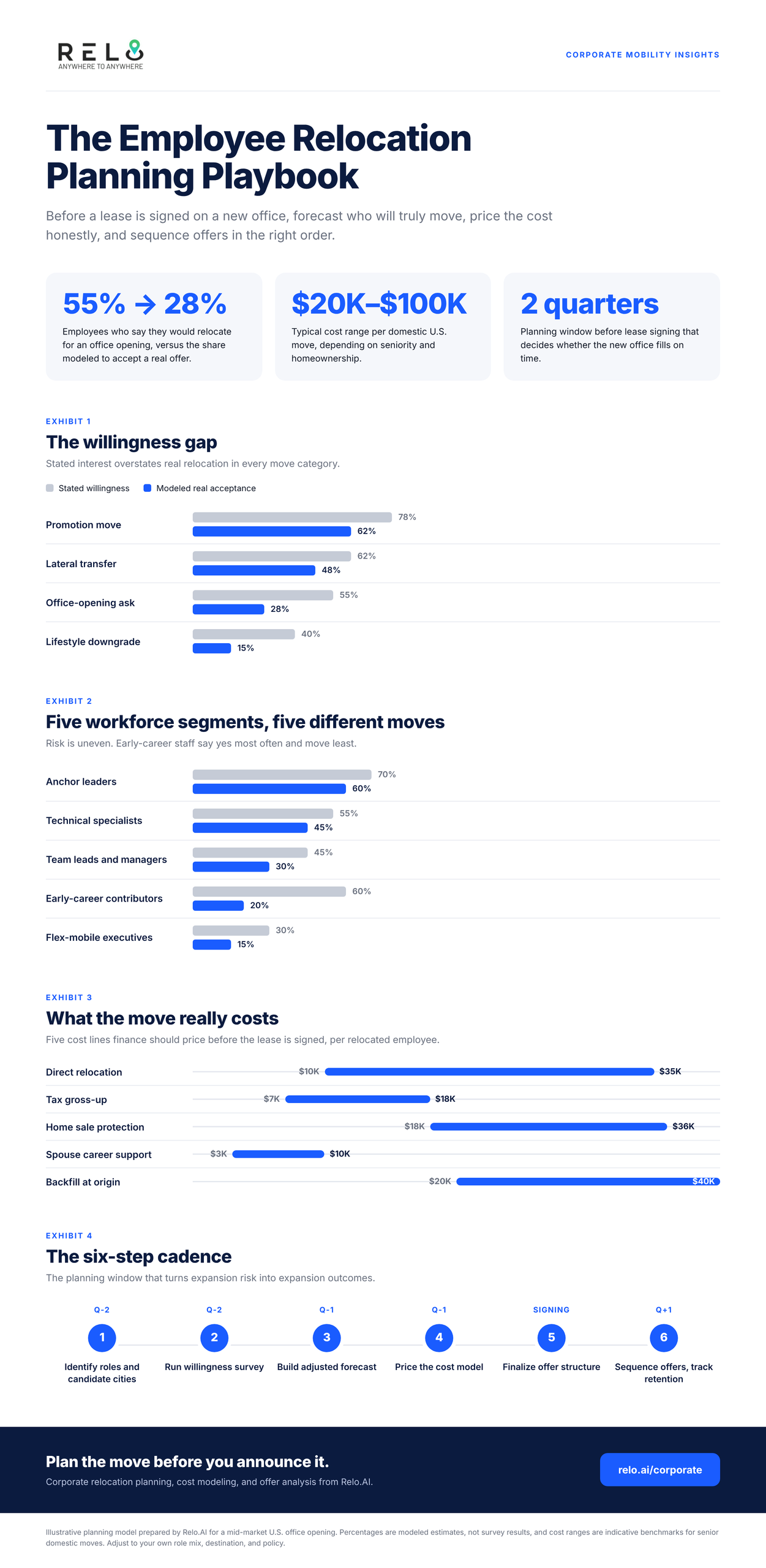
Industry benchmarks vary, but a few patterns are consistent. Atlas Van Lines’ long-running annual corporate relocation survey has repeatedly shown that only a minority of employees offered a relocation accept it, with acceptance rates typically landing in the 50 to 65 percent range when the move is a career promotion and far lower when it is lateral. Allied Van Lines and Worldwide ERC surveys land in a similar neighborhood for domestic U.S. moves. Internal data from large tech firms during the 2020 to 2024 return-to-office period, as reported in SHRM and Wall Street Journal coverage, suggests that unforced relocation requests tied to office openings, not promotions, see acceptance rates in the 20 to 35 percent range, sometimes lower when the destination is seen as a lifestyle downgrade.
Three honest takeaways flow from this. First, the assumption that half the team will relocate alongside a leader, which frequently anchors expansion planning, is almost always wrong in that direction. Second, willingness is deeply role-dependent, with earlier-career employees, dual-income households, and employees with school-age children being the three segments most likely to decline. Third, the gap between what employees say in a casual survey and what they do when the real offer arrives is usually 15 to 30 percentage points, which means paper willingness overstates real relocation.
Why does the gap between stated willingness and real moves exist?
The gap has a predictable shape. Employees answer a willingness survey with the version of themselves that is optimistic about new experiences and professionally eager to be seen as flexible. The honest decision includes a partner, a child, an aging parent, a mortgage, a non-compete, a lease break, a school calendar, a healthcare provider, a religious community, and a long list of unspoken risk calculations. None of those variables show up in a Likert-scale question.
There are four specific forces that compress stated willingness into a much smaller actual-move number.
Dual-career households. The trailing-spouse career impact is the single most cited reason corporate relocations fail. If one partner has strong professional roots in the origin city, the move stops being a career question and becomes a household economics question. The answer usually trends toward no.
School-age children. Families with children in grades three through ten are the most relocation-resistant group in almost every corporate survey. The willingness-to-consider answer is much higher than the willingness-to-truly-uproot answer.
Housing equity and cost of living. Employees who hold meaningful equity in a home at a 3 percent mortgage are not going to voluntarily buy a new home at a 7 percent mortgage, even if the destination is cheaper on paper.
Local professional networks. Senior employees have spent a decade building the relationships that make their job possible. Starting over in a new city is a two-year productivity reset that most senior people are unwilling to absorb without a major title or equity change.
The useful version of employee relocation planning takes each of these forces, turns it into a survey signal, and uses the result to forecast real moves, not aspirational ones..
What should a pre-expansion employee relocation planning survey measure?
A survey that is useful to a finance team has three sections and takes seven minutes or less to complete. Keep it short, keep it anonymous enough to produce honest answers, and keep it specific enough to produce a usable model.
The first section is role, tenure, and cost-of-living context. Current city, years at company, team, seniority, and a simple salary band. These anchor the response to a cost of replacement figure.
The second section is household context. Marital status, partner employment status in the origin city, number and ages of dependents, homeowner or renter, and any aging-parent care responsibility that sits in the household. These are the variables that drive the real decision.
The third section is the preference block. A specific hypothetical (“if the company opened an office in [destination] in the next 12 months, how likely are you to relocate if offered a competitive relocation package”) with a five-point scale, followed by three open-ended questions that collect the top three factors that would make the move more likely and the top three that would make it less likely. Finish with one calibration question that asks what minimum relocation package (total value) would make the move a serious consideration.
The survey is strongest when it is scoped to the question the business genuinely needs answered, which is rarely “where would you like to live.” It is “if the company opened an office at this specific location, on this timeline, with this kind of package, what would you do.” Specificity yields forecastable data. Vague surveys yield vague answers.
How do you frame the willingness conversation without leaking the plan?
The confidentiality problem is real. If a company surveys 400 employees about a hypothetical Austin office, the news that Austin is in play will reach LinkedIn before the end of the week. There are three ways to handle this that still produce useful data.
Scope the survey to multiple hypothetical cities, not one. Ask about Austin, Nashville, Raleigh, and Columbus together. The pattern in the responses will reveal which cities each employee prefers without identifying the real target. Legal and communications should sign off on the specific wording.
Use a trusted third party for the survey administration. A Relo.AI corporate mobility assessment, a mobility consultant, or an anonymous survey platform reduces the chance that any single response is traced back to an internal planning leak.
Keep the survey open for a short window, close it before internal speculation builds, and share only the aggregate findings with the broader org. The specific city and role-level breakdowns stay with the workforce planning team, the CHRO, and the real estate committee.
Done well, the exercise is one more quarterly engagement data point. Done poorly, it becomes a rumor accelerant. Preparation is the difference.
Which five employee segments drive the office expansion risk model?
Not every role carries the same risk. A useful employee relocation planning model segments the current workforce into five bands and forecasts each band separately, because a single aggregate willingness number hides the segments that matter most to the business case.
Critical founding staff for the new office. These are the five to fifteen people whose on-site presence in the destination city is a precondition for the office succeeding at all. If fewer than 60 percent of this group will truly move, the expansion thesis is in trouble and should be revisited before the lease closes.
Technical specialists. People whose skills are hard to rehire locally. The willingness-to-move number here needs to be modeled against the local talent availability for the same skill. A destination with weak local supply makes technical willingness more valuable.
Team leads and middle managers. The connective tissue of the new office. Low willingness in this band is a leading indicator of high first-year attrition at the new site.
Early-career individual contributors. This group has the highest paper willingness, the lowest actual-move rate, and the easiest local-market substitution. Plan to hire them locally, not to relocate them.
Executives with remote flexibility. Senior leaders who can travel regularly without a full move. For some roles, 40 percent on-site presence is enough. Pulling them out of the relocation tally and into a travel budget is often the right call. Companies that frequently move the same leaders between hubs will also want to read the Relo.AI Repeat Relocation Policy Guide, which addresses the specific policy design questions that come up with multi-move employees.
The output of this segmentation is not a single willingness percentage. It is a stacked forecast that tells the finance team how many people from each band will realistically move, when, and at what cost. The finance organization will respect the model far more than a single headline percentage.
How does family, equity, and lifestyle data shape employee relocation planning?
The most reliable predictors of a real move are not professional at all. They are personal. Three data points, collected carefully during the willingness survey, explain most of the variance between stated and real willingness.
Partner employment status. A single employee is roughly twice as likely to relocate as a dual-career employee in most corporate datasets. A dual-career employee whose partner can work remotely moves more often than one whose partner cannot. The relocation package for a dual-career employee has to include meaningful spouse career support or the move will stall.
Home equity and housing market delta. An employee at a 3 percent mortgage in a hot market who would have to sell into a cooler destination market is making a decision that costs them real money over the long run. Companies that offer a housing-loss protection (buyer value option or guaranteed buyout) for senior relocations consistently see higher yes rates. Companies that offer only a cash grant see lower yes rates for homeowners with meaningful equity.
Dependents and life-stage markers. School-age children, aging parents, special medical needs, and even a child’s sports or performing-arts commitments are all legitimate reasons that a theoretically willing employee becomes a practically unwilling one. These do not have to be asked explicitly. They can be surfaced through the open-ended “what would make this harder” question in the survey.
A good employee relocation planning model takes these three variables, assigns a probability weight to each, and produces an adjusted move probability that is almost always lower than the self-reported one. That adjusted number is the one that belongs in the business case.
THE RELO.AI DAILY NEWSLETTER
Daily Digest of Relocation News, Deals & Reviews
Subscribe for free and get proven relocation and travel strategies, personalized support, valuable rewards, and trusted reviews for every move.
Thank you for subscribing!
Your email has been added to our list.
What cost model should finance use before the lease is signed?
The headline relocation benchmark the industry quotes is roughly $20,000 to $100,000 per domestic U.S. move, depending on seniority and on homeownership status. International moves land much higher. Those numbers are useful anchors, but a serious finance model needs five lines, not one.
Direct relocation costs. Household goods shipping, temporary housing, travel for house-hunting trips, final-move travel, and lease-break fees at origin. Typically $10,000 to $35,000 per move.
Gross-up for tax. Since the 2017 Tax Cuts and Jobs Act and the permanent extension under the 2025 One Big Beautiful Bill Act, civilian relocation benefits are taxable as ordinary income. A benefit paid without a gross-up transfers about 25 to 40 percent of its value to the IRS and state treasuries. Finance should model the gross-up as a line item, not fold it invisibly into the benefit cost.
Home sale protection. For senior relocations, the cost of a buyer value option or similar home sale support typically runs 3 to 6 percent of the home value. For a $600,000 home, that is $18,000 to $36,000.
Spouse career support. A meaningful spouse employment program costs $3,000 to $10,000 per family and significantly improves acceptance and retention. Underbudgeting this line is one of the most common planning mistakes.
Backfill and hiring cost at origin. When an employee relocates to a new office, the origin role usually needs to be refilled. Fully loaded, a backfill hire costs 20 to 30 percent of first-year salary. The business case has to carry this line, not hide it on the recruiting ledger.
The output of this model is a defensible per-move number and a defensible aggregate expansion budget. When finance sees the five lines explicitly, the conversation becomes a strategy conversation, not a budget negotiation. For teams running this exercise on live offer data, the Relo.AI Offer Analyzer separates the compensation package from the destination’s true cost and tax picture, and the Relo.AI Relocation Calculator is the right tool for sanity-checking the per-move estimate across origin and destination cities.
How should HR structure the relocation offer package to maximize acceptance?
The structure of the offer matters almost as much as the dollar value. Three principles move acceptance rates in most corporate datasets.
Pay a meaningful portion of the benefit as a signing payment within 30 days of acceptance. The employee’s cash-flow pressure peaks in the month before the move. A back-loaded benefit lowers acceptance even when the total value is high.
Offer at least one guaranteed-value protection. Home sale support, lease-break coverage, or a defined spousal career budget. Something that answers the household’s biggest risk concretely.
Build in a 60-day decision window and a formal in-person discovery trip to the destination. A rushed yes becomes a six-month no. A visit converts the abstract into a real decision.
A fourth, softer principle. Have the destination office leader, not HR, make the primary pitch to the senior candidates. Relocations that are sold by the future direct manager and future on-site peer group close at a noticeably higher rate than ones sold by a mobility coordinator working from a script. The decision is relational, not transactional.
What does a good employee relocation planning framework look like end-to-end?
A complete employee relocation planning framework runs on a six-step cadence, usually across a two-quarter window before any lease signature.
Quarter minus two. Identify the destination candidates (three to five cities), the critical roles that must be staffed at the destination from day one, and the headcount profile for the first 18 months.
Quarter minus two. Administer the willingness survey across the relevant teams, scoped to all candidate cities, under confidentiality. Collect role, household, and preference data.
Quarter minus one. Build the adjusted move probability model using household weights. Produce a per-segment forecast of real relocations.
Quarter minus one. Price the five-line cost model against the adjusted forecast. Share with finance. Choose the destination city that produces the best combined score of willingness, local talent availability, and real-estate cost.
Lease signing quarter. Finalize the relocation offer structure. Pre-identify the 10 to 15 specific employees who will be invited first. Line up spouse career support, housing partners, and tax guidance.
First operating quarter. Begin actual offers in a coordinated sequence (anchor hires first, then specialists, then team leads). Hold a quarterly retention check for the first 24 months to catch at-risk relocations before they become quits.
This framework turns employee relocation planning from a reactive process into an auditable workforce planning discipline. It does not eliminate the gap between stated and real willingness, but it prices and plans around that gap honestly. That is the difference between a successful office opening and an expensive empty one.
How Relo.AI supports employee relocation planning
Most of the teams the Relo.AI corporate practice works with on employee relocation planning reach out at one of two inflection points. The first is the quarter before a new office is announced, when the leadership team needs a credible willingness read and a defensible per-move cost before the real estate committee signs the lease. The second is the quarter after, when the gap between forecast and reality has already shown up and the executive sponsor needs a corrective plan.
The practical work splits across three repeatable building blocks. The willingness survey is run with the destination and role-level data held confidentially, so communications and legal can sign off on the external wording. The five-line finance model uses a combination of client cost data and current industry benchmarks to produce a per-move and aggregate number finance can defend. The offer structure uses the Relo.AI Offer Analyzer to pressure-test each senior relocation package against the actual destination cost of living and tax picture, and the Relo.AI Relocation Calculator is used alongside for the employee-facing conversation.
THE RELO.AI DAILY NEWSLETTER
Daily Digest of Relocation News, Deals & Reviews
Subscribe for free and get proven relocation and travel strategies, personalized support, valuable rewards, and trusted reviews for every move.
Thank you for subscribing!
Your email has been added to our list.
The output of this cycle is almost always the same set of deliverables. A ranked destination recommendation. A segmented, adjusted willingness forecast. A full cost model. A tiered offer template. A 24-month retention tracking plan. Companies that run the full cycle before the lease is signed consistently report higher first-year staffing accuracy and lower first-year relocation attrition than the peer benchmark, because the whole exercise is grounded in real household data, not headline willingness.
Frequently asked questions about employee relocation planning
How early should employee relocation planning start before a new office opens?
At least two full quarters before the lease is signed. Earlier is better when the destination candidate list is still open. Starting after the lease is signed turns planning into damage control.
How accurate is a willingness survey in predicting real moves?
A well-designed survey, adjusted for household variables, typically predicts within 10 to 15 percentage points of actual acceptance. An unadjusted survey overstates real willingness by 20 to 30 percentage points on average. The adjustment model is the difference.
What is the biggest single mistake companies make in office-expansion relocation planning?
Underbudgeting spouse career support and home sale protection. These two line items are the ones that most often convert a reluctant yes into a confident one, and they are the ones most often cut first in a budget review.
Can a company use employee relocation planning to choose between candidate cities?
Yes, and it is one of the highest-value applications. Running the willingness survey across three or four candidate cities before committing to one lets leadership select the destination that combines the strongest internal pull with the strongest local talent market.
How should relocation offers be sequenced for a new office?
Anchor leaders and critical specialists first, then team leads, then individual contributors, with local hiring filling the remainder. Sequencing matters because early relocation successes become recruiting assets for the second and third waves.
A final word on planning before signing
The companies that open new offices well share one habit. They know, to a reasonable confidence level, who is coming before they announce that the office is opening. They have priced the realistic number of relocations, structured offers that address the actual household concerns, and chosen a destination that their own workforce finds credible. Employee relocation planning done this way is not a bureaucratic exercise. It is the difference between an expansion that compounds company talent and an expansion that quietly drains it. Running the willingness analysis once, before the lease is signed, is the single highest-leverage decision in the entire office-expansion playbook. The tools to do it, from a Relo.AI workforce mobility assessment to the full offer-analyzer stack, exist to make that one decision auditable, defensible, and quick.
Sources
Industry benchmarks and reporting
- Atlas Van Lines, Corporate Relocation Survey (annual)
- Allied Van Lines, Workforce Mobility Study
- Worldwide ERC, U.S. Domestic Benchmark
- SHRM, Relocation Benefits and Mobility Coverage
- Wall Street Journal, Return-to-Office Relocation Coverage, 2023-2024
- U.S. Bureau of Labor Statistics, Occupational Employment and Wage Statistics
Tax and policy references
- IRS, Taxable fringe benefits and moving expenses, Publication 15-B
- Foster Garvey, “One Big Beautiful Bill Act Part 8 Worker Moving Expenses”
Relo.AI resources
- Relo.AI Offer Analyzer
- Relo.AI Relocation Calculator
- Relo.AI Corporate Resources
- Relo.AI Repeat Relocation Policy Guide