
Jobs That Offer Relocation Assistance Pay You to Start Fresh Anywhere - Relocation
AI Workers Are the New Expats: Where Tech’s Hottest Talent Is Landing - Relocation
How to Find a Job in Miami and Thrive in the Sunshine State - Relocation
Athletic Trainers Relocation - Athletics
Doctor Relocation Timeline From Offer Letter to Hospital Onboarding - Medical
Top Cities for Female Physicians to Practice in the United States - Medical
Easy Relocation for Physicians - Medical
The Best Cities for Registered Nurses: Where Pay Meets Possibility - Medical
How Relocation Packages for Nurses Support Long-Term Career Moves - Medical
Relocating as a Traveling Nurse - Medical
10 Best Neobanks in the US That Fit Modern Financial Habits - Personal Finance
Corporate Credit Card vs. Business Credit Card: Which Option Is Appropriate for Business - Finance
Jobs That Offer Relocation Assistance Pay You to Start Fresh Anywhere - Relocation
AI Workers Are the New Expats: Where Tech’s Hottest Talent Is Landing - Relocation
How to Find a Job in Miami and Thrive in the Sunshine State - Relocation
Athletic Trainers Relocation - Athletics & Sports
Doctor Relocation Timeline From Offer Letter to Hospital Onboarding - Medical
Top Cities for Female Physicians to Practice in the United States - Medical
Easy Relocation for Physicians - Medical
The Best Cities for Registered Nurses: Where Pay Meets Possibility - Medical
How Relocation Packages for Nurses Support Long-Term Career Moves - Medical
Relocating as a Traveling Nurse - Medical
10 Best Neobanks in the US That Fit Modern Financial Habits - Personal Finance
Corporate Credit Card vs. Business Credit Card: Which Option Is Appropriate for Business - Finance


Finding jobs with relocation assistance is easy. Candidates lose money trying to figure out whether the offered assistance will actually cover their move. A recruiter says the company “provides relocation support.” You picture the truck, the deposit, the two months of overlapping rent. They picture a line item approved by finance last spring that nobody has revisited since.
Two facts closed that gap further in 2026. First, the IRS now treats almost every dollar an employer gives you to move as taxable wages, and it has permanently eliminated the exclusion that used to shelter it, rather than merely suspending it. Second, the federal government publishes exactly what it costs to move a household — and the number is far larger than most private relocation packages.
Put those together and you get the only calculation that matters: what your package is worth after tax, set against what your move actually costs. Here is how to run it, and what to ask before you accept.
What a Complete Relocation Package Contains
Employers rarely define “relocation assistance” in a job posting, and there is no industry standard. The most useful neutral benchmark is the one the US government uses for its own transferred employees, because it is published, itemised, and not trying to sell you anything. Under the Federal Travel Regulation, a relocating federal employee can be reimbursed for:

THE RELO.AI DAILY NEWSLETTER
Daily Digest of Relocation News, Deals & Reviews
Subscribe for free and get proven relocation and travel strategies, personalized support, valuable rewards, and trusted reviews for every move.
Thank you for subscribing!
Your email has been added to our list.
- Transportation of household goods, paid against a published rate table, with storage in transit
- Home purchase settlement charges, against a defined matrix of which closing fees qualify
- A withholding tax allowance and a relocation income tax allowance, intended to cover substantially all of the extra tax created by the reimbursements themselves (GSA)
Separately, agencies may pay a relocation incentive of up to 25% of annual basic pay for each year of a service agreement, up to four years, rising to 50% a year with a critical-need waiver (OPM).
That gives you a checklist and a yardstick. A private package built from the same components — goods, housing transaction costs, tax protection, and an incentive sized against salary — is a complete one. A package that is just a cheque is not, and you should price the difference yourself. Our guide to relocation costs covered by employers walks through each line as private employers usually structure it.
What Moving Actually Costs, at Government Rates
Most cost guidance for movers comes from companies selling moves. The Federal Travel Regulation’s commuted rate table avoids that problem entirely: it is the rate the government pays to shift household goods, published per hundred pounds and updated each November.
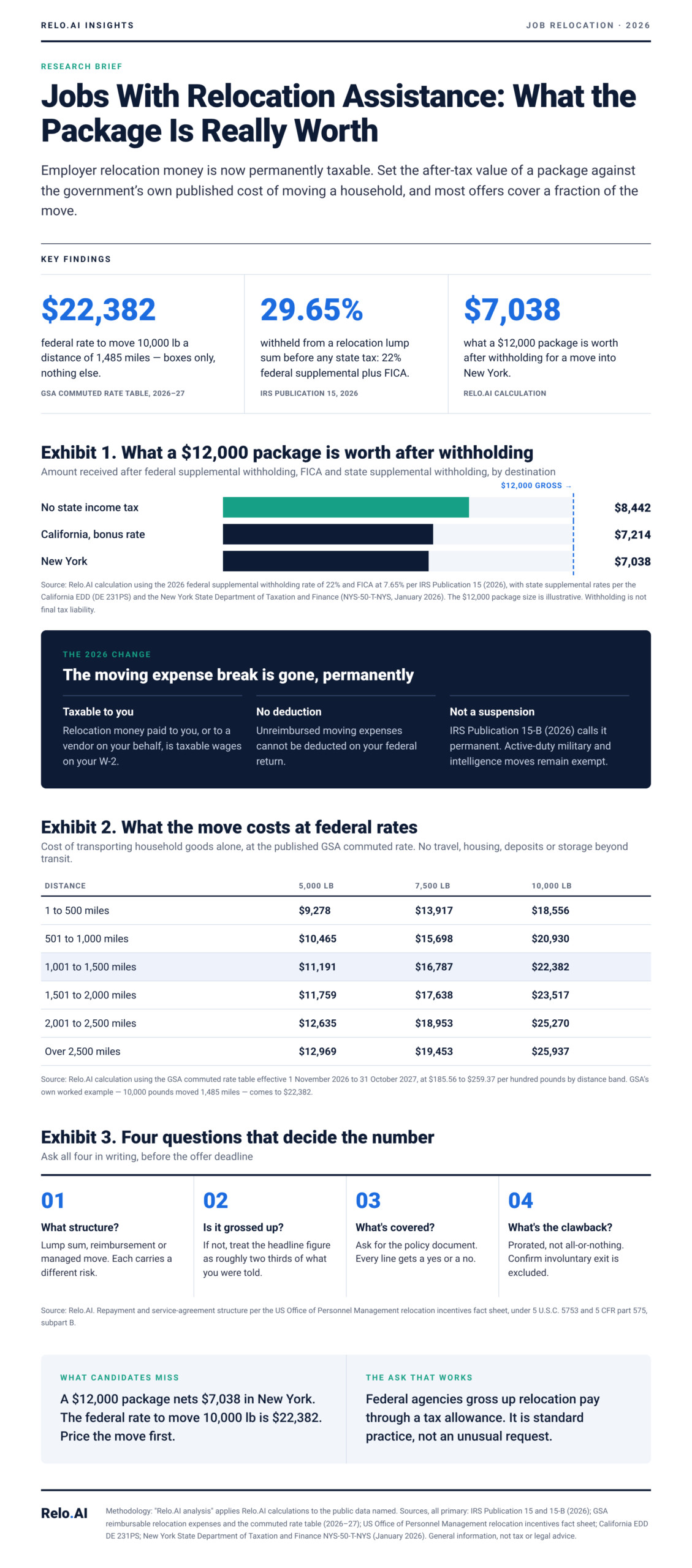
A Relo.AI calculation applying the rates effective 1 November 2026 gives the following cost of transporting household goods alone:
| Distance | 5,000 lb | 7,500 lb | 10,000 lb |
| 1 to 500 miles | $9,278 | $13,917 | $18,556 |
| 501 to 1,000 miles | $10,465 | $15,698 | $20,930 |
| 1,001 to 1,500 miles | $11,191 | $16,787 | $22,382 |
| 1,501 to 2,000 miles | $11,759 | $17,638 | $23,517 |
| 2,001 to 2,500 miles | $12,635 | $18,953 | $25,270 |
| Over 2,500 miles | $12,969 | $19,453 | $25,937 |
Source: Relo.AI calculation using the GSA commuted rate table effective 1 November 2026 to 31 October 2027, at $185.56 to $259.37 per hundred pounds by distance band (GSA). GSA’s own worked example — 10,000 pounds moved 1,485 miles — comes to $22,382.
Read that bottom-right corner carefully. $22,382 is the government’s rate for moving the boxes. It includes no flights, no hotel nights on the drive, no temporary housing, no security deposit, no utility connections, no lease-break penalty and no vehicle shipping. Those sit on top.
So when a package is quoted at $10,000 or $12,000, you are not being offered the cost of your move. You are being offered a contribution to it. The useful question is how big a contribution, after tax.
The 2026 Tax Change That Reset Everything
Most job seekers haven’t caught up with this, and it is now settled law rather than a temporary measure.
Before 2018, qualified moving expense reimbursements could be excluded from your income. That exclusion was suspended, and many expected the suspension to lapse after 2025. It did not. IRS Publication 15-B for 2026 states plainly that the law “permanently eliminates the exclusion for qualified moving expense reimbursements from your employee’s income” (IRS).
Two narrow exceptions survive. The exclusion remains available to a member of the US Armed Forces on active duty moving under orders, and to an employee or new appointee of the intelligence community who moves pursuant to a change in assignment requiring relocation. For everyone else, the position is now:
- Relocation money paid to you is taxable wages on your W-2.
- Relocation costs paid on your behalf are generally taxable to you as well.
- You cannot deduct unreimbursed moving expenses on your federal return.
That makes the gross-up — the employer paying the tax on the benefit so your net matches the quoted figure — the single most valuable thing to negotiate. More on that below, including why it is a reasonable ask.
What a Relocation Lump Sum Is Actually Worth
Here is the arithmetic an offer letter never shows. A relocation lump sum is supplemental wages, and IRS Publication 15 for 2026 sets the flat withholding rate at 22%, rising to 37% on supplemental wages above 184,500** and Medicare at 1.45% (IRS). That is 29.65% before any state tax at all.
A Relo.AI calculation on those published rates:
| Lump sum quoted | Federal withholding at 29.65% | What you actually receive |
| $10,000 | $2,965 | $7,035 |
| $12,000 | $3,558 | $8,442 |
| $15,000 | $4,448 | $10,552 |
| $25,000 | $7,412 | $17,588 |
Source: Relo.AI calculation using the 2026 federal supplemental withholding rate of 22% plus FICA at 7.65%, per IRS Publication 15 (2026). Withholding is not the same as final tax liability.
Then your destination state takes its share, and the spread is wide. California withholds supplemental wages at 10.23% on bonuses and 6.6% on other supplemental payments (California EDD). New York’s 2026 withholding tables set a supplemental rate of 11.70% (NY Department of Taxation and Finance). Texas, Florida, Tennessee and Washington have no state income tax on wages at all.
On a $12,000 lump sum, that works out as:
| Destination | Combined withholding | You receive |
| No state income tax | 29.65% | $8,442 |
| California, bonus rate | 39.88% | $7,214 |
| New York | 41.35% | $7,038 |
Source: Relo.AI calculation combining IRS Publication 15 (2026) federal rates with published 2026 state supplemental withholding rates. The $12,000 figure is an illustrative package size, not a survey average.
Now put the two halves together. A 7,038**. The federal government’s own rate for moving 10,000 pounds 1,485 miles is $22,382. Your package covers under a third of the boxes, before a single night in a hotel.
That is the whole argument in one line, and it is built entirely from published government figures you can send to a recruiter.
Ask for the Gross-Up — the Government Does
When an employer says a gross-up is not something they do, it is worth knowing that the largest employer in the United States does exactly that. Federal agencies pay a withholding tax allowance and a relocation income tax allowance specifically to cover substantially all of the additional tax liability created by relocation reimbursements (GSA).
So the ask is not exotic. It is standard practice in the public sector, and the numbers are easy to put in writing. A Relo.AI calculation of the gross payment required to leave you with a given net amount:
| You need to net | No state income tax | California, bonus rate | New York |
| $12,000 | $17,058 | $19,960 | $20,460 |
| $22,382 | $31,815 | $37,229 | $38,162 |
Source: Relo.AI calculation. Gross required = net ÷ (1 − combined withholding rate), using IRS Publication 15 (2026) and published 2026 state supplemental rates.
THE RELO.AI DAILY NEWSLETTER
Daily Digest of Relocation News, Deals & Reviews
Subscribe for free and get proven relocation and travel strategies, personalized support, valuable rewards, and trusted reviews for every move.
Thank you for subscribing!
Your email has been added to our list.
If a full gross-up is refused, ask for a partial one on the largest single component, or ask for the package to be increased by the withholding amount rather than grossed up formally. Either gets you most of the way. Our explainer on relocation bonus tax covers how the calculation is usually run in practice.
The Repayment Agreement Nobody Reads
Almost every relocation package comes with a clawback: leave within a defined window and you repay some or all of it. This is normal and not unreasonable. What varies — and what is negotiable — is the shape.
The federal model is a useful reference because it is published in full. A relocation incentive requires a written service agreement signed before payment, covering a period of no more than four years. If the agreement is terminated for cause or for failure to meet its terms, the employee keeps the portion attributable to completed service and repays only the portion attributable to uncompleted service, prorated across the period (OPM, under 5 U.S.C. 5753 and 5 CFR part 575).
Three things to check in whatever your employer puts in front of you:
- Is it prorated, or all-or-nothing? Prorated is the fairer structure and the one the federal rules use. An agreement that demands 100% back on day 364 is worth pushing on.
- Do you repay gross or net? Being asked to return the pre-tax value of money you received after tax is a genuinely expensive outcome, and it is the most commonly missed clause in the document.
- What triggers it? A well-drafted agreement excludes redundancy, restructuring and termination without cause. If yours does not, ask for that language.
Seven Questions to Ask Before You Accept
Send all seven in one email, before the offer deadline. You get a written record, consistent answers, and a quick read on whether the employer has a real policy or an improvised one.
- Is the package a lump sum, a reimbursement, or a managed move? Each carries a different risk, and the answer shapes every other question.
- Is it grossed up? If the answer is no, treat the headline figure as roughly 60 to 70 cents on the dollar.
- What exactly is covered, line by line? Ask for the policy document, not a summary. Household goods, storage, travel, temporary housing, vehicle shipping, pet transport, lease break and deposits each get a yes or a no.
- How long is temporary housing, and what if I need longer? Thirty days is common and often not enough in a tight rental market.
- What are the repayment terms, and what triggers them? Get the schedule in writing, confirm it is prorated, and confirm involuntary termination is excluded.
- Is there a salary adjustment for cost of living, separate from the move? The move is one-off. The price difference between two cities is permanent. Those are two different conversations.
- What is the deadline for spending it, and who keeps the remainder? Some employers let you keep what is left of a lump sum. Others reclaim it.
For the follow-up conversation, see questions to ask HR before accepting a relocation offer and what’s actually negotiable in your relocation package.
Frequently Asked Questions
Is relocation assistance taxable in 2026? Yes, for almost everyone. IRS Publication 15-B for 2026 states that the exclusion for qualified moving expense reimbursements has been permanently eliminated. Your relocation money is taxable wages on your W-2. Active-duty members of the Armed Forces moving under orders, and certain intelligence community employees and new appointees, are the exceptions.
How much of a relocation lump sum do you actually keep? About 70% before state tax. Federal supplemental withholding is 22%, and FICA adds 6.2% for Social Security up to the 2026 wage base of $184,500 plus 1.45% for Medicare. In a high-rate state such as New York, combined withholding on a lump sum can exceed 41%.
What is a gross-up, and should you ask for one? A gross-up is the employer paying the tax on your relocation benefit so your net equals the figure you were quoted. Yes, ask. Federal agencies do it as a matter of policy, through a withholding tax allowance and a relocation income tax allowance, so it is a well-established practice rather than an unusual request.
How much relocation assistance is reasonable to ask for? Anchor on your actual costs rather than a percentage. Price the household goods move first, add travel, temporary housing and deposits, then present the total. As a sense-check on scale, federal agencies may pay a relocation incentive of up to 25% of annual basic pay for each year of a service agreement.
Do jobs with relocation assistance pay less in salary? Not systematically. Relocation budgets usually sit outside the salary band, in a separate mobility or talent acquisition line. Settle salary first, then open the relocation conversation, so the two do not become a trade.
Can you negotiate relocation assistance after accepting the offer? It is harder but not impossible, particularly if your circumstances changed or quotes came in above the estimate. Your leverage is highest before you sign, so use that window to get the full package in writing.
What happens if you leave the job soon after relocating? You will almost certainly owe money back under a repayment agreement. Check whether it is prorated or all-or-nothing, whether you repay the gross or the net amount, and whether involuntary termination is excluded. The federal model prorates repayment across a service period of no more than four years, which is a reasonable structure to argue for.
THE RELO.AI DAILY NEWSLETTER
Daily Digest of Relocation News, Deals & Reviews
Subscribe for free and get proven relocation and travel strategies, personalized support, valuable rewards, and trusted reviews for every move.
Thank you for subscribing!
Your email has been added to our list.
Conclusion
Relocation assistance is one of the few parts of a job offer routinely quoted in a number that is not the number you receive. The 2026 position makes that permanent: the exclusion is gone, the deduction is gone, and in a high-rate state more than 40% of a lump sum can disappear before you have booked a truck.
The candidates who do well are not the ones who negotiate hardest. They are the ones who arrive with two figures — what the move costs at published rates, and what the package is worth after published withholding — and ask for the difference. Both numbers come from government sources. Neither is a matter of opinion.
Price your move first. Then negotiate the gap.
Get the Numbers Before You Sign
Relo.AI builds relocation intelligence for the people doing the moving. Run your offer through the Relo.AI offer analyzer to see what a package is worth after tax in your destination, compare the cost of living between your current city and the new one, and get a line-by-line estimate of what your move will cost before you reply to the recruiter.
Start at relo.ai, or call +1-617-333-8453 to talk to someone who does this daily.
Sources
- Internal Revenue Service, Publication 15 (2026), Employer’s Tax Guide — supplemental wage withholding, Social Security and Medicare rates, 2026 wage base
- Internal Revenue Service, Publication 15-B (2026), Employer’s Tax Guide to Fringe Benefits — permanent elimination of the qualified moving expense reimbursement exclusion, and the Armed Forces and intelligence community exceptions
- US General Services Administration, reimbursable relocation expenses and rates — commuted rate table effective 1 November 2026, withholding tax allowance and relocation income tax allowance
- US Office of Personnel Management, relocation incentives fact sheet — 5 U.S.C. 5753 and 5 CFR part 575, subpart B
- California Employment Development Department, DE 231PS, supplemental wage payments
- New York State Department of Taxation and Finance, NYS-50-T-NYS, withholding tax tables and methods, January 2026