
Jobs That Offer Relocation Assistance Pay You to Start Fresh Anywhere - Relocation
AI Workers Are the New Expats: Where Tech’s Hottest Talent Is Landing - Relocation
How to Find a Job in Miami and Thrive in the Sunshine State - Relocation
Athletic Trainers Relocation - Athletics
Doctor Relocation Timeline From Offer Letter to Hospital Onboarding - Medical
Top Cities for Female Physicians to Practice in the United States - Medical
Easy Relocation for Physicians - Medical
The Best Cities for Registered Nurses: Where Pay Meets Possibility - Medical
How Relocation Packages for Nurses Support Long-Term Career Moves - Medical
Relocating as a Traveling Nurse - Medical
10 Best Neobanks in the US That Fit Modern Financial Habits - Personal Finance
Corporate Credit Card vs. Business Credit Card: Which Option Is Appropriate for Business - Finance
Jobs That Offer Relocation Assistance Pay You to Start Fresh Anywhere - Relocation
AI Workers Are the New Expats: Where Tech’s Hottest Talent Is Landing - Relocation
How to Find a Job in Miami and Thrive in the Sunshine State - Relocation
Athletic Trainers Relocation - Athletics & Sports
Doctor Relocation Timeline From Offer Letter to Hospital Onboarding - Medical
Top Cities for Female Physicians to Practice in the United States - Medical
Easy Relocation for Physicians - Medical
The Best Cities for Registered Nurses: Where Pay Meets Possibility - Medical
How Relocation Packages for Nurses Support Long-Term Career Moves - Medical
Relocating as a Traveling Nurse - Medical
10 Best Neobanks in the US That Fit Modern Financial Habits - Personal Finance
Corporate Credit Card vs. Business Credit Card: Which Option Is Appropriate for Business - Finance
Jobs That Offer Relocation Assistance Pay You to Start Fresh Anywhere - Relocation
AI Workers Are the New Expats: Where Tech’s Hottest Talent Is Landing - Relocation
How to Find a Job in Miami and Thrive in the Sunshine State - Relocation
Athletic Trainers Relocation - Athletics & Sports
Doctor Relocation Timeline From Offer Letter to Hospital Onboarding - Medical
Top Cities for Female Physicians to Practice in the United States - Medical
Easy Relocation for Physicians - Medical
The Best Cities for Registered Nurses: Where Pay Meets Possibility - Medical
How Relocation Packages for Nurses Support Long-Term Career Moves - Medical
Relocating as a Traveling Nurse - Medical
10 Best Neobanks in the US That Fit Modern Financial Habits - Personal Finance
Corporate Credit Card vs. Business Credit Card: Which Option Is Appropriate for Business - Finance
Jobs That Offer Relocation Assistance Pay You to Start Fresh Anywhere - Relocation
AI Workers Are the New Expats: Where Tech’s Hottest Talent Is Landing - Relocation
How to Find a Job in Miami and Thrive in the Sunshine State - Relocation
Athletic Trainers Relocation - Athletics & Sports
Doctor Relocation Timeline From Offer Letter to Hospital Onboarding - Medical
Top Cities for Female Physicians to Practice in the United States - Medical
Easy Relocation for Physicians - Medical
The Best Cities for Registered Nurses: Where Pay Meets Possibility - Medical
How Relocation Packages for Nurses Support Long-Term Career Moves - Medical
Relocating as a Traveling Nurse - Medical
10 Best Neobanks in the US That Fit Modern Financial Habits - Personal Finance
Corporate Credit Card vs. Business Credit Card: Which Option Is Appropriate for Business - Finance


At 4:47 p.m. on a Thursday, the email lands in your inbox. Great title. The raise looks real, and you’ve had the city on your shortlist for years. Then you reach the last line: “We’ll need your answer by end of day Saturday.” That gives you just 48 hours to make a major life decision. You may need to break a lease, move your family, change schools, and work out if a $7,500 relocation stipend will cover the move. Most people spend longer choosing a couch. Welcome to the world of exploding job offers.
These offers are common in competitive hiring. They work because a short deadline can turn a career choice into a rushed decision. However, the deadline may be more flexible than it first appears. Research also suggests that candidates often have more room to ask for time than they think.
This guide explains why recruiters use exploding job offers, what the data says about pushing back, how to ask for more time, and which relocation costs you should check before the deadline.
What Exploding Job Offers Actually Are (and Why Recruiters Use Them)
An exploding offer is a job offer with a short, hard expiration date: accept by Friday, or it’s gone. Harvard Business School professor Robert J. Robinson defined the tactic in a classic 1995 Negotiation Journal paper, “Defusing the Exploding Offer”, as a proposal with an artificial deadline designed to force a yes before you can shop around.

THE RELO.AI DAILY NEWSLETTER
Daily Digest of Relocation News, Deals & Reviews
Subscribe for free and get proven relocation and travel strategies, personalized support, valuable rewards, and trusted reviews for every move.
Thank you for subscribing!
Your email has been added to our list.
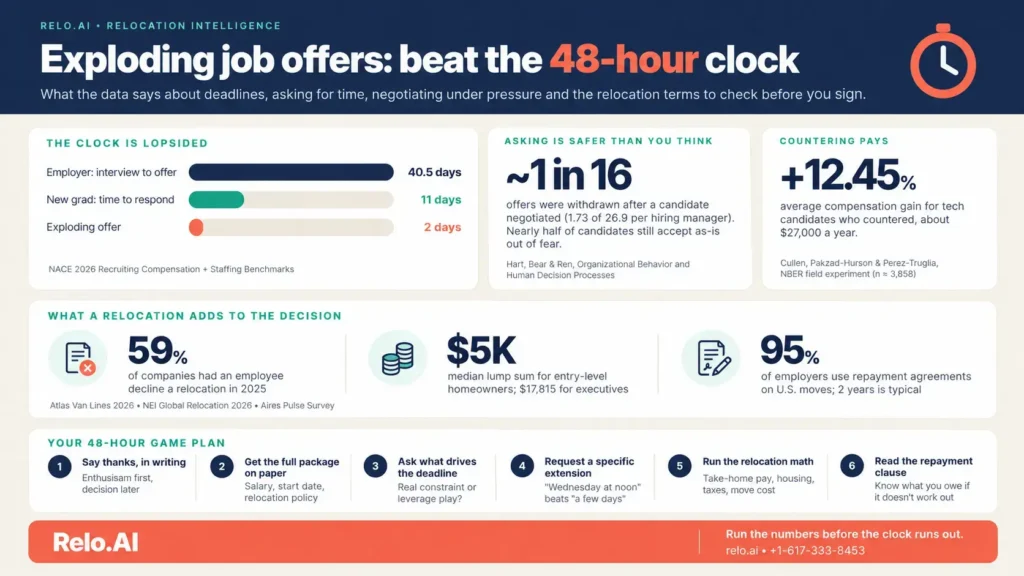
Context matters here. Employers almost never move at that speed themselves. The National Association of Colleges and Employers (NACE) reports in its 2026 benchmarks that employers take an average of 40.5 days between interview and offer for new grads, then give students about 11 days to respond. Experienced hires see a similar imbalance.
Huntr’s 2025 job search report found the median time to a first offer climbed from 57 days in the first quarter to 83 days by the fourth. So a company that took two months to decide is now asking you to decide in two days.
Why do it? A few honest reasons and a few less flattering ones –
- In hot fields like AI, finance and medicine, recruiters fear losing you to a competing offer you haven’t received yet.
- A backup candidate. If the runner-up is waiting, the hiring manager wants an answer before that person accepts somewhere else.
- Budget or headcount timing. A req tied to a quarter-end budget can genuinely expire.
- A short clock discourages negotiation and comparison shopping. That one is about power, not logistics.
Knowing which one you’re dealing with changes your strategy, which we’ll get to in a minute.
Related – Moving for a Job in 2026? Read This Before You Accept the Offer
Exploding Job Offers at a Glance
A 48-hour deadline can feel extreme when an employer took weeks to make a hiring decision. This infographic shows the key facts behind exploding job offers. It covers response times, negotiation risks, relocation costs, repayment terms, and a simple six-step plan to help you make a clear decision under pressure.
Download Now (High-Quality Image Version)
Why a 48-Hour Deadline Hits Harder When You Have to Move
A local job switch is mostly a career decision. A relocation is a career decision stapled to a housing decision, a family decision and a financial decision. Exploding job offers compress all four into the same weekend.
The data shows how much is riding on those other three. Atlas Van Lines’ 59th annual Corporate Relocation Survey found that 59% of companies had an employee decline a relocation in 2025.
The top reasons had nothing to do with the job itself: family ties (34%), housing or mortgage concerns in the new city (28%) and worries about selling or leaving a home (21%). Moving kids to a new school debuted in the top five. Those are exactly the issues you can’t resolve in 48 hours, and exactly the ones people regret skipping.
Then there’s the money. A relocation offer bundles a salary that has to stretch across a new cost of living with a package that may or may not cover the actual move. NEI Global Relocation’s 2026 lump sum survey found that 53% of companies now use lump-sum-only programs, with a median of $5,000 for entry-level homeowners and $17,815 for executives.
Our breakdown of the real cost of moving shows how quickly a long-distance move eats through $5,000. Sign without checking, and that gap comes out of your savings.
Housing timelines add one more squeeze. Landlords in tight markets often want proof of income before they’ll approve you, and a rental approval timeline can run longer than your start date allows.
If you sign on Saturday and start in three weeks, you may be living in temporary housing longer than you think.
The Research Says Exploding Offers Backfire on Employers
Here’s the part recruiters rarely mention. The academic case against exploding job offers is strong, and some of it comes from the people who teach negotiation for a living.
Wharton professor Adam Grant wrote an open letter to recruiters titled “It’s Time to Eliminate Exploding Job Offers.” He pointed to research by Harris Sondak and Max Bazerman showing that exploding offers reduced matching efficiency by 8% to 13%, meaning people and jobs paired up worse.
Grant also cited INSEAD experiments where candidates “punished” exploding offers at five to six times the rate of extended offers. His argument: a pressure deadline attracts risk-averse hires instead of the best-fit ones, and the people who do accept tend to repay the pressure with less loyalty.
That matters for you in two ways. First, a deadline that tight is a signal about how the company operates, and worth weighing alongside salary.
Second, many hiring managers privately agree that the tactic is clumsy, which makes them more open to a reasonable request for time than the email suggests.
Fear of asking is usually the bigger problem. In a set of seven studies published in Organizational Behavior and Human Decision Processes, George Mason University’s Einav Hart and co-authors Julia Bear and Zhiying (Bella) Ren found that candidates badly overestimate the risk of losing an offer by negotiating.
Hiring managers in the study had extended an average of 26.9 offers in their careers and withdrawn just 1.73 after a candidate negotiated. That’s roughly one in 16. Yet nearly half of candidates accepted as-is because they were afraid. “Negotiating is not just zero-sum,” Hart said. Asking for 72 more hours is about the gentlest negotiation there is.
Is the Deadline Real? How to Read the Pressure
Not every short deadline is a bluff. Before you respond, figure out which kind you’re facing, because each one calls for a different move.
| Signal | What it probably means | Your best move |
| “We have another finalist waiting” | Real but flexible; they’d rather have you | Ask for 3 to 5 business days and give a firm date |
| Deadline tied to a cohort start or training class | Real and rigid | Ask what can move instead: start date, relocation timing, remote start |
| Offer arrives before you’ve met the team or seen the package | Pressure tactic | Request the full written package and a call with your future manager first |
| Recruiter won’t put the package in writing | Red flag | Don’t accept anything until terms are on paper |
| “This offer is non-negotiable, and it expires tomorrow” | Leverage play | Negotiate time first, then the package; most firms still flex on one |
| Deadline comes from a staffing agency, not the employer | Agency quota pressure | Ask whether the hiring manager set the date; often they didn’t |
The single best diagnostic question is simple: “Can you help me understand what’s driving the timeline?” If the constraint is genuine, a recruiter will usually explain it clearly.
On the other hand, someone who becomes defensive or vague may be revealing something important about the process. For that reason, it is worth looking for other warning signs before you commit. Our list of relocation offer red flags covers more issues worth checking.
Your First Six Hours – Triage the Offer
Clock management starts the moment the offer arrives. However, don’t respond in the first hour.
Instead, do this –
- First, thank them in writing right away. A quick note saying you’re excited and reviewing the details shows good faith and creates goodwill for what comes next.
- Next, get everything on paper. Confirm the base salary, bonus, equity, start date, title, reporting line, remote policy, and the full relocation package, including whether it’s a lump sum or a managed move. Do not rely on a verbal offer alone. Ask for the complete terms in writing before making a decision.
- Then, ask for the relocation policy document. Don’t rely only on the summary line in the offer letter. More importantly, the policy shows what’s covered, what’s capped, and what you could owe back if you leave.
- At the same time, loop in your household. If a partner’s career or a child’s school year is affected, this conversation can’t wait until hour 47. Our guide to dual-career relocation is a useful starting point.
- After that, list your open loops. This may include other interviews in progress, a lease end date, a home you’d need to sell, or a bonus you’d forfeit by leaving now. Ultimately, these become your strongest reasons for needing more time.
- Finally, pick your number. Decide the exact date you realistically need to answer by. In most cases, specific beats vague every time.
How to Ask for More Time Without Losing the Offer
Asking for an extension is normal. Asking badly is what gets people in trouble. Fortunately, three simple rules can make the request land better: be enthusiastic, be specific, and give a reason that shows you want to make the right decision, not shop the offer around.
For example, here’s a script that works by phone or email –
“Thank you again. I’m genuinely excited about this role and the team. Because this offer involves relocating my family from Boston to Denver, I want to make sure I understand the relocation package and housing timing before I commit. Could we extend the deadline to Wednesday at noon? I’d also love 20 minutes with [hiring manager] before then to talk through the start date.”
Notice what that does. It gives a concrete reason, relocation, a concrete date, Wednesday at noon, and a concrete next step, a call. Just as importantly, it doesn’t mention other offers, which can make the request sound like a bidding war you haven’t earned yet.
However, if you do have other active interviews, it’s fair to be honest about them, especially if you’re close to the end. Grant’s suggested compromise for employers is to let candidates finish processes already underway.
In that case, you can ask for exactly that: “I’m in final rounds with one other company and expect to hear by Tuesday. I’d like to make a clean decision without leaving anyone hanging.”
Finally, what if they say no? Ask what can move instead. For instance, a later start date, a remote first month, or a delayed relocation date can relieve much of the pressure even if the signing deadline stays put.

Also read – Job Relocation Timeline From Offer Letter to Move In
Run the Relocation Math Before the Clock Runs Out
Exploding job offers do not give you much time for a full relocation review. Still, you can cover the 80% that matters most in two days. Start with the key numbers. Focus on the costs and benefits that could change your final decision.
Start with real take-home pay. A $20,000 raise moving from Austin to San Francisco can be a pay cut once you factor in state income tax and rent.
Plug both cities into our relocation calculator, or run the whole offer through the Relo.AI offer analyzer to compare salary, cost of living and package value side by side.
If you’re weighing two offers at once, our guide on how to compare two job offers walks through the framework, and equity gets its own treatment in comparing equity compensation across states.
Then pressure-test the package against your actual move –
| What to check | Why it matters in a 48-hour window |
| Lump sum vs. managed move | A lump sum is taxable and capped; overruns are yours to cover |
| Tax gross-up | Without one, a $10,000 stipend can shrink by a quarter or more; see our relocation bonus tax guide |
| Temporary housing days | 30 days rarely covers a home search plus a lease approval in a tight market |
| Home sale or lease-break help | Selling a home or breaking a lease can cost more than the whole stipend |
| Repayment agreement | Determines what you owe if the job doesn’t work out in the first year or two |
| Start date flexibility | The cheapest concession for an employer and often the most valuable for you |
Don’t forget the costs no offer letter lists: deposits, utility setup, a car you may need to buy or sell, and the gap before your first paycheck after relocation. A small relocation emergency fund cushions all of them.
Negotiate the Package, Not Just the Deadline
Here’s a counterintuitive truth about exploding job offers: the deadline itself is often your opening. After all, a company in a hurry is a company that wants you, and wanting you gives you leverage.
Importantly, the research backs this up. In a large field experiment with about 3,858 tech job seekers, economists Zoë Cullen of Harvard, Bobak Pakzad-Hurson of Brown, and Ricardo Perez-Truglia of UCLA Anderson found that candidates who countered saw compensation rise by about 12.45%, roughly $27,000 a year. In fact, the nudge they sent participants said it plainly: “companies expect you to negotiate.”
For a relocation offer, however, salary is only one lever. Often, the bigger wins are in the package itself, where an extra $5,000 may matter far less to the company’s budget than it does to yours.
Good asks under time pressure include –
- A larger lump sum, or a gross-up so it isn’t eaten by taxes
- Extra weeks of temporary housing
- A house-hunting trip before your start date
- Lease-break or home-sale assistance
- A later start date or a remote first month
- A shorter or prorated repayment term
Our guides on what’s actually negotiable in your relocation package and how to negotiate a relocation package go deeper. If the offer came with no relocation assistance at all, that’s the first thing to raise. Keep the ask focused. Under a 48-hour clock, two or three priorities beat a list of ten.
One timing tip: negotiate before you accept, not after. You can sometimes negotiate relocation after accepting, but your leverage drops sharply the moment you sign.
THE RELO.AI DAILY NEWSLETTER
Daily Digest of Relocation News, Deals & Reviews
Subscribe for free and get proven relocation and travel strategies, personalized support, valuable rewards, and trusted reviews for every move.
Thank you for subscribing!
Your email has been added to our list.
Read the Fine Print on Exploding Job Offers Before You Sign
Speed is where people skim, and skimming is expensive. Three clauses deserve a careful read even on a tight clock.
The repayment agreement. Almost every relocation package has one. An Aires pulse survey found 95% of employers use repayment agreements for U.S. domestic moves, and two years is the most common term. Some prorate; some require 100% back if you leave in year one. Read our breakdown of the relocation repayment agreement and what happens if you pay back relocation if you quit.
Contingencies. With exploding job offers, a fast deadline can make it tempting to act before every detail is final. However, background checks, reference checks, licensing, and drug screens can still delay or derail an offer. Huntr’s 2025 data found that more than one in 10 job seekers had an offer revoked last year. For this reason, wait until every contingency clears in writing before you resign, break a lease, or list your house.
Layoff protection. If the company cuts your role six months after you move, does the repayment clause still apply? Do they cover a move back? These are fair questions, and our guide to negotiating layoff protection before you relocate has language you can borrow.
For a complete checklist, keep our questions to ask HR before accepting a relocation offer open while you review.
When the Employer Won’t Budge – The Farpoint Gambit
Sometimes, the employer will not give you more time or better terms. Even then, you may have one more option from Robinson’s 1995 paper. He called it the “Farpoint Gambit.”
The idea is simple. You accept the offer only after a few fair conditions are met. These conditions may take time to sort out. In Robinson’s words, “I accept. Provisionally.” For example, you may agree after you review the written relocation policy, confirm your partner’s job transfer, or read the repayment terms.
Robinson also says that “the key is to make requests that are completely reasonable.” While both sides work through these details, the deadline may pass. As a result, the pressure may start to ease.
However, use this approach with care. Robinson warns against making it a habit. Your conditions should be real, fair, and linked to the move. In other words, use this tactic to get the facts you need, not just to delay your answer.
Finally, if you need to use this tactic, pay attention to how the employer responds. Their reaction may tell you a lot about how they handle pressure, questions, and flexibility before you join.
When to Walk Away From Exploding Job Offers
Not every job offer is worth accepting quickly. If an exploding job offer comes with any of these warning signs, it may be better to walk away:
- The company will not put the relocation package in writing.
- No one can clearly explain why the deadline is so short.
- The recruiter pushes you to resign before all checks or conditions are complete.
- The relocation package does not cover basic moving costs, and the company will not discuss it.
- Your family has not had enough time to weigh in, and the move could split the household.
Saying no to an offer will not ruin your career. In fact, Atlas found that many companies saw candidates turn down relocation offers last year. It is a normal part of hiring.
If you are still deciding whether to leave your current employer, read our guide on whether to relocate or resign. Families planning a move in stages can also learn more about split family relocation.
Exploding Job Offers at Every Career Stage
Exploding job offers can look different depending on where you are in your career. The employer, the deadline, and your room to negotiate may all change with your experience level.
New grads and interns. Exploding job offers are common in campus recruiting. However, students often have support available. Many university career centers publish recruiting guidelines with minimum response times. So, if a deadline feels too short, contact your career office. Our guides to new grad relocation packages and the intern relocation stipend explain what you may expect.
Contract and travel roles. Staffing agencies may use short deadlines to fill roles quickly. Before you decide, ask if the client truly needs an answer by that date. If you’re relocating for a contract job, flexible housing can matter even more because the role may be temporary.
Specialized and senior roles. Engineers, physicians, and AI professionals may have more leverage because their skills are in high demand. As a result, a short deadline can sometimes reflect strong competition for the role. Our guides on software engineer relocation and relocation for AI jobs explain the types of support these roles may receive.
Internal transfers. Exploding job offers can also happen inside a company when a manager needs to fill a role fast. In many cases, internal employees may have more room to ask questions or request time. See our internal transfer relocation guide for more details.
Finally, if the deadline starts before you have visited the new city, ask about interview travel. Our guide on whether companies pay for interview travel can help. Seeing the city before you sign may make the decision much easier.
For HR Teams – Exploding Offers Cost You More Than Time
If you lead talent acquisition or mobility, the evidence suggests that exploding job offers can do more harm than good. Grant’s summary of the research is clear. These offers can reduce match quality, discourage careful candidates, and push some new hires to keep looking even after they start.
Relocation can make the problem worse. A candidate who accepts too quickly may not have checked the costs or discussed the move with their family. As a result, they may back out before day one or leave soon after. With 59% of companies already seeing relocations decline, a strict 48-hour deadline can add even more pressure.
Fortunately, the solution is simple. Give relocating candidates at least a week to decide. Send the full relocation policy with the offer, not later. Finally, offer a call with a mobility contact who can answer questions about housing, taxes, and the move.
Our 2026 relocation package guide, which looks at employee relocation costs and an overview of relocation challenges for HR leaders, shows how to build offers that close without the pressure.
Recommended read – 40% of Employee Relocations Fail — Here Are the 5 HR Mistakes Driving It
Beat Exploding Job Offers With Relo.AI Before You Decide
Exploding job offers can feel stressful when you have only 48 hours to decide. Without clear numbers, it is easy to feel unsure. Relo.AI helps you review the offer, compare the real costs, and make a clearer decision.
Start with our offer analyzer. It can help you review the salary, relocation benefits, bonuses, and other key terms. Then use the relocation calculator to compare your take-home pay with your moving costs. This can give you a better idea of what the offer may be worth after the move.
Location also matters. Use our city guides to compare neighborhoods, housing, commute times, and other daily costs. These details can help you spot missing relocation support and ask for more time with greater confidence.
For employers, our corporate relocation services help HR and mobility teams create relocation packages that are easier for candidates to understand.
Clear costs, useful support, and simple relocation terms can make a short decision window easier to manage.
Schedule a FREE consultation with us or call +1-617-333-8453.
THE RELO.AI DAILY NEWSLETTER
Daily Digest of Relocation News, Deals & Reviews
Subscribe for free and get proven relocation and travel strategies, personalized support, valuable rewards, and trusted reviews for every move.
Thank you for subscribing!
Your email has been added to our list.
Frequently Asked Questions (FAQ) About Exploding Job Offers
1. What is an exploding job offer?
An exploding job offer is an offer with a short, firm deadline, often 24 to 72 hours, after which the employer says it will be withdrawn. In other words, the goal is to get a quick yes before you have enough time to compare options or negotiate.
2. Can you ask for more time on an exploding job offer?
Yes. First, ask politely and give a specific reason, such as relocation logistics. Then, suggest a clear date by which you can provide your decision. Research from George Mason University found that hiring managers rarely pull offers after a candidate negotiates, so asking for a few extra days can be a modest and reasonable request.
3. Will an employer rescind an offer if you ask for an extension?
It’s possible, but it is uncommon with exploding job offers. For example, one study found that hiring managers withdrew about 1.73 offers out of an average of 26.9 after candidates negotiated. Therefore, asking for more time does not always put your offer at risk. Keep your request polite, explain why you need extra time, and give the employer a clear date for your decision.
4. How long should you have to consider a relocation offer?
There’s no legal standard. However, a week can be reasonable for a move that affects housing, finances, and family. For comparison, NACE data puts the average response window for new graduates at about 11 days.
5. Should you negotiate relocation benefits under a tight deadline?
Yes. However, focus on two or three priorities, such as a bigger lump sum, tax gross-up, additional temporary housing, or a later start date. Whenever possible, negotiate before you sign, since your leverage can drop significantly after acceptance.
6. Are exploding job offers legal?
Yes. In the U.S., employers can set deadlines on job offers. However, that does not necessarily make the deadline non-negotiable. As a result, you can still ask for additional time, especially when the decision involves a significant relocation.
Take Control Before You Say Yes
Exploding job offers can make you feel like you have no choice. However, you often have more options than you think. First, ask for more time and give a clear reason. Next, get the full relocation package in writing. Then, check the real costs before you decide. Most importantly, read the repayment terms before you sign.
Finally, pay attention to how the company responds. If it will not give you a few days to consider a cross-country move, that may tell you something important about what working there could be like.
Sources –
- Robert J. Robinson, “Defusing the Exploding Offer: The Farpoint Gambit,” Negotiation Journal (1995)
- NACE: As Employers Push Out Time From Interview to Offer, Student Response Time Holds Steady (with 2026 benchmarks)
- Huntr: 2025 Annual Job Search Trends Report
- Atlas Van Lines: 59th Annual Corporate Relocation Survey (2026)
- NEI Global Relocation: 2026 Relocation Lump Sum Survey
- Government Executive: Adam Grant, “It’s Time to Eliminate Exploding Job Offers”
- George Mason University: Research: Negotiating Is Unlikely to Jeopardize Your Job Offer (Hart, Bear and Ren)
- George Mason University: Scared to Negotiate Job Offers? Do It Anyway
- UCLA Anderson Review: Most Job Seekers Skip Negotiation and Pay a High Price (Cullen, Pakzad-Hurson and Perez-Truglia)
- Aires: Pulse Survey on Repayment Agreements
Disclaimer – This article is for general information only. It is not legal, tax, financial, or employment advice. Relocation terms and laws can differ by employer, state, and situation. Review the details carefully and speak with a qualified professional if needed.