
Jobs That Offer Relocation Assistance Pay You to Start Fresh Anywhere - Relocation
AI Workers Are the New Expats: Where Tech’s Hottest Talent Is Landing - Relocation
How to Find a Job in Miami and Thrive in the Sunshine State - Relocation
Athletic Trainers Relocation - Athletics
Doctor Relocation Timeline From Offer Letter to Hospital Onboarding - Medical
Top Cities for Female Physicians to Practice in the United States - Medical
Easy Relocation for Physicians - Medical
The Best Cities for Registered Nurses: Where Pay Meets Possibility - Medical
How Relocation Packages for Nurses Support Long-Term Career Moves - Medical
Relocating as a Traveling Nurse - Medical
10 Best Neobanks in the US That Fit Modern Financial Habits - Personal Finance
Corporate Credit Card vs. Business Credit Card: Which Option Is Appropriate for Business - Finance
Jobs That Offer Relocation Assistance Pay You to Start Fresh Anywhere - Relocation
AI Workers Are the New Expats: Where Tech’s Hottest Talent Is Landing - Relocation
How to Find a Job in Miami and Thrive in the Sunshine State - Relocation
Athletic Trainers Relocation - Athletics & Sports
Doctor Relocation Timeline From Offer Letter to Hospital Onboarding - Medical
Top Cities for Female Physicians to Practice in the United States - Medical
Easy Relocation for Physicians - Medical
The Best Cities for Registered Nurses: Where Pay Meets Possibility - Medical
How Relocation Packages for Nurses Support Long-Term Career Moves - Medical
Relocating as a Traveling Nurse - Medical
10 Best Neobanks in the US That Fit Modern Financial Habits - Personal Finance
Corporate Credit Card vs. Business Credit Card: Which Option Is Appropriate for Business - Finance
Jobs That Offer Relocation Assistance Pay You to Start Fresh Anywhere - Relocation
AI Workers Are the New Expats: Where Tech’s Hottest Talent Is Landing - Relocation
How to Find a Job in Miami and Thrive in the Sunshine State - Relocation
Athletic Trainers Relocation - Athletics & Sports
Doctor Relocation Timeline From Offer Letter to Hospital Onboarding - Medical
Top Cities for Female Physicians to Practice in the United States - Medical
Easy Relocation for Physicians - Medical
The Best Cities for Registered Nurses: Where Pay Meets Possibility - Medical
How Relocation Packages for Nurses Support Long-Term Career Moves - Medical
Relocating as a Traveling Nurse - Medical
10 Best Neobanks in the US That Fit Modern Financial Habits - Personal Finance
Corporate Credit Card vs. Business Credit Card: Which Option Is Appropriate for Business - Finance
Jobs That Offer Relocation Assistance Pay You to Start Fresh Anywhere - Relocation
AI Workers Are the New Expats: Where Tech’s Hottest Talent Is Landing - Relocation
How to Find a Job in Miami and Thrive in the Sunshine State - Relocation
Athletic Trainers Relocation - Athletics & Sports
Doctor Relocation Timeline From Offer Letter to Hospital Onboarding - Medical
Top Cities for Female Physicians to Practice in the United States - Medical
Easy Relocation for Physicians - Medical
The Best Cities for Registered Nurses: Where Pay Meets Possibility - Medical
How Relocation Packages for Nurses Support Long-Term Career Moves - Medical
Relocating as a Traveling Nurse - Medical
10 Best Neobanks in the US That Fit Modern Financial Habits - Personal Finance
Corporate Credit Card vs. Business Credit Card: Which Option Is Appropriate for Business - Finance


Two employees at the same company, moving to the same city, can end up with wildly different outcomes depending on one structural choice buried in the offer letter. A lump sum relocation package looks like the better deal on paper. The math after taxes tells a different story.
A lump sum package is a fixed cash payment an employer hands over so the employee can arrange and pay for their own move. A managed move flips that structure, with the company or a relocation partner booking movers, coordinating temporary housing, and paying vendors directly. Both approaches move the same boxes to the same new city.
They differ sharply in who controls the process, who absorbs the risk, and how much of the stated dollar figure the employee genuinely keeps.
What Is a Lump Sum Relocation Package?
A lump sum relocation package gives the employee one payment and then steps back. The amount often ranges from $5,000 to $35,000. It depends on the employee’s level and homeownership status.

THE RELO.AI DAILY NEWSLETTER
Daily Digest of Relocation News, Deals & Reviews
Subscribe for free and get proven relocation and travel strategies, personalized support, valuable rewards, and trusted reviews for every move.
Thank you for subscribing!
Your email has been added to our list.
The employee hires movers, books flights, and arranges temporary housing. They also keep any money left over. Most policies do not require receipts, approval steps, or outside coordination.
Employers like this structure for a simple reason. It sets a clear limit on relocation costs. It also removes most of the administrative work from HR. Employees with moving experience may benefit as well.
They can compare movers, negotiate rates, and manage their budget. As a result, they may save money and retain more control over the move.
Related – Relocation Package Guide 2026: What’s Standard, What’s Negotiable
Why Are Companies Pulling Back on Cash-Only Packages?
Despite their appeal, employers have started reducing single-payment relocation benefits. SHRM’s 2025 Employee Benefits Survey found that relocation lump-sum payments saw the largest drop among housing and relocation benefits that year.
SHRM’s 2026 findings show that the broader decline in housing and relocation support is continuing. It has not reversed.
The reason for this decline is clear. Employees may underestimate moving costs. They may also spend the payment too early. Then, under pressure, they may choose the cheapest mover.
A bad experience with a low-cost vendor can create unnecessary stress. It can also delay an employee’s start date. That is the very outcome a relocation benefit should prevent. Employers noticed this pattern and began to rethink the structure.
What Does a Lump Sum Relocation Package Really Cost You in Taxes?
First, the number in an offer letter rarely matches the amount an employee receives in the bank. Taxes and withholding lower the final payment. In addition, since 2018, the IRS has treated relocation benefits for civilian employees as taxable income. This rule applies to a lump sum relocation package and other payment options.
The IRS treats employer-paid relocation amounts as supplemental wages. As a result, employers must withhold federal tax at a flat 22% rate. They must also withhold Social Security, Medicare, and any applicable state taxes.
A Real Number, Not a Theoretical One
Federal, state, and payroll taxes can reduce a $20,000 lump sum relocation package by $6,000 to $8,000. Employees can lose that money before movers load even a single box. This leaves roughly $12,000 to $14,000 in real spending power for the move. As a result, many employees do not notice the gap until their first paycheck arrives after the move.
In a managed move, the company pays relocation vendors directly. It does not deposit cash into the employee’s account. This structure can reduce tax exposure for the coordination part of the benefit.
Therefore, a smaller managed package can provide more usable value than a larger lump sum package. The difference becomes clear after the employee calculates the after-tax amount.
This gap leads people to compare offers by the headline dollar figure alone. Consequently, they can reach the wrong conclusion.
Also read – What is a Lump Sum Relocation Package and How Does It Work?
When Does the Cash Option Make the Most Sense?
None of this means a lump sum relocation package is a bad choice in every case. Employees who have relocated before may prefer cash in hand. They know how to find competitive moving quotes.
In addition, they can manage logistics under a deadline. As a result, they may come out ahead after taxes reduce the payment. They can also skip services they do not need. Then, they can use that budget for other moving costs.
A single mover without a family or a home to sell offers the clearest case for taking cash. This type of move has fewer parts to manage. It also gives a self-managed process fewer chances to go wrong.
The tax hit may feel easier to absorb. The total dollar figure is often smaller, and the move itself is simpler.
Employees who get three moving quotes can make smarter vendor choices. They should also confirm the repayment terms before accepting the role. Before they spend the remaining funds, they need to set aside enough money for the estimated tax bill.
THE RELO.AI DAILY NEWSLETTER
Daily Digest of Relocation News, Deals & Reviews
Subscribe for free and get proven relocation and travel strategies, personalized support, valuable rewards, and trusted reviews for every move.
Thank you for subscribing!
Your email has been added to our list.
Together, these three habits help employees get more value from cash relocation benefits.
When Does a Lump Sum Relocation Package Make More Sense Than a Managed Move?
A managed move proves its value when a lump sum relocation package becomes hard to manage. Complexity creates the biggest challenge. Families who relocate together face many moving parts.
First-time movers may not know the destination market. Homeowners may also need to sell one home while buying another. Without professional coordination, these employees face a greater risk of costly mistakes.
A managed structure pays vendors directly. Therefore, it can avoid the worst outcome of a poorly planned lump sum relocation package. Employees do not run out of money in the middle of the move with nowhere else to turn.
That certainty offers real value when a relocation cannot go wrong. Employees may manage a new job start date, a home closing, and school enrollment at the same time. These priorities can quickly fill an already busy calendar.
A relocation coordinator manages the logistics and keeps the move on track. As a result, employees can focus on their new role from day one.
Is There a Middle Option Worth Asking About?
More employers now offer a hybrid option. This option is called a managed lump sum. Employees receive a cash allowance. In addition, they can use approved moving vendors and relocation support.
Employees can skip the extra support. In that case, the option works like a standard lump sum relocation package. They can also use the vendor network. Then, the option works more like a managed move.
Some offers show only two choices. Employees may see full cash or full coordination.
However, they should still ask HR about a blended option. Many employers offer this choice. The first offer sheet may not mention it.
Recommended read – How to Negotiate a Relocation Package to Boost Your Career Path
The Bottom Line
Choosing between a lump sum relocation package and a managed move is not about which sounds more generous on the offer letter. It is about who is better positioned to absorb the coordination risk and who keeps more value after taxes are applied. Experienced, single movers with straightforward relocations tend to do well with cash. Families, first-time relocators, and homeowners juggling a sale tend to do better with structured support.
Before accepting either option, run the actual after-tax numbers instead of comparing the two headline figures side by side.
THE RELO.AI DAILY NEWSLETTER
Daily Digest of Relocation News, Deals & Reviews
Subscribe for free and get proven relocation and travel strategies, personalized support, valuable rewards, and trusted reviews for every move.
Thank you for subscribing!
Your email has been added to our list.
Get Clarity Before Accepting Your Relocation Package
Not sure which relocation option offers more value?
A lump sum and a managed move can lead to very different results. Taxes, vendor costs, and support services can change the final value.
At Relo.AI, we compare your offer side by side. We review the cash amount and tax impact. In addition, we look at moving support, temporary housing, storage, travel coverage, and other benefits in your package.
We compare your offer with current market data for similar roles and locations. This helps you see which option may offer more value. Your move, timeline, family needs, and budget all matter.
First, use the Offer Analyzer to review your package.
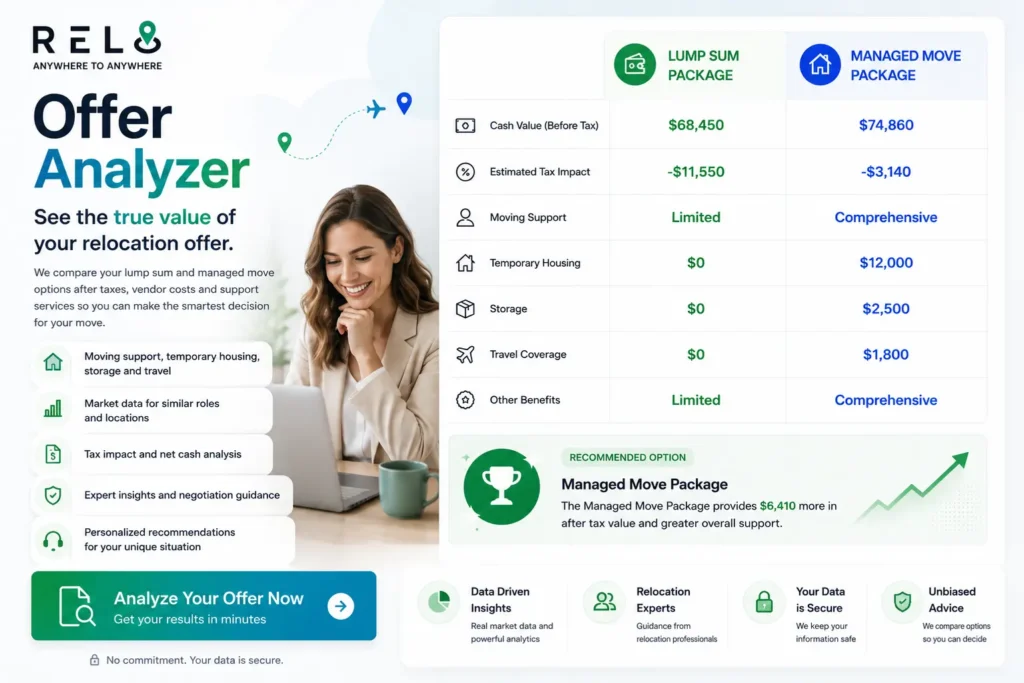
Then, book a FREE strategy call before responding to HR. Get expert guidance on your offer, identify gaps, and prepare stronger questions for your negotiation.