
Jobs That Offer Relocation Assistance Pay You to Start Fresh Anywhere - Relocation
AI Workers Are the New Expats: Where Tech’s Hottest Talent Is Landing - Relocation
How to Find a Job in Miami and Thrive in the Sunshine State - Relocation
Athletic Trainers Relocation - Athletics
Doctor Relocation Timeline From Offer Letter to Hospital Onboarding - Medical
Top Cities for Female Physicians to Practice in the United States - Medical
Easy Relocation for Physicians - Medical
The Best Cities for Registered Nurses: Where Pay Meets Possibility - Medical
How Relocation Packages for Nurses Support Long-Term Career Moves - Medical
Relocating as a Traveling Nurse - Medical
10 Best Neobanks in the US That Fit Modern Financial Habits - Personal Finance
Corporate Credit Card vs. Business Credit Card: Which Option Is Appropriate for Business - Finance
Jobs That Offer Relocation Assistance Pay You to Start Fresh Anywhere - Relocation
AI Workers Are the New Expats: Where Tech’s Hottest Talent Is Landing - Relocation
How to Find a Job in Miami and Thrive in the Sunshine State - Relocation
Athletic Trainers Relocation - Athletics & Sports
Doctor Relocation Timeline From Offer Letter to Hospital Onboarding - Medical
Top Cities for Female Physicians to Practice in the United States - Medical
Easy Relocation for Physicians - Medical
The Best Cities for Registered Nurses: Where Pay Meets Possibility - Medical
How Relocation Packages for Nurses Support Long-Term Career Moves - Medical
Relocating as a Traveling Nurse - Medical
10 Best Neobanks in the US That Fit Modern Financial Habits - Personal Finance
Corporate Credit Card vs. Business Credit Card: Which Option Is Appropriate for Business - Finance


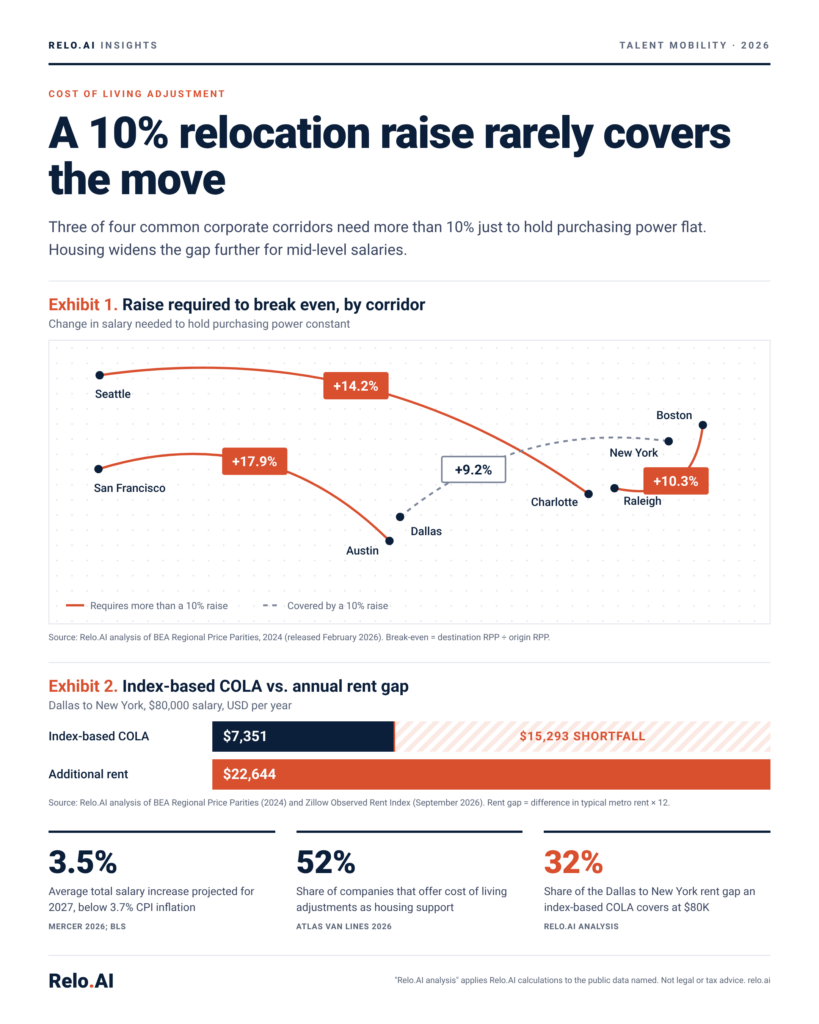
A 10% raise sounds generous until the first rent check clears. Move an employee from Dallas to New York on that offer and, by the federal government’s own price data, they’ve barely broken even. Move them on a $80,000 salary and the rent gap alone wipes out the raise nearly three times over. That’s the quiet problem with the cost of living adjustment in most relocation offers: it’s built on averages, and nobody lives in an average.
For HR and mobility leaders, this isn’t a payroll footnote. In Atlas Van Lines’ 2026 survey of 549 companies, 59% had at least one employee decline a relocation in 2025, and housing or mortgage concerns at the new location drove 28% of those declines (Atlas Van Lines). The same survey found that 52% of companies now offer cost of living adjustments as housing-related support. So the tool is common. The question is whether it’s calibrated.
Here’s how to tell if a raise actually covers the new city, and how to build a COLA that holds up.
The Raise Market Is Moving Slower Than Prices
Start with the baseline. Mercer’s July 2026 QuickPulse survey of 1,001 U.S. organizations projects average merit increases of 3.2% for 2027, and total salary increases of 3.5% once promotions and other adjustments are included (Mercer). “If projections hold, this will mark four consecutive years of moderate compensation increases,” said Tauseef Rahman, Marsh’s US Workforce Reward Solutions Leader.

THE RELO.AI DAILY NEWSLETTER
Daily Digest of Relocation News, Deals & Reviews
Subscribe for free and get proven relocation and travel strategies, personalized support, valuable rewards, and trusted reviews for every move.
Thank you for subscribing!
Your email has been added to our list.
Meanwhile, consumer prices rose 3.7% in the 12 months ending September 2026, with shelter up 3.2% (BLS). In other words, the typical annual raise doesn’t even keep a non-moving employee whole this year.
Now add a move. Relocation stacks a one-time price shock on top of ordinary inflation. An employee isn’t asking whether their raise beats 3.7%. They’re asking whether it beats 3.7% plus the difference between two cities. That’s a much bigger number, and it’s where offers quietly fail.
The Math Most Offer Letters Skip
The cleanest public benchmark is the Bureau of Economic Analysis’ Regional Price Parities (RPPs), which measure each metro’s price level against the national average of 100. The latest release, covering 2024, came out in February 2026 (BEA).
The formula is simple: new salary = current salary × (destination RPP ÷ origin RPP). Applied to common corporate corridors, a Relo.AI analysis of the BEA data shows how far the typical raise falls short:
| Move | Origin RPP | Destination RPP | Raise needed to break even | Salary needed on $150K |
| Austin to San Francisco | 98.1 | 115.6 | 17.9% | $176,800 |
| Charlotte to Seattle | 97.3 | 111.1 | 14.2% | $171,200 |
| Raleigh to Boston | 98.2 | 108.3 | 10.3% | $165,400 |
| Dallas to New York | 103.1 | 112.6 | 9.2% | $163,800 |
| San Francisco to Austin | 115.6 | 98.1 | -15.2% | $127,200 |
Source: Relo.AI analysis of BEA Regional Price Parities for 2024, accessed via FRED.
Two things stand out. First, a standard 10% relocation bump clears only one of these four upward moves. Second, the “break-even” number is a floor, not a target. It holds purchasing power flat. It doesn’t reward the employee for uprooting a family, which is the whole point of a move. If you want the full cost picture beyond salary, our breakdown of what companies pay for employee relocation is a good place to start.
Why Housing Breaks the Average
Here’s the flaw in every index-based cost of living adjustment. RPPs blend housing with groceries, gas and services. But housing varies far more than anything else. BEA’s housing rents parity runs from 54.2 in West Virginia to 154.3 in California, a spread of roughly 100 points (BEA). Bread doesn’t do that.
And rent is moving fast in exactly the markets companies are hiring into. Zillow’s September 2026 report puts typical rent at $3,445 in San Francisco, up 11.8% in a year, and $3,812 in San Jose, up 8.3% (Zillow). Austin sits at $1,603. Dallas is $1,659. New York is $3,546.
That creates a pattern most compensation teams miss. Because rent is a bigger share of a lower salary, a percentage-based COLA shortchanges the people who need it most. A Relo.AI analysis comparing RPP-based adjustments with Zillow’s typical rent gaps shows the problem:
| Move | Annual rent gap | RPP adjustment on $80K | Share of rent gap covered | RPP adjustment on $150K | Share covered |
| Dallas to New York | $22,644 | $7,351 | 32% | $13,784 | 61% |
| Raleigh to Boston | $15,816 | $8,239 | 52% | $15,448 | 98% |
| Austin to San Francisco | $22,104 | $14,314 | 65% | $26,840 | 121% |
Source: Relo.AI analysis of BEA Regional Price Parities (2024) and Zillow Observed Rent Index (September 2026).
Read that first row again. An $80,000 employee moving from Dallas to New York on an index-based adjustment covers only about a third of the rent difference, before a single subway fare. And for homeowners, the math gets worse. With 30-year mortgage rates at 7.28% at the end of September, the highest since November 2023, according to Freddie Mac data cited by Zillow, buying into a high-cost market can cost far more than renting. Bridging that gap often takes temporary housing or a housing stipend on top of any COLA.
How Companies Structure a Relocation COLA Today
Domestic cost of living assistance has settled into a recognizable shape. Aires’ Pulse Survey found that 84% of companies offering a COLA pay it through ongoing payments rather than one lump sum, usually over two to four years, with the amount declining each year (Aires). Only 8% paid a separate amount for high housing costs. NEI reports that three years with annual step-downs is the most common U.S. design, and that 44% of companies in its 2024 COLA survey set an eligibility threshold at a 5% cost difference (NEI Global Relocation).
The logic behind the phase-down is sound. A temporary COLA buys the employee time to adjust housing choices, while future merit increases and promotions are supposed to close the gap permanently. The weakness is that it assumes merit budgets keep pace. At 3.2%, they don’t in fast-rising markets like San Francisco. So check the tail end of your schedule against current rent growth, not the rent growth you saw when the policy was written.
The other common lever is a permanent geographic pay differential, where the employee simply moves onto the destination’s salary structure. That’s the right answer for a permanent transfer into a market you already staff. A temporary COLA is better when you’re testing a new location or moving someone for a two- or three-year project. Your domestic relocation policy should say which tool applies when, so it isn’t negotiated case by case.
A Five-Step Framework for a Fair Cost of Living Adjustment
Here’s a sequence that keeps the COLA defensible to finance and believable to the employee:
THE RELO.AI DAILY NEWSLETTER
Daily Digest of Relocation News, Deals & Reviews
Subscribe for free and get proven relocation and travel strategies, personalized support, valuable rewards, and trusted reviews for every move.
Thank you for subscribing!
Your email has been added to our list.
- Benchmark the corridor, not the city. Use origin-and-destination price data together, with a third-party index or BEA RPPs as the baseline. A destination number alone tells you nothing.
- Separate housing from everything else. Apply the index to non-housing spend, then price housing directly from current rents for the employee’s household size. This fixes the lower-earner gap shown above.
- Set a threshold and a cap. A 5% eligibility threshold, as 44% of NEI respondents use, avoids paying for noise. A cap protects the budget on executive moves.
- Phase it down on a published schedule. Three years at 100%, 66%, and 33% is a common pattern. Tie the schedule to a review date so it can be adjusted if rents spike.
- Account for taxes and communicate the net. COLA payments are taxable wages, and most employers don’t gross them up. Show the employee the after-tax number in the offer, not on their first paycheck.
This also belongs inside your broader relocation tier structure, so a COLA for a manager and a COLA for a new grad follow the same logic, even if the dollars differ.
Taxes and the Reverse Move
Taxes can widen or shrink the gap in ways a price index ignores. Texas levies no state income tax on wages, while California taxes them at graduated rates up to 13.3%. Under an illustrative Relo.AI model, a $176,800 salary in San Francisco carries roughly 7% in effective state income tax that the same employee never paid in Austin. That’s another $12,000 or so the break-even math has to absorb. Our guide to relocation bonus tax covers how federal withholding treats these payments, and moves late in the year should follow our year-end relocation tax planning checklist.
Then there’s the reverse move. When someone transfers from San Francisco to Austin, the index says their salary could fall 15% with no loss in purchasing power. Few companies cut pay that sharply, and for good reason. A pay cut on transfer reads as a penalty and can erode retention for years. A more common approach is to freeze base pay and let future increases run at the lower market rate. Either way, decide in advance, and write it into your relocation package guide.
FAQ
What is a cost of living adjustment for relocation?
It’s extra pay your employer gives you to offset higher prices in your new city. It can be a permanent salary increase or a temporary payment that steps down over two to four years.
How do you calculate a cost of living adjustment for a move?
Multiply your current salary by the destination’s price index and divide by your origin’s. BEA Regional Price Parities are a free, reliable starting point. Then price your housing separately, because rent varies far more than other costs.
Is a 10% raise enough to move to a more expensive city?
Sometimes. A 10% raise covers a Dallas to New York move on BEA data, but falls short for Austin to San Francisco, which needs about 18%. You can test your own move with the relocation calculator.
Is a relocation COLA taxable?
Yes. COLA payments are taxable wages, and most employers don’t gross them up. So ask for the after-tax amount before you accept the offer.
How long do relocation COLA payments last?
Most domestic COLAs last two to four years, with three years the most common. The payment usually declines each year as your merit increases are expected to catch up.
Can you negotiate your cost of living adjustment?
Yes, especially if you bring data. Show your employer the rent gap for your household size, not just the city index. Our job relocation support can help you build the case before you sign.
Will your salary go down if you move to a cheaper city?
It might. Some companies apply the lower market’s pay structure, while others freeze your pay until the market catches up. Ask which policy applies before you agree to the transfer.
Conclusion: Price the Move, Not the Average
A cost of living adjustment is only as good as the data behind it. With raises averaging 3.5% and inflation running at 3.7%, employees have little room to absorb a bad estimate. The fix isn’t a bigger number across the board. It’s a better method: benchmark the corridor, price housing directly, phase payments on a clear schedule and show the net after tax. Companies that do this spend their COLA dollars where they actually close the gap, and they lose fewer good people to a spreadsheet nobody checked.
THE RELO.AI DAILY NEWSLETTER
Daily Digest of Relocation News, Deals & Reviews
Subscribe for free and get proven relocation and travel strategies, personalized support, valuable rewards, and trusted reviews for every move.
Thank you for subscribing!
Your email has been added to our list.
Set Smarter COLAs With Relo.AI
Relo.AI turns cost-of-living guesswork into a defensible number. Our relocation calculator shows what a move really costs, corridor by corridor, in minutes.
Here’s how we help:
- For HR and mobility leaders. Our corporate relocation services help you set COLA thresholds, phase-down schedules and tier rules that hold up with finance, and keep mobility cost control tight as volume grows.
- For the relocating employee. Our personal relocation services help you find neighbourhoods and housing that fit the budget your offer actually supports.
- For anyone weighing an offer. Our job relocation support helps you check whether your raise covers the new city before you say yes.
Schedule a FREE consultation with us and call us at +1-617-333-8453.
Sources
- Atlas Van Lines: 59th Annual Corporate Relocation Survey (2026)
- Mercer: US Employers Stick With Moderate Pay Increases for 2027
- S. Bureau of Labor Statistics: Consumer Price Index, September 2026
- S. Bureau of Economic Analysis: Real Personal Income and Regional Price Parities, 2024
- FRED: Regional Price Parities by Metropolitan Area
- Zillow: September 2026 Market Report
- Aires: Checking the Pulse of U.S. Domestic Cost-of-Living Assistance
- NEI Global Relocation: COLA Benefit Maintenance