
Jobs That Offer Relocation Assistance Pay You to Start Fresh Anywhere - Relocation
AI Workers Are the New Expats: Where Tech’s Hottest Talent Is Landing - Relocation
How to Find a Job in Miami and Thrive in the Sunshine State - Relocation
Athletic Trainers Relocation - Athletics
Doctor Relocation Timeline From Offer Letter to Hospital Onboarding - Medical
Top Cities for Female Physicians to Practice in the United States - Medical
Easy Relocation for Physicians - Medical
The Best Cities for Registered Nurses: Where Pay Meets Possibility - Medical
How Relocation Packages for Nurses Support Long-Term Career Moves - Medical
Relocating as a Traveling Nurse - Medical
10 Best Neobanks in the US That Fit Modern Financial Habits - Personal Finance
Corporate Credit Card vs. Business Credit Card: Which Option Is Appropriate for Business - Finance
Jobs That Offer Relocation Assistance Pay You to Start Fresh Anywhere - Relocation
AI Workers Are the New Expats: Where Tech’s Hottest Talent Is Landing - Relocation
How to Find a Job in Miami and Thrive in the Sunshine State - Relocation
Athletic Trainers Relocation - Athletics & Sports
Doctor Relocation Timeline From Offer Letter to Hospital Onboarding - Medical
Top Cities for Female Physicians to Practice in the United States - Medical
Easy Relocation for Physicians - Medical
The Best Cities for Registered Nurses: Where Pay Meets Possibility - Medical
How Relocation Packages for Nurses Support Long-Term Career Moves - Medical
Relocating as a Traveling Nurse - Medical
10 Best Neobanks in the US That Fit Modern Financial Habits - Personal Finance
Corporate Credit Card vs. Business Credit Card: Which Option Is Appropriate for Business - Finance


A relocation vendor scorecard is how HR, procurement and the CFO pick the vendor that actually gets your people moved, not just the one with the cheapest bid. It rates every vendor on service outcomes, total cost, response times and claims, then rolls those scores into one number you can defend.
Here’s why that matters. Three vendors answer your RFP, and one quotes a fee 20% below the rest. Procurement loves it, and so does finance. Six months later, though, your new VP of Engineering is stuck in a corporate apartment for two extra weeks. Her piano arrived with a cracked soundboard, and the claim is still “under review.” As a result, the fee savings are gone after the first exception request.
This happens all the time, and it’s not because HR teams are careless. Instead, it happens because most selections compare the one number that’s easy to compare: the fee. Everything else gets judged on gut feel. A weighted relocation vendor scorecard fixes that, so everyone signs off on the same answer.
Below, you’ll learn how to build one that predicts which vendor will make your moves go well. You’ll also see a worked example where the “cheapest” vendor finishes dead last.
Why Price Alone Is the Wrong Way to Pick a Relocation Vendor
Relocation is expensive, so cost pressure is real. Relo.AI’s planning ranges put a senior homeowner move at about $55,000 to $90,000 or more. Meanwhile, a mid-level move runs $15,000 to $35,000, and an early-career renter move runs $5,000 to $15,000 (see our 2026 relocation package guide). Budgets are also growing. Atlas Van Lines surveyed 549 company leaders for its 59th annual Corporate Relocation Survey. It found that 61% of companies expect bigger relocation budgets in 2026 (Transport Topics).

THE RELO.AI DAILY NEWSLETTER
Daily Digest of Relocation News, Deals & Reviews
Subscribe for free and get proven relocation and travel strategies, personalized support, valuable rewards, and trusted reviews for every move.
Thank you for subscribing!
Your email has been added to our list.
So yes, the CFO will ask about price. However, the real question is which price. A relocation management company (RMC) can earn money in more ways than its fee. For example, it may take supplier markups, broker referral fees or commissions on household goods moves. Some vendors even charge suppliers to join their network. Because of this, relocation isn’t something you can buy off a rate card. You also have every right to ask a vendor exactly how it makes money on your program.
The hidden cost is people. The same Atlas survey found that 46% of companies saw more employees decline relocation offers in 2025. In addition, 59% had at least one employee turn one down (Atlas Van Lines; Transport Topics). In many cases, those failures start with a vendor that couldn’t flex or didn’t pick up the phone. Others, meanwhile, start with a damage claim that never got paid. Our guide to relocation challenges for HR leaders covers the knock-on effects.
In short, a low fee from a vendor that loses you one senior hire is the most expensive deal you’ll sign all year.
What a Relocation Vendor Scorecard Should Measure
A good relocation vendor scorecard does three jobs. First, it makes your team agree on what matters before the sales pitches start. Second, it turns gut feel into numbers you can defend in a budget meeting. Finally, it gives you a baseline to hold the winner to after you sign.
Most scorecards fail because they list twenty criteria with equal weight. But equal weight is a choice too, and usually a bad one. Procurement research firm SpendEdge makes the same point about supplier scorecards in general. It advises weighting KPIs by priority, so “if cost reduction is a priority, cost-related metrics should be heavily weighted” (SpendEdge).
Instead of a long list, group your criteria into six categories. Then define what a 1 and a 5 look like for each one. Here’s the relocation vendor scorecard we suggest as a starting point for a domestic program with both homeowners and renters:
| Category | Weight | What to measure | What a “5” looks like |
| Service outcomes and transferee experience | 30% | Post-move satisfaction, on-time move-in, temp housing overstays, home sale results | Transferee satisfaction of 90%+ and nearly every move-in on the planned date |
| Total program cost and pricing transparency | 25% | All-in cost per move by tier, markups, referral fee sharing, invoice accuracy | Pass-through pricing, rebates shared, fewer than 1% of invoices disputed |
| Responsiveness and response times | 15% | Time to first contact, inquiry response time, escalation time, after-hours coverage | First contact within one business day; urgent issues answered within two hours |
| Claims and household goods performance | 15% | Claims frequency, average claim cost, days to settle, delivery on time | Claims on a small share of shipments, settled well inside federal timelines |
| Technology, tax accuracy and reporting | 10% | Gross-up and W-2 error rate, expense reimbursement time, dashboards, HRIS integration | Near-zero tax errors and reimbursements paid within a week |
| Account management and strategic fit | 5% | Dedicated account lead, quarterly reviews, policy advice, client references | Proactive policy and cost recommendations every quarter |
How to Calculate Your Relocation Vendor Scorecard Total
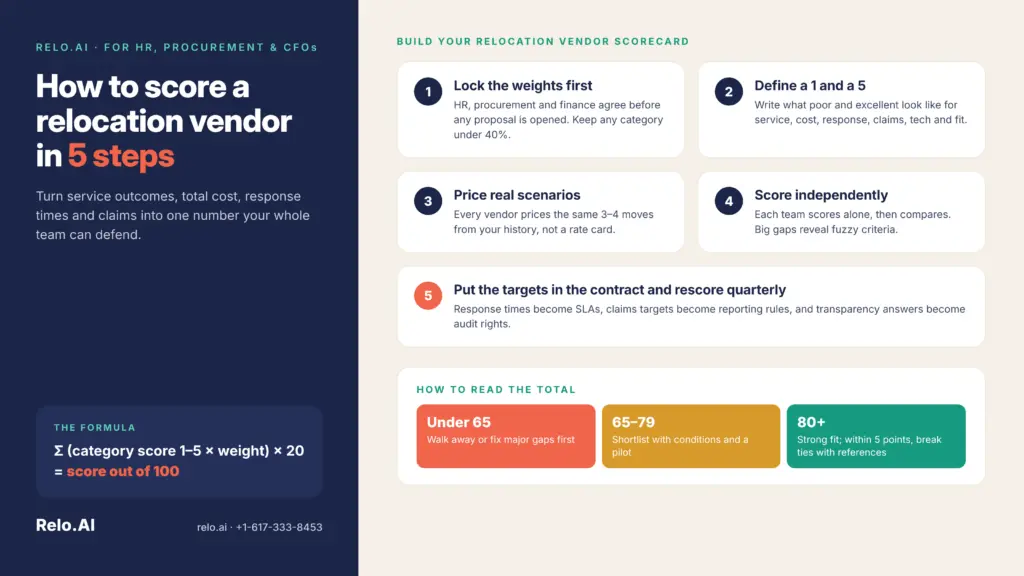
The math, however, is simple. Score each category from 1 to 5 and multiply it by its weight. Next, add the results and multiply by 20 to get a score out of 100.
Keep in mind that the “what a 5 looks like” column shows our suggested targets. They are not industry rules, so adjust them to your own history. Also, score current vendors on their actual reports rather than their marketing claims.
The rest of this guide walks through each category. After that, it shows how the weights shift depending on who’s in the room.
Related – The Hidden Cost of Relocating a Business
Service Outcomes – The Biggest Slice of Your Relocation Vendor Scorecard
Service outcomes carry the most weight because they’re the reason you hire a vendor at all. A vendor’s job is to get a person and a household settled in a new city with as little friction as possible. So measure that directly.
Transferee Satisfaction and Timelines
Ask for post-move survey results by service line, not one blended score. That means separate scores for the move coordinator, household goods, temporary housing, home sale and destination services.
Why insist on data? A J.D. Power transferee study, now old but still useful, found that only 57% of transferees had a positive relocation experience. Even worse, only about 54% said their belongings arrived on time and undamaged (HR Reporter, 2007). Testimonials won’t show you numbers like that, but survey data will.
Next, track how many employees start work and move into permanent housing on the planned date. Temporary housing overstays are the clearest sign of a vendor that’s slipping. They’re also expensive, so watch them closely. If your policy includes corporate housing, read our comparison of corporate housing vs. a housing stipend. Our guide to temporary housing during a relocation also explains where overstays come from.
Home Sales and Family Support
For homeowner programs, real estate results tend to track closely with how employees feel about the whole move. Therefore, score days on market, sale-to-list ratio and the share of homes that end up in inventory. If you run a buyout program, read our explainer on BVO vs. GBO first. Our overview of relocation home sale programs is also worth a look, since the program structure changes what “good” looks like.
Family matters just as much, too. Atlas found that family ties were the top reason employees declined a move (34%). Housing worries at the destination came next (28%). Vendors that handle the human side well earn their score here. That includes school searches, dual-career support, moving with teenagers and pet transport. As always, ask for examples rather than promises.
Total Program Cost – Look Past the Management Fee
On a relocation vendor scorecard, the cost category should never be “lowest fee wins.” Instead, score the total cost of a typical move in each policy tier. Then score how clearly the vendor shows you where the money goes.
Price Real Scenarios, Not Rate Cards
Start by asking every vendor to price the same three or four scenarios from your own history. For example, use an executive homeowner moving across the country, a mid-level renter and a new grad with a lump sum. You might add an international assignee too. Identical scenarios also beat rate cards, because rate cards are built to look cheap. For a starting point, see our guide to what companies pay for employee relocation. The Relo.AI relocation calculator will also get you realistic numbers fast.
After that, dig into transparency. Ask whether the vendor or its suppliers collect referral fees on home sales and purchases. Next, find out if those fees are disclosed and shared. Similarly, check whether household goods moves or appraisals carry markups. Then ask one more sharp question: does the pricing make inventory homes more profitable for the vendor than amended value sales? If so, the vendor’s incentives and yours point in different directions.
Cost Items to Score
- All-in cost per scenario, including fees, supplier costs and the expected tax gross-up.
- Pricing model. Pass-through pricing with disclosed fees scores higher than bundled pricing with hidden margins.
- Referral fee and rebate sharing. Credits returned to you or the employee lower your real cost.
- Invoice accuracy. Ask what share of invoices were disputed or corrected last year, because billing errors eat HR and accounts payable time.
- Exception management. Policy exceptions are routine. However, a vendor that tracks and reports them helps you control them, while one that just approves them is a cost leak.
The CFO’s favorite question belongs here too. What does this vendor do to make spending more predictable? For the full playbook, see our guide to mobility cost control and our piece on relocation ROI.
If you’re weighing a lump sum against managed moves, our lump sum vs. managed move comparison shows how the vendor’s role changes.
How Should You Score Response Times on Your Relocation Vendor Scorecard?
Fast replies matter to employees. Yet many HR teams fail to track them.
Think of an employee whose home closing is on Friday. It’s now Wednesday, and the relocation vendor has not replied to an urgent email. A high satisfaction score means little at that point.
That’s why response times need their own weight on your relocation vendor scorecard. The contract should also set clear service targets.
Here are six key areas to track:
- First contact: How soon does the vendor reach out after a move starts? One business day is a fair target for a domestic move.
- Employee questions: How many business hours does it take to get a reply? Ask the vendor to report these times each month.
- Urgent issues: For temporary housing, aim for a reply within two hours. Employees should also get access details at least 48 hours before check-in.
- Escalation time: How long does it take to fix a complaint? Also, track how often HR needs to step in.
- Weekend support: Home closings, lease signings, and moving days often fall on weekends. Make sure employees can reach someone who has the power to help.
- Expense reimbursement: Slow payments can leave employees short of cash for weeks. Our guide on getting relocation receipts reimbursed faster explains what employees should expect.
Don’t judge response times by a sales demo alone. Speak with current clients and test the employee helpline yourself. If you already use the vendor, check its monthly service reports.
Keep in mind that vendors often put their best foot forward during the RFP process. If they struggle to reply on time now, that’s a warning sign.
Claims – Household Goods Damage and How Fast It Gets Fixed
Nothing sours a move faster than a damaged dining table followed by four months of paperwork. That’s why claims get their own category. They measure two things at once: how well the movers handle goods, and how hard the vendor fights for your employee when they don’t.
Federal rules set the outer limits. Under Federal Motor Carrier Safety Administration guidance, a shipper has nine months from delivery to file a loss or damage claim. The mover must then acknowledge it within 30 days. After that, it has 120 days to respond with a settlement offer.
That said, coverage matters as well. Released value protection pays only 60 cents per pound per item. So a 50-pound TV would yield a $30 settlement, while full value protection covers replacement value (FMCSA). In other words, a vendor that’s merely compliant with these rules is not a vendor you want.
Also read – 30 Questions to Ask Before Buying a House That Defines Your Future
Claims Metrics to Score
- Claims frequency: the share of household goods shipments with at least one claim.
- Average claim cost, tracked over time, so you can see whether damage is getting more or less expensive.
- Days to settle: the average time from filing to payment. Strong vendors settle well inside 120 days.
- Valuation coverage: whether your program buys full value protection by default.
- On-time delivery, measured against the date promised to the employee.
- Carrier oversight: how the vendor rates its own movers, and what happens to one after a bad quarter.
On-time delivery and damage claims also tend to move in step with employee satisfaction. As a result, claims data works as an early warning. When it slips, your satisfaction scores are next.
Technology, Tax Accuracy and Reporting
Ten percent may sound low for technology. Still, this category carries more risk than its weight suggests, because tax errors land on employees’ W-2s and on your payroll team.
Ask every vendor for its error rate on U.S. tax gross-up calculations. Also ask how many W-2s it corrected last year. Relocation benefits are generally taxable income, so a wrong gross-up creates a mess that shows up months after the move. Our explainer on relocation bonus taxes covers why this matters to employees.
Beyond tax, score these items –
- Employee portal and mobile access, with real-time status tracking.
- Client dashboards that show cost by tier, exceptions, satisfaction and cycle times without a custom report.
- HRIS and payroll integration, so payroll submissions are on time and accurate.
- Data security and privacy controls, since the vendor holds sensitive employee and family data.
- AI and automation, judged on results. Every vendor now claims AI. So ask what their automation has improved, in numbers, such as faster expense processing or fewer errors.
Good reporting makes every other category on your relocation vendor scorecard easier to measure. If a vendor can’t produce the data to score itself, then score it low.
THE RELO.AI DAILY NEWSLETTER
Daily Digest of Relocation News, Deals & Reviews
Subscribe for free and get proven relocation and travel strategies, personalized support, valuable rewards, and trusted reviews for every move.
Thank you for subscribing!
Your email has been added to our list.
How to Weight a Relocation Vendor Scorecard for HR, Procurement and the CFO
This is where most vendor reviews quietly fall apart. HR, procurement and finance usually care about different things. If you don’t settle the weights before the pitches, each group will back the vendor that scored best on its favorite metric.
HR and mobility lean toward service outcomes and responsiveness. After all, they field the angry emails and own the employee experience.
Procurement pushes for pricing transparency, contract terms and SLAs with teeth, because it has to defend the contract.
The CFO wants predictable, all-in costs. Above all, finance wants proof that the program improves offer acceptance and retention.
Still, none of them is wrong. The fix is to agree on weights as a group and write them down. Then lock them before you open a single proposal.
Adjust Weights to Your Program
Once you set the base weights, adjust them to match your relocation program. Each type of move comes with different needs and risks.
- Executive homeowner programs: Give more weight to service quality and home sale results. A failed executive move can cost far more than the price difference between two vendors.
- High-volume new hire and intern programs: Focus more on cost, technology, and response times. These programs need simple processes that work well at scale. Our guides to corporate relocation tier structures, core-flex relocation policy, and intern relocation stipends explain how these programs work.
- Group moves and office relocations: Give more weight to fast replies and account support. These moves involve many people, tight schedules, and several tasks at once. Good planning and clear updates are vital. Read our guide to group relocation for more details.
- Global programs: Add a category for immigration rules and legal compliance. Atlas reported that 94% of companies moving staff abroad saw a budget impact from the new $100,000 H-1B fee. Our guide to domestic relocation policy vs. global mobility policy explains the key differences.
Finally, keep each category below 40% of the total score. If one area carries too much weight, your relocation vendor scorecard loses its balance. You may end up choosing a vendor based mainly on price or presentation instead of overall value.
Relocation Vendor Scorecard Example – Scoring Three Vendors
To see how weights change outcomes, here’s an example using the weights above. Note, however, that the vendors and scores are made up. Vendor A has the lowest fee but slow response times and a poor claims record. Vendor B leads on service at a higher price. Meanwhile, Vendor C sits in the middle on price, with excellent claims handling and strong account management.
| Category (HR weight) | Vendor A | Vendor B | Vendor C |
| Service outcomes (30%) | 3 | 5 | 4 |
| Total cost and transparency (25%) | 5 | 3 | 4 |
| Responsiveness (15%) | 2 | 5 | 4 |
| Claims performance (15%) | 2 | 4 | 5 |
| Technology and tax accuracy (10%) | 3 | 4 | 3 |
| Account management and fit (5%) | 3 | 4 | 5 |
| Weighted score with HR weights (out of 100) | 64 | 84 | 82 |
| Weighted score with CFO weights (out of 100) | 69 | 80 | 82 |
Under the HR weights, the cheapest vendor finishes last by a wide margin. Meanwhile, Vendor B edges out Vendor C. Now switch to CFO-leaning weights: cost at 35%, service at 25% and responsiveness at 10%, with the rest unchanged. Vendor A climbs to 69 but still finishes last. Vendor C, on the other hand, moves into first place at 82, just ahead of Vendor B at 80.
That’s the point of a relocation vendor scorecard. The lowest fee rarely survives an honest weighting. Also, the gap between the top two vendors is often small enough that your weights pick the winner. That’s exactly why everyone has to agree on the weights before anyone sees a proposal.
When the top scores land within about five points, don’t treat the scorecard as the final word. Use it to narrow the field. Then let reference calls, a pilot and contract terms break the tie.
Running the Relocation Vendor Scorecard After You Sign
A relocation vendor scorecard isn’t a one-time selection tool. Used well, it becomes the backbone of the whole relationship.
Before and During the RFP
Before the RFP, pull two years of your own data. That includes volume by tier, average cost per move, cycle times, home sale results, household goods costs and satisfaction scores. Hand it to bidders so their pricing reflects your real program. If your data is thin, a corporate relocation consultant can help you pull it together.
During the review, have at least one person each from HR, procurement and finance score every vendor on their own. Then compare notes. Big gaps between scorers are useful, because they usually reveal a criterion nobody defined clearly.
Before signing, turn your scorecard targets into contract terms. Response times become SLAs, and claims targets become reporting rules. Likewise, transparency answers become audit rights. If a vendor won’t commit to measuring what you scored, that tells you something.
After Go-Live
Once the contract starts, rescore the vendor every quarter. Use its own reports, and check them against your employee surveys. Then share the results in quarterly business reviews. Vendors improve fast when they know exactly how they’re measured. Plus, you’ll have a clear record if you ever need to rebid.
Short pulse surveys also help. Run them at key points in each move, such as kickoff, move day and 30 days after arrival. That way, you can fix service problems while they’re still fixable. Also track what happens to relocated employees afterwards. Our piece on building a relocation talent pipeline explains why retention after the move is the metric most programs forget.
Red Flags That Should Override the Score
Some findings shouldn’t just lower a vendor’s score. Instead, they should end the conversation, whatever the total.
- It won’t explain how it makes money. If you can’t get a straight answer on markups, referral fees and network fees, assume they’re large.
- No data on claims or satisfaction. After all, a vendor that can’t report its own results can’t manage them.
- Only brand-new clients as references. Instead, ask for a client of three years or more, plus one that left.
- Ownership or merger uncertainty. Ask who owns the vendor and whether a merger is underway, since service models often change mid-transition.
- Supplier networks nobody vets. As one HR buyer’s checklist put it, “A vendor that cannot clearly answer these questions may be outsourcing your employees to unvetted third parties” (FingerLakes1).
- Pressure to sign before a pilot. For a large program, a short pilot on a handful of moves is a fair ask. So a vendor that resists it is protecting something.
Recommended read – Relocation Offer Red Flags: 9 Clauses That Should Worry You
Build a Smarter Relocation Vendor Scorecard With Relo.AI
A relocation vendor scorecard only works when the numbers behind it are real. That’s where Relo.AI comes in. We give HR, procurement and finance teams the data to set realistic targets and hold vendors to them. Price real move scenarios with the relocation calculator and the global relocation estimator. Then benchmark packages against our 2026 relocation package guide, and use our other relocation tools to test your cost assumptions before the RFP goes out.
Want hands-on help? Our corporate relocation services team works with HR and mobility leaders to design policies and build a relocation vendor scorecard that fits. We also help turn your criteria into contract terms that protect both your budget and your people.
Schedule a FREE consultation with us and call us at +1-617-333-8453.
THE RELO.AI DAILY NEWSLETTER
Daily Digest of Relocation News, Deals & Reviews
Subscribe for free and get proven relocation and travel strategies, personalized support, valuable rewards, and trusted reviews for every move.
Thank you for subscribing!
Your email has been added to our list.
Frequently Asked Questions (FAQ)
1. What is a relocation vendor scorecard?
A relocation vendor scorecard is a weighted tool for rating a relocation management company or moving supplier. It scores categories such as service outcomes, total cost, response times, claims and technology. Each category gets a weight and a score. As a result, they produce one number that HR, procurement and finance can compare and defend.
2. What criteria should HR use to evaluate a corporate relocation vendor?
The core criteria are service outcomes, all-in cost and pricing transparency, responsiveness, claims performance, tax accuracy, reporting and account management. Global programs should also add immigration and compliance.
3. How should you weight a relocation vendor scorecard?
A balanced start is 30% service outcomes, 25% cost, 15% responsiveness, 15% claims, 10% technology and tax accuracy, and 5% account management. Then adjust for your program. For example, raise service for executive moves or cost for high-volume new hire programs. Either way, keep any single category under 40%.
4. What KPIs should a relocation vendor report?
Ask for satisfaction by service line, on-time move-ins, temporary housing overstays and home sale days on market. You should also get claims frequency, settlement time, invoice accuracy, reimbursement time, tax error rates and exceptions by policy tier.
5. How long does a mover have to resolve a household goods claim?
Under FMCSA guidance, an employee has nine months from delivery to file a claim. The mover must acknowledge it within 30 days and then respond with a settlement offer within 120 days. Strong vendors settle well inside that window.
6. How often should we update our relocation vendor scorecard?
Quarterly works for most programs, so tie it to business reviews. Rescore using the vendor’s reports and check them against your employee surveys. Also run a full competitive review every three to five years, or sooner if scores slide for two quarters in a row.
Bottom Line
Picking a relocation vendor on fee alone is how companies end up paying more for worse moves. A weighted relocation vendor scorecard puts service, cost, response times and claims on the same page. It also gets HR, procurement and the CFO to agree on what matters before the pitches start. So build it before the RFP, write its targets into the contract and rescore every quarter. Your employees will feel the difference long before finance sees it in the numbers.
Sources –
- Transport Topics: Atlas Survey Signals Confidence in Corporate Relocation (2026)
- Atlas Van Lines: 59th Annual Corporate Relocation Survey (2026)
- SpendEdge: Supplier Scorecards, Best Practices for Effective Procurement
- FMCSA: Discovered Loss or Damage
- HR Reporter: J.D. Power Corporate Relocation Transferee Satisfaction Study (2007)
- FingerLakes1: How to Evaluate a Relocation Management Company, a Checklist for HR Buyers (2026)