
Jobs That Offer Relocation Assistance Pay You to Start Fresh Anywhere - Relocation
AI Workers Are the New Expats: Where Tech’s Hottest Talent Is Landing - Relocation
How to Find a Job in Miami and Thrive in the Sunshine State - Relocation
Athletic Trainers Relocation - Athletics
Doctor Relocation Timeline From Offer Letter to Hospital Onboarding - Medical
Top Cities for Female Physicians to Practice in the United States - Medical
Easy Relocation for Physicians - Medical
The Best Cities for Registered Nurses: Where Pay Meets Possibility - Medical
How Relocation Packages for Nurses Support Long-Term Career Moves - Medical
Relocating as a Traveling Nurse - Medical
10 Best Neobanks in the US That Fit Modern Financial Habits - Personal Finance
Corporate Credit Card vs. Business Credit Card: Which Option Is Appropriate for Business - Finance
Jobs That Offer Relocation Assistance Pay You to Start Fresh Anywhere - Relocation
AI Workers Are the New Expats: Where Tech’s Hottest Talent Is Landing - Relocation
How to Find a Job in Miami and Thrive in the Sunshine State - Relocation
Athletic Trainers Relocation - Athletics & Sports
Doctor Relocation Timeline From Offer Letter to Hospital Onboarding - Medical
Top Cities for Female Physicians to Practice in the United States - Medical
Easy Relocation for Physicians - Medical
The Best Cities for Registered Nurses: Where Pay Meets Possibility - Medical
How Relocation Packages for Nurses Support Long-Term Career Moves - Medical
Relocating as a Traveling Nurse - Medical
10 Best Neobanks in the US That Fit Modern Financial Habits - Personal Finance
Corporate Credit Card vs. Business Credit Card: Which Option Is Appropriate for Business - Finance
Jobs That Offer Relocation Assistance Pay You to Start Fresh Anywhere - Relocation
AI Workers Are the New Expats: Where Tech’s Hottest Talent Is Landing - Relocation
How to Find a Job in Miami and Thrive in the Sunshine State - Relocation
Athletic Trainers Relocation - Athletics & Sports
Doctor Relocation Timeline From Offer Letter to Hospital Onboarding - Medical
Top Cities for Female Physicians to Practice in the United States - Medical
Easy Relocation for Physicians - Medical
The Best Cities for Registered Nurses: Where Pay Meets Possibility - Medical
How Relocation Packages for Nurses Support Long-Term Career Moves - Medical
Relocating as a Traveling Nurse - Medical
10 Best Neobanks in the US That Fit Modern Financial Habits - Personal Finance
Corporate Credit Card vs. Business Credit Card: Which Option Is Appropriate for Business - Finance
Jobs That Offer Relocation Assistance Pay You to Start Fresh Anywhere - Relocation
AI Workers Are the New Expats: Where Tech’s Hottest Talent Is Landing - Relocation
How to Find a Job in Miami and Thrive in the Sunshine State - Relocation
Athletic Trainers Relocation - Athletics & Sports
Doctor Relocation Timeline From Offer Letter to Hospital Onboarding - Medical
Top Cities for Female Physicians to Practice in the United States - Medical
Easy Relocation for Physicians - Medical
The Best Cities for Registered Nurses: Where Pay Meets Possibility - Medical
How Relocation Packages for Nurses Support Long-Term Career Moves - Medical
Relocating as a Traveling Nurse - Medical
10 Best Neobanks in the US That Fit Modern Financial Habits - Personal Finance
Corporate Credit Card vs. Business Credit Card: Which Option Is Appropriate for Business - Finance

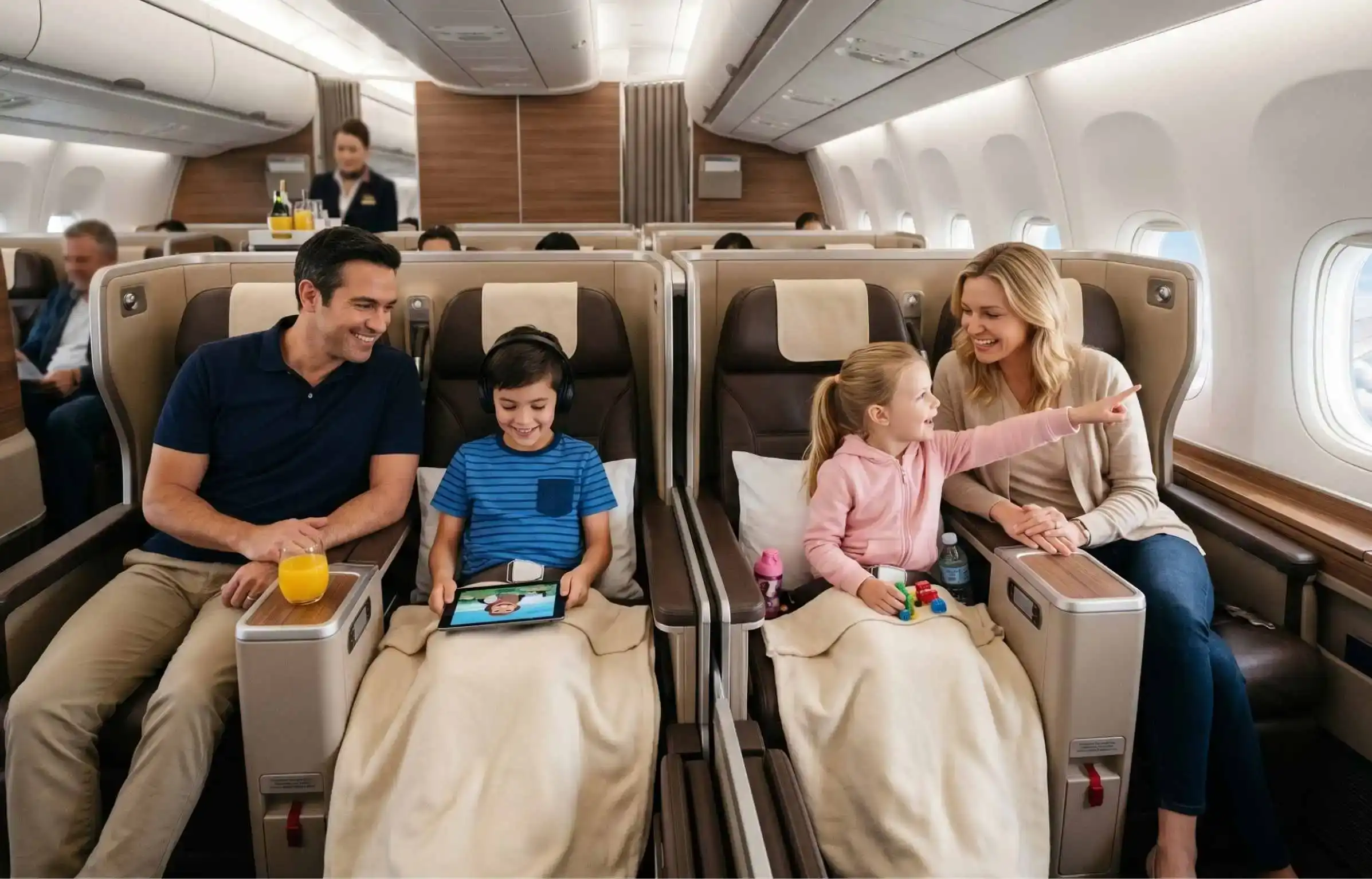
Flying first class with children can sound unrealistic until you understand how to fly first class with kids on points and how award travel works. Premium cabins can cost thousands in cash, but points can make lie-flat seats, lounge access, priority boarding, and extra space possible. Families need more strategy. Finding several first-class award seats takes flexible dates, smart routing, and the right loyalty program. Demand is also working against travelers. IATA reported that global passenger demand rose 5.3% in 2025, while the full-year passenger load factor reached a record 83.6%. That means planes are fuller, and premium award seats are harder to find (IATA).
TSA also screened 904 million passengers in 2024, more than 5% above 2023, showing how crowded U.S. travel has become (PR Newswire). Still, families can do it. The goal is not to chase luxury for its own sake. It is to use points wisely so parents and kids arrive rested, safer, and less stressed.
This guide explains how to fly first class with kids, including how to earn points faster, find multiple award seats, choose family-friendly programs, avoid common booking mistakes, and prepare children for premium cabins.
1. Start with Realistic Expectations
The first rule of how to fly first class with kids on points is simple. You are not booking like a solo traveler.

THE RELO.AI DAILY NEWSLETTER
Daily Digest of Relocation News, Deals & Reviews
Subscribe for free and get proven relocation and travel strategies, personalized support, valuable rewards, and trusted reviews for every move.
Thank you for subscribing!
Your email has been added to our list.
A single adult can grab one last-minute award seat and call it a win. A family may need three or four seats together, plus predictable timing, safe connections, and child-friendly policies. This is why flexibility matters more than loyalty to one airline.
In addition, Airlines for America expected U.S. airlines to carry a record 52.6 million passengers during the 2025 winter holiday travel period, averaging about 2.9 million passengers per day (Airlines).
Parents should search several departure airports, consider nearby arrival cities, and compare nonstop flights against better premium cabin availability. A family in New York, for example, may need to search from JFK, Newark, Boston, Philadelphia, and Washington, D.C. if the destination is competitive.
Related – A Comprehensive Guide to Flying Business Class for the First Time
2. Build Points in Flexible Currencies
The best family award trips usually begin with flexible points, not airline-specific miles. Flexible points from major credit card programs can often transfer to multiple airlines and hotel programs, giving families more ways to find premium award seats.
This matters because first-class availability changes constantly. One airline may show nothing, while a partner program may show seats on the same aircraft for fewer miles. Keeping points flexible until you are ready to book protects you from devaluations and limited availability.
The practical rule for how to fly first class with kids on points is to earn in a flexible program first, then transfer only when you find confirmed award space.
3. Best Credit Cards to Build Points for First Class Family Travel
Families learning how to fly first class with kids on points should focus on travel credit cards that earn flexible rewards. These points can often be transferred to airline and hotel partners, giving parents more options when searching for multiple premium cabin seats on the same flight.
The right card depends on your household spending. Some families earn faster through dining and groceries, while others benefit more from travel, rent, or everyday purchases.
| Credit card | Best for | Points or travel value | How it helps families fly first class on points | Card Link |
| Chase Sapphire Preferred® Card | Families starting with travel rewards | Flexible Chase Ultimate Rewards points | A strong starter card for building transferable points for airline and hotel partners | Apply Now |
| Chase Freedom Flex® | Families earn points from everyday spending | Chase Ultimate Rewards points | Builds points through bonuses, dining, drugstores, and Chase Travel | Apply Now |
| Capital One Venture X Rewards Credit Card | Premium travel perks | Flexible Capital One miles | Useful for families who want simple earnings, lounge-style benefits, and transfer partner options | Apply Now |
| Capital One Venture Rewards Credit Card | Flat-rate travel rewards | Miles on everyday purchases | Good for families who want simple rewards without managing many bonus categories | Apply Now |
| American Express® Business Gold Card | Dining and grocery-heavy households | Membership Rewards points | Useful for families earning points through everyday food spending before transferring to airline partners | Apply Now |
| The Business Platinum Card® from American Express | Premium flights and airport benefits | Membership Rewards points and premium travel perks | Best suited for families who travel often and can use airfare, lounge, and travel benefits | Apply Now |
4. Use Family Pooling Where It Helps
Some loyalty programs make family travel easier by allowing members to combine points. British Airways says its Household Account lets up to six people pool Avios, and children can join, so everyone in the family can collect Avios when they fly (British Airways). United also allows MileagePlus members to pool miles with friends and family without transfer fees (United Airlines).
Flying Blue offers family benefits through its Air France and KLM loyalty program, including options for family accounts and youth benefits (flyingblue.com). Air Canada Aeroplan also promotes Family Sharing as a way to combine points with family members for free (Air Canada).
Pooling is especially useful when parents have points spread across several accounts. A child’s small mileage balance may not book a ticket alone, but in a family pool, it can help close the gap.
5. Search for Seats Before Transferring Points
This is where many families lose money.
Credit card points transfers are usually one-way. Once you move points to an airline, you may not be able to move them back. So, before you transfer, check the route, date, cabin, number of seats, taxes, and infant rules.
For families, the search should include every traveler. Do not assume one open first-class seat means four seats are available. Airlines often release premium award seats in small batches.
A simple workflow helps when planning how to fly first class with kids on points. Search for one seat first to check the price. Then search for the full family. After that, call or chat with the airline if you need to add an infant or child ticket.
6. Know the Difference Between First Class and Business Class
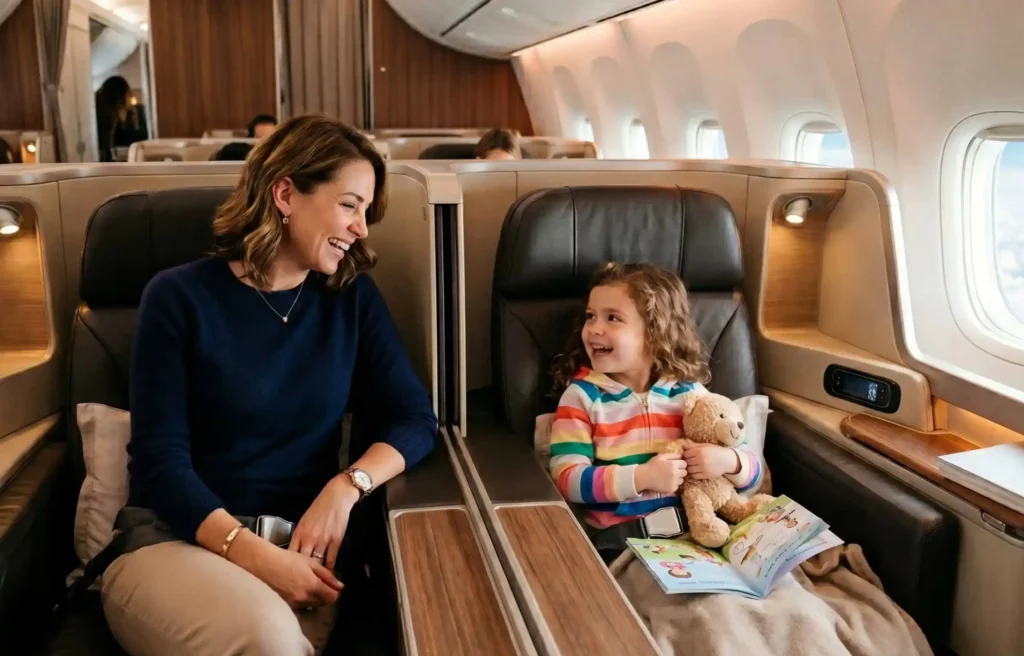
In the United States, “first class” often means a wider seat at the front of the plane. It may not include a bed or private space.
On long-haul international flights, first class is different. It can include a private suite, better meals, premium lounges, and more personal service. For families, this extra space can make a long trip feel calmer and easier.
For families learning how to fly first class with kids on points, international business class may be the smarter choice. It often has more award seats. It also has more cabin space for families.
Many seats still turn into lie-flat beds, which can help children sleep on long flights. A true international first class is harder to find. It may also be harder to book when you need seats for several passengers.
The better question is not always “How do we fly first class?” It is “Which premium cabin gives our family the most rest for the fewest points?”
7. Book Early, then Keep Checking
Premium cabins are competitive. So, families should start early. Try to search 10 to 12 months before departure when possible. This matters most for school holidays, summer trips, spring break, and December travel.
Still, early booking is not the only option. Some airlines release award seats close to departure. This can help if your dates are flexible. However, it can feel risky for families. Parents with school-age kids may prefer to book early. Families with younger children may have more room to wait.
After you book, keep checking. Award prices can drop. Better routes can appear. More seats may open. This is an important part of how to fly first class with kids on points. Before making any changes, check the airline’s change and cancellation rules.
Also read – Best Business Class Airlines That Redefine Luxury in the Skies
8. Be Careful with Lap Infants in Premium Cabins
Children under 2 can often travel as lap infants, but policies vary by airline and route. American Airlines says only one infant may sit on the lap of each ticketed adult, and the infant must be included in the reservation. If a child turns 2 during the trip, they need their own seat for the remainder of the trip (American Airlines).
International lap infant tickets can be more complicated. Some airlines charge a percentage of the adult fare, which can be painful in first class because the cash fare may be extremely high. In some cases, buying a separate award seat for the child may be better.
There are also airline-specific restrictions. Emirates, for example, has reportedly restricted children aged eight and under from first class bookings using miles or upgrades, while cash bookings are treated differently. Families should verify current rules directly with the airline before transferring points (News.com.au).
9. Put Safety Before Luxury
A first-class seat is spacious, but it is still an aircraft seat. Parents should think about safety first, especially for toddlers.
The FAA says the CARES device is certified for children up to 40 inches tall and weighing between 22 and 44 pounds, for children who can sit upright alone in a forward-facing seat (Federal Aviation Administration). The FAA also says it does not require child restraint systems on commercial airplanes, but parents may still choose approved restraints for added safety.
Before booking a premium cabin, check your child’s car seat or restraint. Make sure it can be used in that seat. This matters when planning how to fly first class with kids on points. Some first-class suites, angled seats, or airbag seatbelts may have restrictions.
THE RELO.AI DAILY NEWSLETTER
Daily Digest of Relocation News, Deals & Reviews
Subscribe for free and get proven relocation and travel strategies, personalized support, valuable rewards, and trusted reviews for every move.
Thank you for subscribing!
Your email has been added to our list.
10. Choose Flights Around Your Child’s Rhythm
The best first-class redemption can still go wrong if the timing is bad.
For younger kids, overnight flights can work well. This is true if they usually sleep on planes. For other kids, a daytime flight may feel easier. Parents are less tired. The cabin is brighter. Meal times are simpler.
Toddlers can also struggle with long waits. Taxi delays, late meals, and evening departures can make the trip harder.
So, think like a parent first. Then think like a points traveler. A nonstop business class flight at bedtime may be better than a fancy first-class route with two connections.
11. Prepare children for the premium cabin experience
Premium cabins can be welcoming, but they are also quieter, smaller, and more service-focused than economy. Children do not need to be silent, but they do need preparation.
Before the trip, explain the basics. There will be other passengers resting. Flight attendants will bring meals in courses. Seat buttons are not toys. Lounge food is shared. Voices should stay low.
When learning how to fly first class with kids on points, pack familiar snacks, headphones, a tablet with downloaded shows, small toys, pajamas, and backup clothes. Do not rely on airline entertainment or children’s meals alone. Even in first class, catering mistakes happen.
12. Use Airport Benefits to Reduce Family Stress
The value of first class starts before boarding. Priority check-in can save time. Fast-track security, where available, can reduce stress. Lounge access gives families space to rest, eat, and regroup before the flight. Extra baggage and early boarding can also make travel easier.
TSA says children 17 and under can join eligible parents in TSA PreCheck lanes for free. TSA also says children will not be separated from parents or guardians during screening. Strollers, baby carriers, car seats, and booster seats can go through the checkpoint, but they must be screened (Transportation Security Administration).
For parents, these details matter. A calmer airport experience can help the whole family board with less stress and more energy.
Recommended read – Economy vs. Business Class: Which Provides More Value for Money?
Get Strategy and Relocation Support for How to Fly First Class With Kids on Points
Relo AI can help you compare destinations, organize relocation details, and make smarter travel decisions as you plan how to fly first class with kids on points before you book your next flight.
With our points strategy and relocation support, we help individuals and families review travel rewards options, plan temporary housing, estimate moving costs, and organize every financial detail of a major move.
We also help you think through timing, family travel needs, destination planning, and relocation expenses so your points strategy fits the bigger picture.
If you are planning a family move, a work relocation, or an extended stay in a new city, we can help you turn travel rewards into practical savings while keeping the relocation process clear and organized.
Book a FREE consultation or call +1-617-333-8453-RELO to speak with us now.
Frequently Asked Questions (FAQ) About How to Fly First Class with Kids on Points
1. Can kids fly first class on points?
Yes, many airlines allow children to fly first class on award tickets. But rules vary by airline. So, always check the child, infant, and award ticket policies before you transfer points.
2. Is first class worth it with kids?
It can be worth it on long flights or overnight trips. It may also help when sleep, lounge access, and priority boarding matter. For short flights, though, domestic first class may not be worth the points.
3. Can a lap infant fly in first class?
Often, yes. But premium cabins may have different rules from economy. Some airlines charge extra fees. Others require phone booking or limit infant travel in certain first-class seats.
4. How many points do you need for first class with kids?
It depends on the route, airline, cabin, and number of travelers. For international premium cabins, a family of four may need several hundred thousand points. The exact number can change by date, destination, and seat availability.
THE RELO.AI DAILY NEWSLETTER
Daily Digest of Relocation News, Deals & Reviews
Subscribe for free and get proven relocation and travel strategies, personalized support, valuable rewards, and trusted reviews for every move.
Thank you for subscribing!
Your email has been added to our list.
5. What is the best points program for families?
There is no single best program for every family. British Airways Avios, United MileagePlus, Flying Blue, and Aeroplan all offer family-friendly features. Still, the right choice depends on your route, travel dates, and available award seats.
6. Should you book first class or business class with children?
Business class often gives families better value. It usually has more seats and lower award prices. On long-haul flights, it can still offer lie-flat comfort.
7. When should you book first-class award seats for a family?
Start searching 10 to 12 months before peak travel when planning how to fly first class with kids on points. Check again close to your trip, too. Some airlines release premium seats at the last minute, especially when flights are not full.
8. Do children need their own frequent flyer accounts?
Yes, in many programs, children need their own loyalty accounts to earn miles or join family pooling. British Airways notes that even children can join and collect Avios (British Airways).
Bottom Line on Flying First Class With Kids on Points
Knowing how to fly first class with kids on points is possible. But it takes planning, patience, and the right rewards strategy. Families need flexible points, early award searches, and backup routes. They also need to understand child and infant travel rules before booking. Most importantly, parents should choose the cabin that fits the trip best, not just the one that sounds the most luxurious.
The best redemption is not always the flashiest suite in the sky. Instead, it is the trip that works best for the whole family. Everyone gets there safely. Parents feel less drained. Kids stay more comfortable. Most importantly, the points you use feel worth it because they make the journey easier, calmer, and more practical.
Affiliate Disclosure – This article contains affiliate links. We may earn a small commission at no additional cost to you if you purchase through our links. Please be assured that we only recommend products and services that meet our quality standards.