
Jobs That Offer Relocation Assistance Pay You to Start Fresh Anywhere - Relocation
AI Workers Are the New Expats: Where Tech’s Hottest Talent Is Landing - Relocation
How to Find a Job in Miami and Thrive in the Sunshine State - Relocation
Athletic Trainers Relocation - Athletics
Doctor Relocation Timeline From Offer Letter to Hospital Onboarding - Medical
Top Cities for Female Physicians to Practice in the United States - Medical
Easy Relocation for Physicians - Medical
The Best Cities for Registered Nurses: Where Pay Meets Possibility - Medical
How Relocation Packages for Nurses Support Long-Term Career Moves - Medical
Relocating as a Traveling Nurse - Medical
10 Best Neobanks in the US That Fit Modern Financial Habits - Personal Finance
Corporate Credit Card vs. Business Credit Card: Which Option Is Appropriate for Business - Finance
Jobs That Offer Relocation Assistance Pay You to Start Fresh Anywhere - Relocation
AI Workers Are the New Expats: Where Tech’s Hottest Talent Is Landing - Relocation
How to Find a Job in Miami and Thrive in the Sunshine State - Relocation
Athletic Trainers Relocation - Athletics & Sports
Doctor Relocation Timeline From Offer Letter to Hospital Onboarding - Medical
Top Cities for Female Physicians to Practice in the United States - Medical
Easy Relocation for Physicians - Medical
The Best Cities for Registered Nurses: Where Pay Meets Possibility - Medical
How Relocation Packages for Nurses Support Long-Term Career Moves - Medical
Relocating as a Traveling Nurse - Medical
10 Best Neobanks in the US That Fit Modern Financial Habits - Personal Finance
Corporate Credit Card vs. Business Credit Card: Which Option Is Appropriate for Business - Finance
Jobs That Offer Relocation Assistance Pay You to Start Fresh Anywhere - Relocation
AI Workers Are the New Expats: Where Tech’s Hottest Talent Is Landing - Relocation
How to Find a Job in Miami and Thrive in the Sunshine State - Relocation
Athletic Trainers Relocation - Athletics & Sports
Doctor Relocation Timeline From Offer Letter to Hospital Onboarding - Medical
Top Cities for Female Physicians to Practice in the United States - Medical
Easy Relocation for Physicians - Medical
The Best Cities for Registered Nurses: Where Pay Meets Possibility - Medical
How Relocation Packages for Nurses Support Long-Term Career Moves - Medical
Relocating as a Traveling Nurse - Medical
10 Best Neobanks in the US That Fit Modern Financial Habits - Personal Finance
Corporate Credit Card vs. Business Credit Card: Which Option Is Appropriate for Business - Finance
Jobs That Offer Relocation Assistance Pay You to Start Fresh Anywhere - Relocation
AI Workers Are the New Expats: Where Tech’s Hottest Talent Is Landing - Relocation
How to Find a Job in Miami and Thrive in the Sunshine State - Relocation
Athletic Trainers Relocation - Athletics & Sports
Doctor Relocation Timeline From Offer Letter to Hospital Onboarding - Medical
Top Cities for Female Physicians to Practice in the United States - Medical
Easy Relocation for Physicians - Medical
The Best Cities for Registered Nurses: Where Pay Meets Possibility - Medical
How Relocation Packages for Nurses Support Long-Term Career Moves - Medical
Relocating as a Traveling Nurse - Medical
10 Best Neobanks in the US That Fit Modern Financial Habits - Personal Finance
Corporate Credit Card vs. Business Credit Card: Which Option Is Appropriate for Business - Finance


Before you accept a job offer, look beyond the headline salary. Missing relocation support, tax exposure, repayment clauses, and overlooked benefits can all change what the offer is really worth. A job offer analyzer scans offer letters for salary gaps, missing relocation support, tax exposure, and repayment traps so professionals can negotiate from a position of strength instead of guessing. Roughly 55% of American workers accept the first salary offer they receive, according to a Resume Genius survey. That single decision can cost tens of thousands of dollars over a career.
Furthermore, a separate Pew Research Center study found that 66% of candidates who did negotiate walked away with a higher number.
The gap between those two groups is staggering. Consequently, the rise of the offer analyzer addresses a clear need. These tools give professionals a data-backed second opinion before they sign anything.
Instead of relying on gut instinct or scattered searches, candidates can upload their offer letter and receive a structured breakdown of compensation, relocation terms, risk factors, and negotiation points.
This article explains how the tool reviews salary, relocation support, tax risk, and negotiation points.
What Is a Job Offer Analyzer?
A job offer analyzer is a digital tool that evaluates the key terms of a job offer and flags strengths, weaknesses, and hidden risks. Specifically, it reviews base salary, bonus structures, equity, relocation support, tax treatment, repayment clauses, and overall offer competitiveness. The goal is simple. It replaces guesswork with clarity.

THE RELO.AI DAILY NEWSLETTER
Daily Digest of Relocation News, Deals & Reviews
Subscribe for free and get proven relocation and travel strategies, personalized support, valuable rewards, and trusted reviews for every move.
Thank you for subscribing!
Your email has been added to our list.
Traditional offer evaluation usually involves asking friends, browsing salary websites, or hoping the recruiter is being transparent. However, none of those approaches gives a complete picture.
It consolidates everything into one structured report. It scores the offer across multiple dimensions and provides actionable next steps. Therefore, professionals get a clear sense of where the offer is strong and where it falls short.
Most importantly, a good analyzer is employer-free and confidential. The candidate controls the process without tipping off HR.
Indeed, this privacy matters because negotiating a relocation package becomes much easier when you already know your leverage points before the conversation starts.
Make your next move with confidence by using the job offer analyzer to check your offer, uncover risks, and prepare stronger questions for HR.
Related – Job Relocation Timeline From Offer Letter to Move In
Why Do So Many Professionals Accept Weak Offers?
The data paints a troubling picture. According to ZipRecruiter, only 31% of job seekers negotiated their offers in early 2025, down from 49% the prior year. That is a dramatic drop. Meanwhile, 73% of employers expect candidates to negotiate. So companies are literally waiting for the ask, yet most candidates never make it.
Several factors drive this behavior. First, many professionals simply do not know what is negotiable. A Robert Half survey confirmed that 41% of workers struggle to identify negotiable terms in their offer letters.
Second, relocation packages add layers of complexity that most candidates have never encountered before. Tax gross-ups, repayment clauses, temporary housing caps, and visa timelines are all buried in fine print.
Consequently, candidates accept offers that look generous on the surface but contain costly blind spots. For example, a $15,000 relocation allowance sounds substantial. Yet after federal and state taxes take roughly 30%, the employee walks away with closer to $10,500.
Without an analyzer, that tax hit is an unpleasant surprise months later. Additionally, repayment clauses can lock employees into 12 to 24 months of mandatory tenure, or they owe back every dollar of their relocation bonus.
What Does a Job Offer Analyzer Evaluate?
A comprehensive job offer analyzer goes beyond base salary. It examines the full picture of compensation, risk, and mobility support. Here is what a thorough analysis covers.
Compensation benchmarking is the starting point. The tool compares the offered salary against market rates for the same role, location, and experience level. Next, it evaluates equity and bonus structures.
Stock options, RSU grants, and performance bonuses all have different vesting schedules and tax implications. Therefore, two offers with identical base salaries can differ by $20,000 or more in total value.
Relocation support is another critical area. The analyzer checks for moving expense coverage, temporary housing duration, house-hunting trip allowances, and spousal employment assistance.
Specifically, it flags common shortfalls like temporary housing capped at 30 days when most employees need 60 to 90 days to get settled. It also flags the absence of tax gross-ups. A relocation tax gross-up can increase total package costs by 40% to 65%, so its presence or absence significantly changes the real value of the offer.
Finally, the analysis digs into repayment obligations. Clawback provisions typically require full or prorated repayment if the employee leaves within a set window. Some companies use aggressive 24-month repayment periods with no proration.
Others reduce the obligation by one-twelfth for each completed month. The difference between those two structures can mean owing $0 versus $40,000.
How Does the Relo.AI Offer Analyzer Work?
The Relo.AI offer analyzer is built specifically for high-stakes relocation decisions. It goes far beyond a simple salary comparison. Candidates upload their offer letter or input key details, and the tool generates a full intelligence report covering four core dimensions.
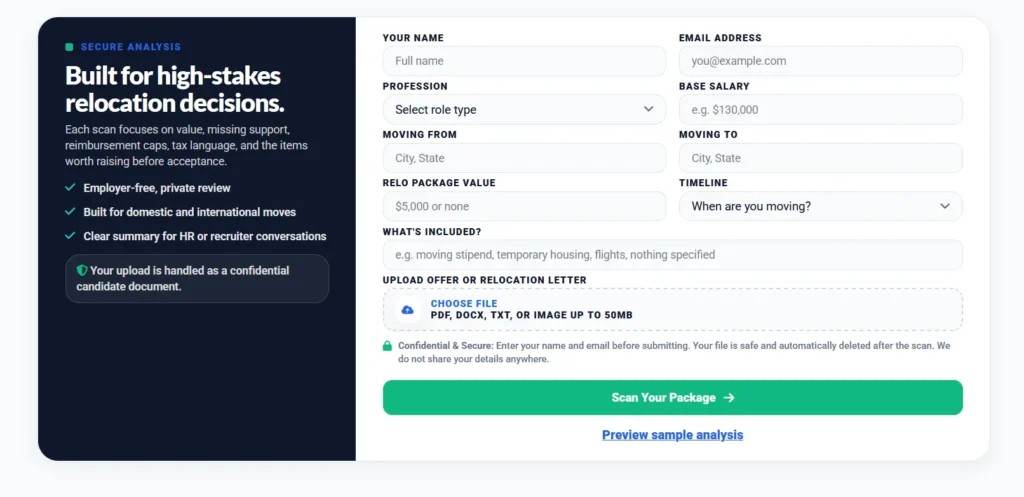
It scores Offer Strength by comparing compensation with role, location, and industry benchmarks. It also reviews the Relocation Package for key support, like moving stipends, temporary housing, flights, and tax treatment.
Then, it flags risks such as taxable allowances, repayment clauses, and non-guaranteed equity. Finally, it highlights the candidate’s strongest negotiation points.
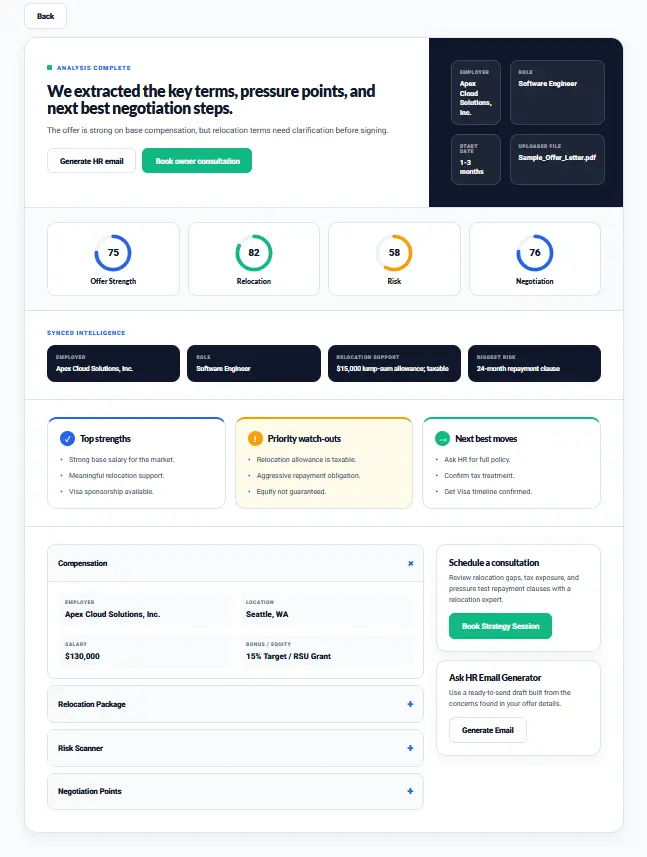
Each section delivers specific, actionable intelligence. For instance, the “Priority Watch-Outs” panel might flag that the relocation allowance is taxable, the repayment clause is aggressive, and the equity is not guaranteed.
Meanwhile, the “Next Best Moves” section tells the candidate exactly what to ask HR, how to confirm tax treatment, and how to get a visa timeline locked down.
Additionally, the tool includes a built-in HR email generator. It creates a ready-to-send draft based on the specific concerns found in the offer analysis. Candidates can copy and customize the email, saving hours of drafting and second-guessing.
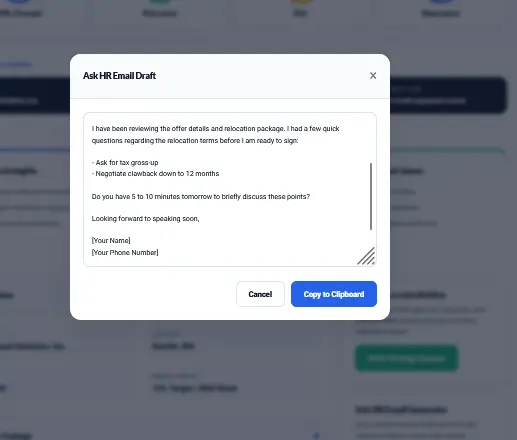
The entire process is confidential and employer-free. Uploads are handled as secure candidate documents and deleted after the scan. This design means professionals can evaluate their offer in private before deciding how to approach the conversation with HR.
Try the job offer analyzer and see what your relocation package is really worth before you sign.
What Hidden Risks Does a Job Offer Analyzer Catch Before Signing?
Many offer letters contain terms that seem standard but carry serious financial consequences. Offer analyzer spots these risks before they become costly mistakes. Here are the most common traps.
Tax exposure on relocation benefits is the biggest blind spot. Since the 2017 Tax Cuts and Jobs Act, nearly all employer-paid relocation expenses are taxable income for civilians.
Consequently, a $30,000 relocation package triggers roughly $9,600 in combined federal and state taxes. Without a gross-up, the employee absorbs that cost entirely. Seven states still offer state-level deductions for moving expense reimbursements, but the federal deduction no longer exists for non-military workers.
Repayment clauses are another area where candidates routinely get blindsided. These clauses require employees to repay some or all relocation costs if they leave before a specified date.
Some agreements include gross-up repayment, meaning the candidate owes back the tax assistance, too. Therefore, leaving a $40,000 relocation deal after six months could trigger a $50,000 or larger repayment bill.
Equity uncertainty is also common, especially in tech and startup offers. An offer might reference “15% Target RSU Grant,” but if the equity is not guaranteed in writing, the employer may still control the award date, final amount, and valuation.
Similarly, vesting cliffs and performance conditions can delay the actual receipt of stock for years.
How Can a Job Offer Analyzer Strengthen Salary Negotiations?
Negotiation is not about being aggressive. It is about being informed. A job offer analyzer gives candidates the specific data points they need to have a productive conversation with HR instead of an awkward one.
According to Glassdoor, over 70% of hiring managers expect candidates to negotiate. Yet 36% of professionals say they struggle to justify their salary requests. The analyzer closes that gap by translating raw offer terms into clear talking points.
For example, if the tool flags that base compensation is 12% below market for the role and location, the candidate has a concrete number to reference. Similarly, if the relocation package lacks a tax gross-up, the analyzer calculates the exact dollar impact and suggests asking for one.
That specificity changes the tone of the entire conversation. Instead of saying “the offer feels low,” the candidate can say “the effective value of the relocation package drops by $9,600 without tax assistance.” Consequently, HR teams are far more likely to respond to data-driven requests.
Additionally, many candidates do not realize that benefits beyond base pay are often the most negotiable terms. Signing bonuses, flexible start dates, remote work arrangements, and relocation bonus structures all have room for adjustment.
It highlights these opportunities so candidates do not leave value on the table. Indeed, professionals who negotiate see an average 18.8% salary increase according to data cited by Aurora University research.
Also read – How Career Relocation Can Propel Your Professional Journey
Who Should Use a Job Offer Analyzer Before Accepting a Role?
The short answer is anyone changing jobs. However, certain professionals stand to gain the most from using an offer analyzer before they sign.
First, anyone relocating for work should treat the analyzer as essential. Relocation packages involve moving costs, temporary housing, tax exposure, and repayment clauses that can swing the total value of the deal by tens of thousands of dollars. Professionals in employer-paid relocation scenarios frequently underestimate these hidden costs until it is too late.
Second, tech professionals evaluating equity-heavy offers benefit significantly. Stock options, RSU grants, and performance bonuses all carry different vesting timelines and tax consequences. Therefore, two offers with the same headline compensation can differ dramatically once equity terms are factored in.
Third, healthcare workers and engineers moving across state lines face unique challenges. Licensing requirements, cost-of-living differences, and state tax variations all affect the real value of the offer.
Offer analyzer accounts for these variables so the candidate gets a complete picture. Furthermore, executives negotiating strategic corporate relocations can use the analysis to pressure-test repayment terms and equity guarantees before committing.
How Does a Job Offer Analyzer Handle Relocation Tax Exposure?
Tax exposure is one of the most misunderstood parts of any relocation offer. Since the Tax Cuts and Jobs Act of 2017 eliminated the civilian moving expense deduction, every dollar of employer-paid relocation support counts as taxable income.
THE RELO.AI DAILY NEWSLETTER
Daily Digest of Relocation News, Deals & Reviews
Subscribe for free and get proven relocation and travel strategies, personalized support, valuable rewards, and trusted reviews for every move.
Thank you for subscribing!
Your email has been added to our list.
Consequently, a $20,000 relocation package does not put $20,000 in the employee’s pocket. After federal and state withholding, the take-home value drops significantly.
A job offer analyzer calculates this gap automatically. It applies the standard supplemental wage withholding rate of 22% at the federal level, then layers in state taxes based on the destination.
For someone moving to California, the combined tax hit on a $30,000 relocation benefit can exceed $12,000. Meanwhile, a move to Texas or Florida carries no state income tax, so the federal hit is all that applies. These differences change the effective value of the package dramatically.
The analyzer also checks for tax gross-up language in the offer. A gross-up means the employer covers the tax burden, so the candidate receives the full intended benefit. However, many companies skip this step to save costs.
Understanding the total relocation costs covered by the employer before signing prevents the kind of surprise tax bill that damages morale and trust in the first year.
What Should a Job Offer Analyzer Reveal About Repayment Clauses?
Repayment clauses, also called clawback provisions, are standard in relocation offers. They require the employee to repay some or all relocation costs if they leave the company within a set timeframe. However, not all repayment clauses are created equal. A job offer analyzer breaks down the specific terms so candidates understand exactly what they are agreeing to.
Some companies use full repayment structures. This means the employee owes back the entire relocation benefit if they resign or are terminated for cause within 12 to 24 months.
Others use prorated models that reduce the obligation by a fraction for each completed month. For instance, a 12-month prorated clause on a $24,000 package reduces the balance by $2,000 per month. Therefore, leaving after nine months would mean repaying only $6,000 instead of the full amount.
The most aggressive clauses include gross-up repayment. This adds the employer’s tax assistance on top of the base relocation cost. Consequently, a $30,000 relocation deal with a full gross-up could result in a repayment obligation above $42,000.
A strong offer analyzer flags these terms clearly and suggests negotiation strategies, such as requesting proration, shortening the clawback window, or capping the repayment amount.
Knowing these details before signing gives the candidate real leverage in understanding the relocation policy behind the offer.
What Makes a Job Offer Analyzer Different From a Salary Calculator?
Salary calculators are everywhere. Sites like Glassdoor, Payscale, and LinkedIn all offer tools that estimate pay ranges for specific roles and locations. However, a salary calculator only answers one question. It tells the candidate if the base number is in the right ballpark. A job offer analyzer goes several layers deeper.
The fundamental difference is scope. A salary calculator ignores relocation support, tax treatment, repayment clauses, equity risk, and negotiation leverage.
It treats the offer as a single number when the offer is really a bundle of interconnected terms. For instance, a candidate might pass a salary check with flying colors but still accept a deal that costs thousands in hidden tax exposure or locks them into an aggressive clawback agreement.
The offer analyzer evaluates all of these variables together and scores the offer across multiple dimensions.
Additionally, salary calculators provide no action plan. They confirm a range and leave the candidate to figure out the next steps alone. Offer analyzer, by contrast, identifies the weakest points in the offer and suggests specific negotiation strategies.
It generates talking points, flags risks, and even drafts HR emails. Consequently, the candidate walks into the negotiation prepared instead of hoping for the best.
Professionals evaluating reasonable relocation packages need that full-picture analysis, not just a salary benchmark.
How Does Cost of Living Affect What a Job Offer Analyzer Shows?
A $150,000 salary in Austin does not stretch the same way as $150,000 in San Francisco. Cost of living is one of the most important factors in evaluating any offer that involves relocation.
Offer analyzer adjusts for this difference by benchmarking the offered salary against local purchasing power, housing costs, transportation expenses, and tax rates in the destination city.
For example, a candidate moving from Houston to Seattle might see a $20,000 salary increase on paper. However, Seattle’s higher state and local costs can erase that gain entirely.
Similarly, a lateral move from New York City to Charlotte could result in a significant lifestyle upgrade even without a raise, because housing and daily expenses are substantially lower. The analyzer quantifies these differences so the candidate can make a decision based on real purchasing power.
Furthermore, cost-of-living data becomes essential when negotiating relocation packages. If the destination city is 30% more expensive, the candidate has a strong case for requesting a cost-of-living adjustment or a larger housing allowance.
Understanding how relocation service costs stack up in different markets is critical to getting a fair deal. Offer analyzer puts all of this data into a single view, so nothing gets missed during the decision-making process.
What Happens After You Run Your Offer Through an Offer Analyzer?
Running the analysis is just the first step. The real value comes from what the candidate does with the results. A good offer analyzer provides a structured action plan, not just a score. It tells the candidate exactly which terms to push back on, which ones are already strong, and which conversations to prioritize with HR.
Typically, the process flows in three stages. First, the candidate reviews the full report and identifies the top two or three areas of concern. These might include missing tax gross-ups, aggressive repayment terms, or below-market compensation.
Second, the candidate drafts a response to HR that addresses each concern with specific data. Tools like the Relo.AI analyzer include a built-in email generator that creates this draft automatically.
Third, the candidate schedules a conversation with HR or the hiring manager to discuss adjustments before signing.
This structured approach is significantly more effective than winging it. According to the Pew Research Center, 66% of candidates who negotiate receive a better offer. The key difference is preparation.
Candidates who work with a job relocation consultant or use a digital analyzer go into that conversation with leverage. Consequently, they close better deals, avoid costly surprises, and start their new role on a stronger financial footing.
Recommended read – Moving Expenses for Job Relocation Across Cities and Careers
Frequently Asked Questions (FAQ) About Job Offer Analyzer
1. Is a job offer analyzer free to use?
Some offer analyzer tools are free, while others offer premium tiers with deeper analysis. The Relo.AI offer analyzer provides a secure, employer-free scan focused on relocation and compensation intelligence at no upfront cost.
THE RELO.AI DAILY NEWSLETTER
Daily Digest of Relocation News, Deals & Reviews
Subscribe for free and get proven relocation and travel strategies, personalized support, valuable rewards, and trusted reviews for every move.
Thank you for subscribing!
Your email has been added to our list.
2. Can an offer analyzer help with international relocation offers?
Yes. A thorough offer analyzer evaluates visa timelines, international tax treatment, and cross-border benefits in addition to domestic terms. This is especially important for professionals relocating internationally, where immigration and tax rules vary significantly.
3. Does using an offer analyzer alert the employer?
No. Tools like the Relo.AI analyzer are completely confidential and employer-free. The uploaded document is treated as a private candidate file and is automatically deleted after the analysis is complete.
4. When should a candidate use an offer analyzer?
The best time is immediately after receiving a written offer and before responding to HR. This allows the candidate to review compensation, relocation terms, and risks while there is still room to negotiate.
5. What types of professionals benefit most from a job offer analyzer?
Engineers, healthcare professionals, executives, and anyone relocating for a new role benefit significantly. Specifically, candidates with relocation packages involving tax implications or repayment clauses should always run their offer through an analysis tool.
Talk to a Relocation Expert Before You Sign
Every job offer looks different once relocation costs, tax exposure, repayment clauses, and missing support terms are reviewed closely. A package that seems generous at first can still leave you with unexpected costs after the move begins.
Relo.AI helps candidates and corporate relocation teams review offers with a practical, detail-first approach. You can start with the job offer analyzer to scan your package, identify hidden risks, and prepare better questions for HR before you accept.
Behind Relo.AI is founder Mac Chinsomboon, a Broker Associate with Coldwell Banker Realty in Boston.
Mac holds an MBA in Finance from MIT Sloan, a BS in Electrical Engineering from the University of Colorado, and a Juris Doctor from Concord Law School.
Over his career, he has completed more than $300 million in lifetime real estate sales and has been recognized by Boston Magazine as a Top Real Estate Agent.
As a result, his guidance brings together finance, law, real estate, and relocation strategy. The review is grounded in numbers, risk, housing realities, and long-term planning, not vague advice.
Book a FREE consultation for relocation support and expert guidance. You can call directly at +1-617-333-8453-RELO.
Bottom Line
Accepting a job offer without analyzing the full terms is one of the most expensive mistakes a professional can make. Salary is just one variable. Relocation support, tax treatment, repayment clauses, equity structures, and negotiation leverage all determine the true value of an offer. A job offer analyzer removes the guesswork and replaces it with structured intelligence.
The result is a clearer path to a better deal, a smoother relocation, and a stronger financial position from day one.
Sources –
- Pew Research Center Salary Negotiation Survey
- Resume Genius Salary Negotiation and Expectations Survey
- ZipRecruiter Job Seeker Negotiation Trends
- Robert Half 2026 Salary Guide
- Glassdoor Hiring Manager Negotiation Data
- Aurora University Salary Negotiation Research
- IRS Supplemental Wage Withholding Regulations
- U.S. Tax Cuts and Jobs Act of 2017
Disclaimer – This article is for informational purposes only and does not constitute legal, tax, or financial advice. Consult a qualified professional for guidance specific to your situation.