
Jobs That Offer Relocation Assistance Pay You to Start Fresh Anywhere - Relocation
AI Workers Are the New Expats: Where Tech’s Hottest Talent Is Landing - Relocation
How to Find a Job in Miami and Thrive in the Sunshine State - Relocation
Athletic Trainers Relocation - Athletics
Doctor Relocation Timeline From Offer Letter to Hospital Onboarding - Medical
Top Cities for Female Physicians to Practice in the United States - Medical
Easy Relocation for Physicians - Medical
The Best Cities for Registered Nurses: Where Pay Meets Possibility - Medical
How Relocation Packages for Nurses Support Long-Term Career Moves - Medical
Relocating as a Traveling Nurse - Medical
10 Best Neobanks in the US That Fit Modern Financial Habits - Personal Finance
Corporate Credit Card vs. Business Credit Card: Which Option Is Appropriate for Business - Finance
Jobs That Offer Relocation Assistance Pay You to Start Fresh Anywhere - Relocation
AI Workers Are the New Expats: Where Tech’s Hottest Talent Is Landing - Relocation
How to Find a Job in Miami and Thrive in the Sunshine State - Relocation
Athletic Trainers Relocation - Athletics & Sports
Doctor Relocation Timeline From Offer Letter to Hospital Onboarding - Medical
Top Cities for Female Physicians to Practice in the United States - Medical
Easy Relocation for Physicians - Medical
The Best Cities for Registered Nurses: Where Pay Meets Possibility - Medical
How Relocation Packages for Nurses Support Long-Term Career Moves - Medical
Relocating as a Traveling Nurse - Medical
10 Best Neobanks in the US That Fit Modern Financial Habits - Personal Finance
Corporate Credit Card vs. Business Credit Card: Which Option Is Appropriate for Business - Finance


Relocating while pregnant can be a smart career move, but only if you plan for three things most offer letters ignore: insurance, leave and timing. Get those right, and the new job feels like a win. Get them wrong, and you could face a coverage gap in your third trimester with no job-protected leave.
Here’s the scenario we see a lot. You land a great offer in another city. You’re 18 weeks along, and the start date is in six weeks. The salary is better, and the team seems great. Then you read the benefits guide. Health coverage starts “on the first of the month after 60 days.” So your baby may arrive before your new plan does.
That’s not a reason to turn down the job. Instead, it’s a reason to plan and negotiate early. Below, you’ll learn how to protect your insurance, what leave you can count on and the best time to move. You’ll also get the exact asks to make before you sign.
Why Relocating While Pregnant Is a Different Kind of Move
Most moves are about boxes and budgets. This one, however, is also about medical care on a fixed deadline. Your due date won’t wait for HR paperwork.

THE RELO.AI DAILY NEWSLETTER
Daily Digest of Relocation News, Deals & Reviews
Subscribe for free and get proven relocation and travel strategies, personalized support, valuable rewards, and trusted reviews for every move.
Thank you for subscribing!
Your email has been added to our list.
The money is real, too. KFF looked at claims for women with employer coverage. It found that pregnancy, childbirth and postpartum care cost about $20,416 on average, with about $2,743 paid out of pocket (KFF). That’s with insurance. Without it, the full bill could land on you.
On top of that, your deductible may reset. If you met it with your old plan, a new plan starts the count again. So a mid-pregnancy job change can mean paying twice.
None of this means you should stay put. After all, a better job can mean better pay, better leave and a better place to raise a family. It just means relocating while pregnant takes more planning than a normal move. Our 2026 relocation package guide is a good place to see what a full package should include.
Health Insurance When Relocating While Pregnant
Insurance is the first thing to sort out when relocating while pregnant, because it’s the easiest to get wrong.
Start with the waiting period. Under the Affordable Care Act, employers can make new hires wait up to 90 days for health coverage. Many plans start on day one or the first of the next month. Others don’t. So ask HR for the exact start date in writing.
Next, plan a bridge. If you leave a job with 20 or more employees, you can usually keep your old plan through COBRA for up to 18 months. The catch is cost. Your old employer can charge up to 102% of the full premium, including the part they used to pay (American Benefits Group). That can easily run into four figures a month for family coverage.
The Marketplace is another option. Moving to a new state usually opens a special enrollment period of 60 days. Most people need to have had coverage for at least one day in the 60 days before the move (Georgetown CHIR). In most states, though, pregnancy alone does not open enrollment. Birth does.
Good news on one point: under the ACA, plans can’t refuse you or exclude your pregnancy as a pre-existing condition.
Relocating While Pregnant? Why a New Job Can Mean No FMLA
This is the trap that catches the most people relocating while pregnant. The Family and Medical Leave Act gives up to 12 weeks of job-protected leave. Yet you only qualify after you’ve worked for the employer for 12 months. You also need 1,250 hours in the past year, at a site with 50 or more employees within 75 miles (U.S. Department of Labor).
In other words, if you start a new job at 20 weeks, you almost certainly won’t qualify for FMLA when the baby comes. Your old job’s tenure doesn’t transfer.
Paid leave is patchy as well. According to BLS data from March 2026, only 49% of private industry workers had access to paid family leave through their employer (Insurance Business).
State programs can help. Fourteen states and Washington, D.C. now run paid family and medical leave programs. Delaware, Minnesota and Maine all started paying benefits in 2026 (HCAMag). Still, each state sets its own rules. Some, like Delaware, require tenure. So check the new state’s rules before you assume you’re covered.
Negotiate Leave and Benefits Into Your Offer
Since the law may not protect you, your offer letter has to. The good news is that many employers will say yes. You just have to ask before you sign.
Here are the asks that matter most when relocating while pregnant:
- Day-one health coverage. Ask HR to waive the waiting period. If they can’t, ask them to pay your COBRA premiums until the new plan starts.
- Guaranteed parental leave. Ask for written leave even though you won’t meet FMLA’s 12-month rule. Spell out the weeks, the pay and your right to return.
- A flexible start date. Pushing your start back by a few weeks can line up coverage with your due date.
- A remote start. Some roles can start remotely, so you move after the baby arrives.
- Full-service packing. You shouldn’t be lifting boxes, so ask for packers in the package.
Also, ask about how the relocation money is paid. A lump sum gives you freedom, but a managed move takes the work off your plate. Our guide to lump sum vs. managed moves breaks down the trade-offs. Keep in mind that relocation benefits are taxable, so see our relocation bonus tax guide before you compare offers.
Your Rights: Pregnancy Protections at Work
You may wonder whether to tell your new employer you’re pregnant. That’s your call, and timing is personal. Still, it helps to know your rights.
Federal law bars employers with 15 or more employees from treating you differently because you’re pregnant. That includes pulling a job offer. On top of that, the Pregnant Workers Fairness Act requires the same employers to make reasonable accommodations. According to the EEOC’s final rule, those can include more breaks, schedule changes, telework, and paid or unpaid leave (Stinson).
In practice, this matters when relocating while pregnant. For example, you could ask to delay your on-site start or work remotely during the move itself. Those are fair requests to put in writing.
That said, the law can’t create leave you aren’t eligible for. That’s why the negotiation step above matters so much.
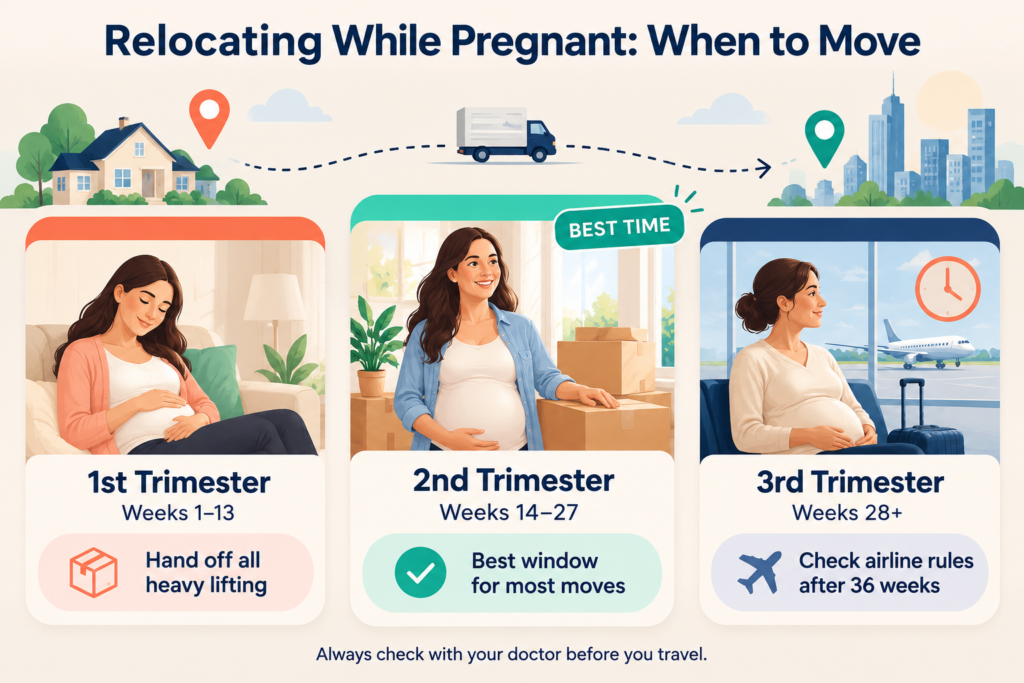
The Best Time for Relocating While Pregnant, by Trimester
If you have any say over timing, aim for the second trimester. Mayo Clinic says it’s often the best time to fly, because the risk of common pregnancy emergencies is lowest then (Mayo Clinic).
Here’s how each stage tends to look:
| Stage | What to expect | Best move strategy |
| First trimester (weeks 1–13) | Nausea and fatigue are common | Move if you must, but hand off all heavy work |
| Second trimester (weeks 14–27) | Energy often returns | The best window for most moves |
| Early third trimester (weeks 28–35) | Travel gets harder | Drive or fly short hops, with your provider’s OK |
| Late third trimester (36+ weeks) | Some airlines won’t let you fly | Avoid moving, or move after the birth |
On the road, take breaks often. Mayo advises walking the aisle about every hour on flights to lower the risk of blood clots. Also, carry your medical records and a note from your provider, since some airlines ask for one late in pregnancy.
THE RELO.AI DAILY NEWSLETTER
Daily Digest of Relocation News, Deals & Reviews
Subscribe for free and get proven relocation and travel strategies, personalized support, valuable rewards, and trusted reviews for every move.
Thank you for subscribing!
Your email has been added to our list.
Above all, talk to your provider first. Twins, high blood pressure or other complications can change the plan.
Find a New OB and Hospital Before You Arrive
When relocating while pregnant, don’t wait until you land to find a new doctor. Good OBs often book out weeks ahead. So start the search as soon as you accept the offer.
First, confirm the new plan’s network. Then pick the hospital where you want to give birth, and find an OB who delivers there. After that, ask your current provider to send your full records, including lab results and ultrasounds.
In addition, get copies for yourself. A digital folder on your phone is enough. If your care is high-risk, ask your current doctor for a referral to a specialist in the new city.
Finally, book your first new appointment before moving day. That way, you never miss a scheduled check-up.
Housing Tips for Relocating While Pregnant
Where you land matters more when relocating while pregnant. Ideally, your first home is within a short drive of the hospital you chose.
If you need time to find a permanent place, temporary housing can help. Ask for longer than the standard 30 days, since house hunting while pregnant takes more time. Our guide to temporary housing during relocation covers what to ask for. You can also compare corporate housing vs. a housing stipend to see which fits your timeline.
Also, think about the nursery. A short-term rental with no space for a crib is fine at 20 weeks. At 38 weeks, it’s not.
Relocating While Pregnant With Kids or a Partner’s Career
Few moves involve just one person. If you have older kids, a partner with a job, or pets, plan for them too.
For older kids, a move plus a new baby is a lot of change at once. So keep their routines steady where you can. Our guide to moving with teenagers has tips that work for younger kids as well.
For your partner, the timing is tricky. They may want to stay home for the birth and look for work later. Ask whether the package includes job search help. Our guide to dual-career relocation explains what to request. And if you have a dog or cat, check whether your relocation package covers pet transport.
What HR Should Build Into Its Policy
If you’re on the employer side, employees relocating while pregnant are a test of your relocation program. Handle them well, and you win loyalty for years. Handle them badly, and you lose a great hire before day one.
So build a few rules into the policy now. First, offer day-one coverage or COBRA reimbursement for every relocating hire. Second, grant parental leave from the start date, not after 12 months. Third, include full-service packing for anyone with a medical need. Finally, allow flexible or remote start dates on request.
These rules fit neatly into a core-flex relocation policy, where the core stays fixed and the flex budget covers family needs. They also show up in relocation ROI, since hires who feel supported tend to stay.
FAQ
Is relocating while pregnant safe?
For most healthy pregnancies, yes, as long as you avoid heavy lifting and plan travel with your provider. The second trimester is often the easiest time. Complications like high blood pressure or twins may change that advice.
THE RELO.AI DAILY NEWSLETTER
Daily Digest of Relocation News, Deals & Reviews
Subscribe for free and get proven relocation and travel strategies, personalized support, valuable rewards, and trusted reviews for every move.
Thank you for subscribing!
Your email has been added to our list.
Can a new employer withdraw a job offer because I’m pregnant?
Employers with 15 or more employees can’t treat you differently because of pregnancy, and that includes pulling an offer. The Pregnant Workers Fairness Act also requires reasonable accommodations.
Will I get FMLA leave at a new job?
Usually not right away. FMLA requires 12 months with the employer and 1,250 hours worked. That’s why you should negotiate written parental leave into your offer.
Does moving to a new state let me change health insurance?
Usually, yes. Moving often opens a 60-day special enrollment period on the Marketplace. In most states, pregnancy alone doesn’t, but the birth of your baby does.
Conclusion: Plan Smart for Relocating While Pregnant
Relocating while pregnant isn’t a deal breaker. It’s a planning problem, and planning problems have answers. Lock in day-one coverage or a COBRA bridge. Get parental leave in writing, since FMLA won’t cover you yet. If you can, time the move for the second trimester, and find your new OB before you arrive.
Want to know if your package covers what you need? Relo.AI compares relocation offers, prices your move and flags gaps before you sign. Try our relocation calculator to see what your move should really cost.
Schedule a FREE consultation with us, or call us at +1-617-333-8453.