
Jobs That Offer Relocation Assistance Pay You to Start Fresh Anywhere - Relocation
AI Workers Are the New Expats: Where Tech’s Hottest Talent Is Landing - Relocation
How to Find a Job in Miami and Thrive in the Sunshine State - Relocation
Athletic Trainers Relocation - Athletics
Doctor Relocation Timeline From Offer Letter to Hospital Onboarding - Medical
Top Cities for Female Physicians to Practice in the United States - Medical
Easy Relocation for Physicians - Medical
The Best Cities for Registered Nurses: Where Pay Meets Possibility - Medical
How Relocation Packages for Nurses Support Long-Term Career Moves - Medical
Relocating as a Traveling Nurse - Medical
10 Best Neobanks in the US That Fit Modern Financial Habits - Personal Finance
Corporate Credit Card vs. Business Credit Card: Which Option Is Appropriate for Business - Finance
Jobs That Offer Relocation Assistance Pay You to Start Fresh Anywhere - Relocation
AI Workers Are the New Expats: Where Tech’s Hottest Talent Is Landing - Relocation
How to Find a Job in Miami and Thrive in the Sunshine State - Relocation
Athletic Trainers Relocation - Athletics & Sports
Doctor Relocation Timeline From Offer Letter to Hospital Onboarding - Medical
Top Cities for Female Physicians to Practice in the United States - Medical
Easy Relocation for Physicians - Medical
The Best Cities for Registered Nurses: Where Pay Meets Possibility - Medical
How Relocation Packages for Nurses Support Long-Term Career Moves - Medical
Relocating as a Traveling Nurse - Medical
10 Best Neobanks in the US That Fit Modern Financial Habits - Personal Finance
Corporate Credit Card vs. Business Credit Card: Which Option Is Appropriate for Business - Finance


Two people take the same job offer, with the same salary and the same $12,000 relocation lump sum. One moves on December 18. The other moves on January 5. Come April, their tax bills can look nothing alike. That’s because the calendar decides which tax year your relocation money lands in, which state gets to tax your income and whether your home sale gain is tax-free. So if you’re moving in the next ten weeks, relocation tax planning year-end deserves a spot on your calendar.
That’s where the real money hides. Pay dates, state tax rules, and home sale dates can all affect your tax bill. Missing a key deadline could mean higher taxes or lost savings. Check these details before year-end to avoid costly surprises.
Below are the moves to make before December 31, built on the 2026 rules, including the changes from the One Big Beautiful Bill Act.
Why Does Relocation Tax Planning Year-End Start With Taxable Benefits?
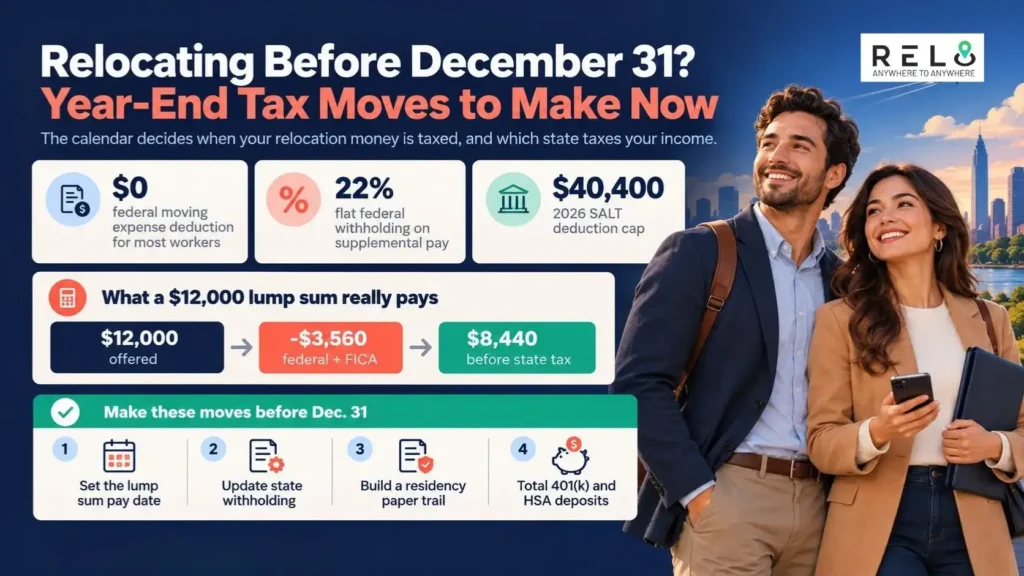
Start with the rule that changed everything. The 2017 tax law suspended the federal moving expense deduction, and it also made employer moving reimbursements taxable. Both breaks were set to come back in 2026. They didn’t. The One Big Beautiful Bill Act made the suspension permanent (Foster Garvey). Only active-duty military on orders and, new for 2026, some intelligence community employees still get the break.

THE RELO.AI DAILY NEWSLETTER
Daily Digest of Relocation News, Deals & Reviews
Subscribe for free and get proven relocation and travel strategies, personalized support, valuable rewards, and trusted reviews for every move.
Thank you for subscribing!
Your email has been added to our list.
So for most movers, every relocation dollar is wages. It shows up on your W-2. In addition, it’s taxed like a bonus. Employers can withhold federal income tax at a flat 22% on supplemental pay, plus 7.65% for Social Security and Medicare (Beancount).
Here’s what that does to a typical package. Atlas Van Lines’ 2026 survey found the most common lump sum is $10,000 to $12,499 (Plus Relocation).
On a $12,000 lump sum, federal withholding and payroll taxes take about $3,560. That leaves roughly $8,440 before any state tax. To hand you a true $12,000, your employer would have to pay about $17,060 with a gross-up.
So the real question in relocation tax planning year-end is when and where this money gets taxed. Our relocation bonus tax guide covers the basics.
Move 1 – Which Tax Year Will Your Relocation Payment Land In?
The payment date matters, not the move date. A lump sum paid on December 30 is 2026 income, while one paid on January 2 is 2027 income. That one week can shift thousands of dollars into a lower bracket.
So look at your 2026 income first. Did you get a big bonus this year? Or did you earn a full year at your old job plus two months at the new one? If so, you may be sitting near a bracket edge. For 2026, the 24% bracket jumps to 32% at $201,775 for single filers and $403,550 for married couples filing jointly (IRS). In that case, ask HR to pay the lump sum in January instead.
The reverse works, too. If 2027 will be your bigger year, take the money now.
For relocation tax planning year-end, there’s one catch. Under the IRS’s constructive receipt rule, money made available to you generally counts in that year, even if you don’t cash it. So you can’t just leave a check in a drawer. Make the ask before payroll runs, and get the new date in writing.
Related – Relocation Income Tax Allowance and How Can It Benefit You?
Move 2 – How Can You Lock In Your State Residency Date?
This is the biggest lever for interstate movers. In the year you move, you’ll usually file as a part-year resident in both states. Each state taxes the income you earned while you lived there. That means your move date splits your 2026 income in two.
Now think about direction. United Van Lines’ 2025 study ranked New Jersey, New York and California as the top three states people left (FOX 29). Those are also some of the highest-tax states in the country. So if you’re heading from one of them to Texas, Florida or Washington, moving before December 31 can make 2027 a full year in the new state. As a result, January’s paycheck and bonus may skip state income tax entirely.
But high-tax states audit residency hard. For instance, New York can treat you as a full-year resident if you keep a home there and spend more than 183 days in the state. Even five minutes in the state counts as a day (CBIZ).
So build a paper trail before year-end –
- Get a new driver’s license and register to vote.
- Sign a lease or close on a home, and keep the dated documents.
- Update your address with payroll, banks and doctors.
- Sell or rent out the old home if you can.
For relocation tax planning year-end, update your state withholding with HR on your move day. Otherwise, your old state might keep withholding tax, even if your new home is elsewhere. Work performed in the old state can still be taxable there after the move.
Move 3 – Which States Still Reward Moving-Expense Receipts?
Federal relief is gone, but some states never followed along. California still lets residents claim a moving expense deduction on Form FTB 3913 for moves that meet a 50-mile distance test and a 39-week work test (California FTB). In addition, New York, Pennsylvania and Massachusetts are among the states that have kept a deduction or exclusion (Beancount).
If your move involves one of those states, keep every receipt as part of your relocation tax planning year-end checklist. Save records for movers, storage, truck rentals, and travel lodging.
Even with a lump sum, these expenses may help reduce your state tax bill.
Our guide to tracking relocation receipts shows an easy system.
Move 4 – When Should You Close on Your Home Sale?
Selling a home before you move? The calendar matters here, too. Normally, you can exclude up to $250,000 of gain, or $500,000 for married couples, if you owned and lived in the home for two of the last five years.
Didn’t make it two years? A work move can still save you. If your new job is at least 50 miles farther from the home than your old one, you may get a partial exclusion.
For example, 15 months of ownership gives you 15/24 of $250,000, or $156,250 of tax-free gain (Instead). So if you’re close to the two-year mark, it may pay to close a few weeks later.
There’s a newer angle as well. The state and local tax (SALT) cap is $40,400 for 2026, up from $10,000 before 2025. However, it starts phasing down once income passes $505,000 (Q3 Advisors). So if you itemize, paying your old home’s property tax bill before December 31 may let more of it count on your 2026 return. If your company offers a buyout, our BVO vs. GBO guide explains how each one affects your closing date.
Move 5 – What Should You Do With Benefits Before Switching Jobs?
Changing employers mid-year creates three quiet tax traps, and each has a fix.
Your 401(k) limit is per person, not per job. For 2026, you can defer $24,500, or $32,500 if you’re 50 or older (ALPA). Your new employer doesn’t know what you put in at the old one. So add up both, and fix any excess before the deadline.
Your HSA limit is shared, too. It’s $4,400 for self-only coverage and $8,750 for family coverage in 2026. Coverage changes mid-year can change your limit, so check it before you top up.
Social Security can be over-withheld. Each employer withholds 6.2% up to the $184,500 wage base. So if you earn more than that across two jobs, you’ll overpay. The good news is that you get the excess back as a credit on your return.
Also, check the health FSA rules at your old employer before your last day. Eligible claim deadlines, run-out periods and any available continuation coverage depend on the plan; unused money can be forfeited.
Also read – Job Relocation Services That Protect Performance at Scale
Move 6 – How Does Relocation Tax Planning Year-End Affect Two-State Returns?
Changing states does not split every dollar of income neatly at midnight. A bonus tied to work before your move may remain taxable to the old work state even when it is paid afterward.
Save final pay stubs, work-location records and the dates your job duties shifted. You may need part-year returns in two states, plus a nonresident return for income sourced to the old one. Resident-state credits can often help prevent double taxation, but the rules and calculations vary.
Use this guide to establish state tax residency to build the evidence before filing season. Getting this allocation right can save you an expensive filing correction.
Move 7 – Does Relocation Tax Planning Year-End Cover Remote Work?
A new home address does not automatically change where your wages are sourced. If your assigned office remains in New York, for example, certain days worked remotely outside New York may still count as New York workdays under its convenience-of-the-employer rule. Other states use different tests.
Before December 31, confirm the official work location on file, track office and home-working days, and ask payroll how it will allocate your wages.
The remote-work tax rules guide explains the questions to raise before an interstate move. A clean workday log can matter as much as a new driver’s license.
Move 8 – Which Payroll Records Should You Collect Before December 31?
Ask for an itemized relocation statement showing the cash allowance, employer-paid movers, temporary housing, any gross-up and the pay date for each item. Confirm which amounts payroll plans to report as taxable wages, and keep the final paystub from each employer.
THE RELO.AI DAILY NEWSLETTER
Daily Digest of Relocation News, Deals & Reviews
Subscribe for free and get proven relocation and travel strategies, personalized support, valuable rewards, and trusted reviews for every move.
Thank you for subscribing!
Your email has been added to our list.
For relocation tax planning year-end, also compare the state wages and withholding shown in payroll with the days you worked in each location.
If a benefit appears missing or duplicated, raise it before Forms W-2 are prepared. This guide to relocation gross-up calculations can help you understand the employer’s math. If the offer is still negotiable, review common relocation offer red flags before accepting the terms.
Move 9 – Can Relocation Tax Planning Year-End Avoid Underpayment?
A larger salary, taxable relocation allowance or stock vesting can leave you short on withholding, even when the bonus itself was withheld at 22%. IRS guidance generally allows taxpayers to avoid an underpayment penalty by paying at least 90% of the current year’s tax or 100% of the previous year’s tax through timely withholding and estimated payments.
That prior-year threshold is commonly 110% when last year’s adjusted gross income exceeded $150,000, with special rules for some filers. Check both federal and state estimates with a tax professional; the timing of payments matters.
For offer negotiations, the Offer Analyzer can help you identify missing tax support and gross-up language, but it does not replace a tax return calculation.
Move 10 – How Do Stock Awards Change Relocation Tax Planning Year-End?
Restricted stock units, options and deferred bonuses deserve a separate review before you relocate. Moving to a state without wage income tax does not necessarily erase tax on awards earned while you worked somewhere else.
California, for example, may allocate restricted-stock income using a workday fraction covering the relevant service period. Capture grant dates, vesting schedules, exercise dates, workday histories and employer allocation statements. Then ask how the award will be sourced on each state return.
See how to compare equity compensation across states before relying on a lower destination-state tax rate. For large grants, a multistate tax adviser can assess the potential exposure before December 31.
What Belongs on Your Before-December-31 Checklist?
Year-end relocation tax planning starts with payment dates, state tax rules, and tax benefits. Taking the right steps before December 31 can help avoid surprise tax bills and save money. Use this checklist to track key tasks and deadlines.
Use this checklist to track key tax tasks and deadlines before December 31.
| Action | Why it matters | Deadline |
| Ask HR when the lump sum will be paid | The payment date sets the tax year | Before payroll runs |
| Request a gross-up in writing | Taxes can eat about 30% of the money | Before you sign |
| Update state withholding | Stops tax going to your old state | Your move day |
| Build your residency paper trail | Proves your new state for 2027 | December 31 |
| Total your 401(k) and HSA deposits | Avoids excess contribution penalties | December 31 |
| Pay old-state property tax if you itemize | May be deductible under the $40,400 cap | December 31 |
| File receipts if CA, NY, PA or MA is involved | May lower your state bill | Tax filing day |
If you’re still negotiating the package, our 2026 relocation package guide shows what to ask for. And for the lump sum vs. full-service choice, see lump sum vs. managed moves.
Recommended read – Safest Countries 2026: Your Boss Won’t Tell You About #4 (But HR Already Knows)
How Can You Make Your Year-End Tax Moves Count?
The tax code took away the moving deduction, but it didn’t take away your timing. When the money lands, when you change states and when you close on the house can still affect the outcome. Treat relocation tax planning year-end like any other negotiation. Run the numbers, then ask for the dates that work in your favor.
Want to see what your move really costs after taxes?
Relo.AI helps individuals and families make smarter relocation decisions with clear insights into moving costs, relocation benefits, and potential tax expenses. We make financial planning easier by helping clients understand costs, compare options, and avoid unexpected expenses. This helps them plan their move with greater confidence.
Our relocation tools estimate moving costs, evaluate relocation packages, calculate tax gross-ups, and highlight potential expenses to support smarter financial decisions.
Our relocation calculator makes it easier to estimate moving costs, compare financial scenarios, and plan a realistic relocation budget. We focus on providing practical, data-driven insights that support better financial decisions before and during the relocation process.
Book a FREE consultation with us and call us at +1-617-333-8453.
What Are the Key Relocation Tax Planning Year-End Questions?
1. Are moving expenses tax-deductible in 2026?
Most moving costs are not deductible from federal taxes in 2026. Some military members and intelligence workers qualify for exceptions. Certain states, including California, may still allow deductions.
2. Is a relocation lump sum taxed in the year of payment or the year of the move?
A relocation lump sum is usually taxed in the year it is paid or made available. A December 2026 payment counts as 2026 income, even if the move happens in January 2027.
THE RELO.AI DAILY NEWSLETTER
Daily Digest of Relocation News, Deals & Reviews
Subscribe for free and get proven relocation and travel strategies, personalized support, valuable rewards, and trusted reviews for every move.
Thank you for subscribing!
Your email has been added to our list.
3. How does moving before December 31 affect state income taxes?
Moving before December 31 can change which states tax income. Part-year tax returns may be needed in both states. Clear moving dates and records help avoid tax disputes.
4. Can relocation tax planning year-end strategies reduce moving-related tax costs?
Yes. Planning payment dates, checking state residency rules, and adjusting tax withholding can help reduce costs. Savings depend on income, state tax laws, and when relocation benefits are paid.
5. Does a relocation tax gross-up cover all applicable taxes?
Not always. A gross-up adds money to help cover taxes on relocation benefits. However, the extra payment is also taxable. Coverage depends on the employer’s policy and the taxes included.
6. Can a job-related relocation qualify for a home sale tax exclusion?
Yes. A work-related move may qualify for a partial home sale tax exclusion. The new workplace generally must be at least 50 miles farther from the home than the old workplace. Other IRS rules apply.
7. How do job changes during relocation affect 401(k) and HSA contributions?
Changing jobs can lead to excess retirement or HSA contributions. In 2026, the standard 401(k) employee limit is $24,500 across jobs. HSA limits are $4,400 for self-only coverage and $8,750 for family coverage, subject to eligibility.
8. Can remote work after relocation create additional state tax obligations?
Yes. Remote work may create tax obligations in more than one state. Rules depend on work location and state tax laws. Checking these requirements before year-end can help avoid unexpected taxes.
In a Nutshell
A relocation scheduled near December 31 can have financial consequences that extend well into the following tax year. The timing of relocation payments, changes in state residency, home sales, and employee benefits can influence the final tax bill. Effective relocation tax planning year-end strategies begin with reviewing payment schedules, confirming state tax obligations, organizing moving expense records, and identifying available deductions.
Even small adjustments made before the calendar year closes can help reduce unexpected expenses and improve financial planning for the move.
Sources –
- Foster Garvey: One Big Beautiful Bill Act, Part 8, Worker Moving Expenses
- IRS: Tax Inflation Adjustments for Tax Year 2026, Including Amendments From the One, Big, Beautiful Bill
- Beancount: Supplemental Wages in 2026, Withholding Guide (2026)
- Beancount: OBBBA’s Permanent Repeal of the Moving Expense Deduction (2026)
- Plus Relocation: 5 Takeaways From the 2026 Atlas Corporate Relocation Survey
- FOX 29: More People Moved Away From These States Than Anywhere Else in 2025 (United Van Lines data)
- CBIZ: Statutory Residency, It’s More Than Just Time and Place
- California Franchise Tax Board: 2025 Instructions for Form FTB 3913, Moving Expense Deduction
- Instead: How to Claim a Partial Home Sale Exclusion After a Work Move (2026)
- Q3 Advisors: SALT Deduction Cap 2026, $40,400 Limit and Phase-Out Explained
- ALPA: 2026 IRS Contribution and Benefit Limits
- IRS: 2026 Employer’s Tax Guide to Fringe Benefits (Publication 15-B)
- IRS: 2026 Instructions for Forms W-2 and W-3
- New York Department of Taxation and Finance: Residency and Telecommuting FAQs
- California FTB: Publication 1004, Equity-Based Compensation Guidelines
- IRS: 2026 Tax Withholding and Estimated Tax (Publication 505)