
Jobs That Offer Relocation Assistance Pay You to Start Fresh Anywhere - Relocation
AI Workers Are the New Expats: Where Tech’s Hottest Talent Is Landing - Relocation
How to Find a Job in Miami and Thrive in the Sunshine State - Relocation
Athletic Trainers Relocation - Athletics
Doctor Relocation Timeline From Offer Letter to Hospital Onboarding - Medical
Top Cities for Female Physicians to Practice in the United States - Medical
Easy Relocation for Physicians - Medical
The Best Cities for Registered Nurses: Where Pay Meets Possibility - Medical
How Relocation Packages for Nurses Support Long-Term Career Moves - Medical
Relocating as a Traveling Nurse - Medical
10 Best Neobanks in the US That Fit Modern Financial Habits - Personal Finance
Corporate Credit Card vs. Business Credit Card: Which Option Is Appropriate for Business - Finance
Jobs That Offer Relocation Assistance Pay You to Start Fresh Anywhere - Relocation
AI Workers Are the New Expats: Where Tech’s Hottest Talent Is Landing - Relocation
How to Find a Job in Miami and Thrive in the Sunshine State - Relocation
Athletic Trainers Relocation - Athletics & Sports
Doctor Relocation Timeline From Offer Letter to Hospital Onboarding - Medical
Top Cities for Female Physicians to Practice in the United States - Medical
Easy Relocation for Physicians - Medical
The Best Cities for Registered Nurses: Where Pay Meets Possibility - Medical
How Relocation Packages for Nurses Support Long-Term Career Moves - Medical
Relocating as a Traveling Nurse - Medical
10 Best Neobanks in the US That Fit Modern Financial Habits - Personal Finance
Corporate Credit Card vs. Business Credit Card: Which Option Is Appropriate for Business - Finance


Your seed round just closed. The engineer you need lives in Austin, your office is in Boston, and Big Tech has offered them a relocation package bigger than your entire monthly benefits payroll. You can’t match it. The good news is that when it comes to relocation benefits for startups, you don’t have to.
Startup relocation plays by different rules. Large companies buy certainty with money. Startups win with speed, flexibility and a few smart dollars spent where candidates actually feel the pain. And the stakes are real. Gallup estimates that replacing an employee costs between one-half and two times their annual salary (Gallup). For a 15-person team, one bad hire or one declined offer can stall a product launch for a quarter.
So here’s how to design relocation benefits for startups that close candidates without burning runway.
Why Relocation Benefits for Startups Matter Again
For a few years, remote work made relocation feel optional. That window is closing. Many early-stage teams, especially in AI, have gone back to in-person work. In San Francisco, startups like Mithrl and Medra work in the office five days a week, and Tako requires four (CNBC via NBC Bay Area). As Tako’s CEO put it, “When you’re trying to invent something new, it’s really hard to do that over Zoom.”

THE RELO.AI DAILY NEWSLETTER
Daily Digest of Relocation News, Deals & Reviews
Subscribe for free and get proven relocation and travel strategies, personalized support, valuable rewards, and trusted reviews for every move.
Thank you for subscribing!
Your email has been added to our list.
The trade-off is a smaller local hiring pool. If you want people in the room, you often need to move them there. That’s why relocation volume is rising across the market. In Atlas Van Lines’ 2026 survey of 549 companies, 54% said relocations increased in 2025, and 52% expect another rise in 2026 (Atlas Van Lines via Transport Topics). Also, 27% named a lack of qualified local talent as a major factor shaping their relocation plans.
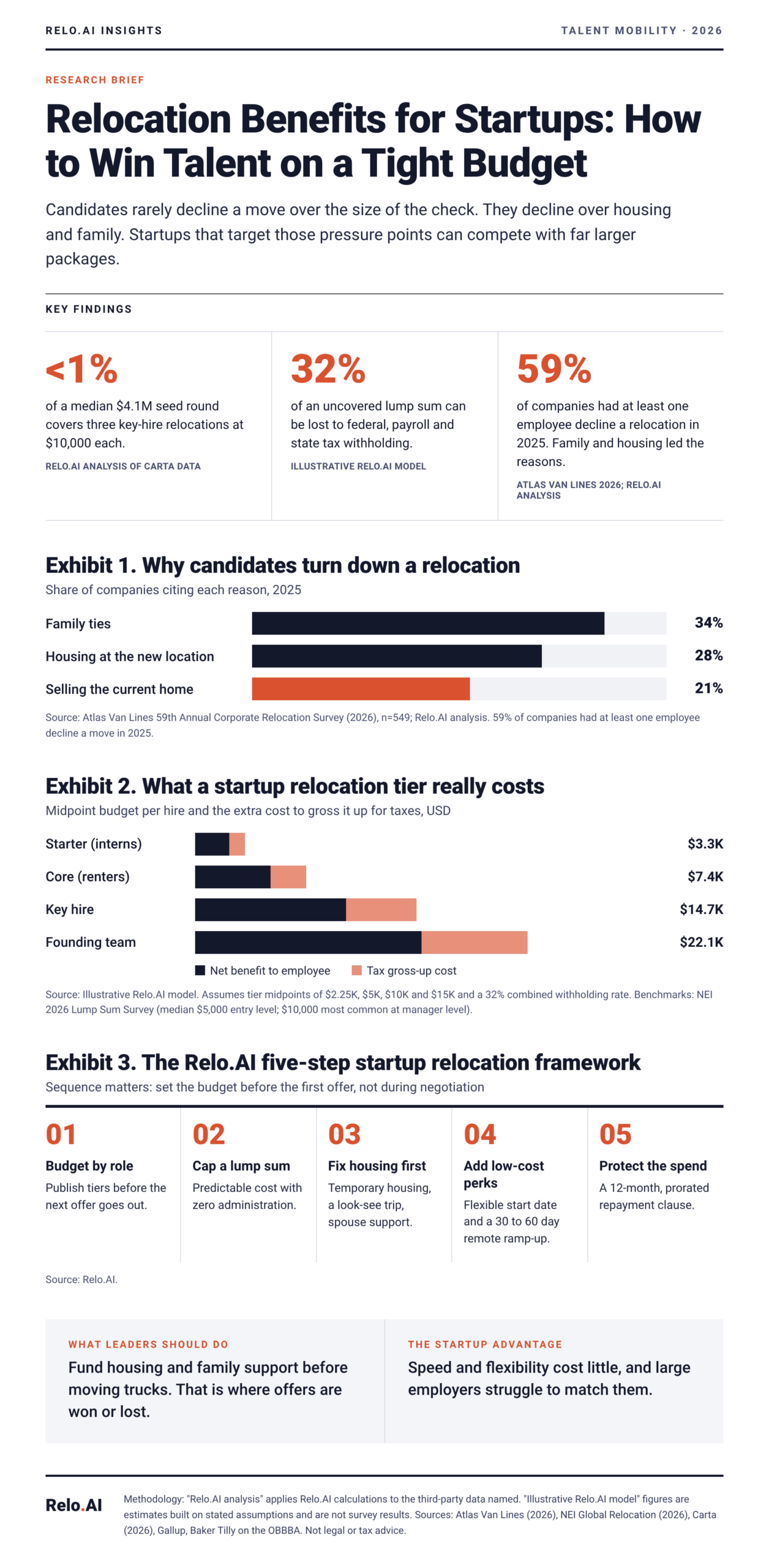
Here’s the part founders miss. Moves are also getting harder to land. In the same survey, 59% of companies had at least one employee decline a move in 2025 (Atlas Van Lines). The top reasons were family ties (34%), housing at the new location (28%) and selling the current home (21%). Notice what’s missing from that list. Nobody said the check was too small. They said the move was too hard.
What Big Companies Pay, and Why You Don’t Need to Match It
Let’s set the benchmark first. NEI’s 2026 lump sum survey of 202 companies found that 53% now use lump-sum-only relocation, up from 46% in 2019 (NEI Global Relocation). The median lump sum for an entry-level homeowner is $5,000. For executives, it’s $17,815. And $10,000 is the most common amount from manager level up.
Those numbers are more reachable than most founders think. A full corporate package with home sale help can run far higher, as our breakdown of what companies pay for employee relocation shows. But a startup isn’t competing on that menu. Your typical hire is a renter, early to mid career, and moving one or two bedrooms. moveBuddha’s 2026 pricing data puts a two- to three-bedroom move of 500 to 1,000 miles at roughly $3,060 to $5,280 (moveBuddha).
So a $5,000 to $10,000 package, spent well, puts you in the same range as many established companies. For context, Carta’s data shows a median seed round of $4.1 million in mid-2026 (Carta). Even three relocations a year at $8,000 each come to well under 1% of that raise. That’s cheap insurance on your most important hires.
Step 1: Set a Budget by Role, Not by Negotiation
Most startups don’t have a relocation policy. Instead, they have whatever the last candidate negotiated. That gets messy fast, especially when two engineers compare notes over lunch.
Fix it with a simple tier sheet before your next offer goes out. NEI found that 60% of companies now base lump sums on job level, up from 42% in 2023. Here’s a lean version a startup can adopt in an afternoon:
| Tier | Who it covers | Example budget | What it should fund |
| Starter | Interns and new grads | $1,500 to $3,000 | Truck or pod, first week of housing |
| Core | Early-career renters | $4,000 to $6,000 | Movers, travel, 2 to 4 weeks of housing |
| Key hire | Senior engineers and team leads | $8,000 to $12,000 | Full movers, look-see trip, 30 days of housing |
| Founding team | First execs and critical roles | $15,000+ | Managed move, extended housing, spouse support |
These are example ranges, not market rates for every city. Adjust for distance and local rents. For intern and new grad budgets, our guide to the intern relocation stipend has current benchmarks. And for a deeper look at levels, see our guide to relocation tier structures.
Step 2: Default to a Capped Lump Sum
For a startup, a lump sum is almost always the right starting point. It’s predictable, it takes no admin and it lets the employee spend the money where their move needs it. NEI’s data backs this up, too. Satisfaction with lump-sum-only programs jumped from 47% to 82% top ratings between 2023 and 2026.
However, a lump sum has one big weakness. The employee does all the work. For a renter moving solo, that’s fine. For a senior hire with kids and a house, it can feel like you handed them a check and walked away. So consider a hybrid for your key hire and founding team tiers. Pay a lump sum for the flexible stuff, and directly cover the one or two items that cause the most stress, usually temporary housing. Our comparison of a lump sum vs. managed move walks through the trade-offs.
Step 3: Spend Where Candidates Actually Feel the Pain
Remember the Atlas numbers. People don’t turn down moves because of the moving truck. They turn them down because of housing and family. So put your dollars there first.
- Temporary housing. Thirty days in a furnished place lets a new hire start work before they sign a lease. Atlas found that 38% of companies now offer extended temporary housing. See our guide to temporary housing for relocation, and compare corporate housing vs. a housing stipend to find the cheaper option.
- A look-see trip. One weekend in the new city, with a few neighborhood tours, answers questions no Slack message can. It usually costs far less than a single week of extra temporary housing.
- Spouse and partner support. A trailing partner’s job is often the real deal breaker. Even a few intros from your investors’ network count as dual-career relocation
- Pets and kids. These sound small to a founder and huge to a family. A missing pet transport benefit can sink an otherwise good offer, and parents will want our guide to moving with teenagers.
Step 4: Add the Low-Cost Perks Big Companies Can’t Offer
Here’s where startups have the edge. Big companies run relocation through policy and approval chains. You can say yes on a Tuesday afternoon.
- A flexible start date. Let people move after the school year ends or their lease runs out. It costs you a few weeks and can save the whole hire.
- A remote ramp-up. Let a new hire work remotely for their first 30 to 60 days while they find a home. They ship code sooner, and you skip weeks of paid housing.
- Equity instead of extra cash. For a key hire, a small equity bump can close a relocation gap without touching your cash. Just be clear about vesting and value.
- Founder access. A dinner with the CEO, or help from your own network to find a good school or neighborhood, costs nothing and signals that you care.
Step 5: Protect the Spend With a Fair Repayment Clause
A repayment agreement protects your runway if someone leaves right after you move them. Keep it fair, though, or it becomes a reason to say no.
A common approach is 12 months, prorated. So if someone leaves after six months, they repay half. Avoid 24-month clawbacks for junior roles, because at a startup that feels like a trap. Also, if you let someone go, waive the repayment. Put the terms in the offer letter, not in a separate document that shows up on day one.
THE RELO.AI DAILY NEWSLETTER
Daily Digest of Relocation News, Deals & Reviews
Subscribe for free and get proven relocation and travel strategies, personalized support, valuable rewards, and trusted reviews for every move.
Thank you for subscribing!
Your email has been added to our list.
Don’t Let Taxes Eat Your Relocation Budget
This is the mistake that quietly shrinks every startup package. Relocation money is taxable wages for most U.S. workers. The One Big Beautiful Bill Act made that rule permanent, ending both the moving expense deduction and the tax-free reimbursement for everyone except the military and the intelligence community (Baker Tilly).
In practice, that means an $8,000 lump sum can shrink by roughly a third after federal, payroll and state taxes. So your new hire might net closer to $5,400. To get them the full $8,000, you’d need to “gross up” the payment to around $11,700. NEI found that 84% of companies still offer tax help at entry level.
On a tight budget, you have two honest options. Gross up only for your key hire and founding team tiers. Or skip the gross-up but say clearly that the amount is pre-tax, so nobody feels misled in their first paycheck. Our guide to relocation bonus tax runs the numbers. And if a move lands near the end of the year, see year-end relocation tax planning.
Mistakes That Make Cheap Relocation Expensive
A few traps turn a lean package into a costly one:
- No written policy. Every offer becomes a fresh negotiation, and your early team will compare notes. Even a one-page policy fixes this. Our 2026 relocation package guide shows what to include.
- Slow reimbursements. If you reimburse rather than pay up front, a three-week wait feels like a broken promise. Our tips on relocation receipts help both sides move faster.
- One-off deals for the first hire. Whatever you give hire number five becomes the floor for hire number 15. A core-flex relocation policy keeps the core fair while giving you room to flex.
- Not tracking the return. Track offer acceptance and 12-month retention for every move. That’s how you prove relocation ROI to your board, and it helps you keep mobility cost control tight as you scale.
FAQ
Do startups offer relocation benefits?
Many do, especially for senior and hard-to-fill roles. However, startup packages are usually smaller and simpler than corporate ones. Most startups offer a capped lump sum, sometimes with temporary housing, rather than a full managed move.
How much should a startup offer for relocation?
A common range is $3,000 to $6,000 for early-career renters and $8,000 to $12,000 for senior hires. For context, NEI’s 2026 survey puts the median corporate lump sum at $5,000 for entry level and $10,000 as the most common amount for managers. You can price a specific move with the relocation calculator.
Can you negotiate relocation with a startup?
Yes, and often more easily than with a big company. Startups have fewer fixed rules. If the cash is tight, ask for a later start date, a remote ramp-up period or temporary housing instead. Our job relocation support can help you weigh the offer before you sign.
Is a startup relocation package taxable?
Yes. Relocation benefits are taxable wages for most U.S. workers, and the One Big Beautiful Bill Act made that permanent. So ask whether your package is grossed up. If it isn’t, expect to net roughly a third less than the stated amount.
Do you have to pay back relocation if you leave a startup early?
It depends on your offer letter. Many startups use a 12-month repayment clause, often prorated. Read the terms before you sign, and ask whether the repayment is waived if the company lets you go or shuts down.
Is a lump sum or reimbursement better for your move?
A lump sum gives you flexibility and cash up front, which helps if your savings are thin. Reimbursement covers actual costs, but you pay first and wait. If you’re a renter with a simple move, a lump sum usually works better for you.
What relocation benefits matter most if your budget is small?
Temporary housing, a look-see trip and a flexible start date usually matter most. They target the real reasons people turn down moves, which are housing and family, not the cost of the moving truck.
Conclusion: Spend Smart, Not Big
You’ll never outspend Big Tech, and you don’t need to. The best relocation benefits for startups are clear, fast and aimed at the real pain points. Set a budget by role, default to a capped lump sum, put money into housing and family support, and use the flexibility only a small team can offer. Done right, a $6,000 package can beat a $20,000 one, because it shows the candidate exactly how much you want them there.
THE RELO.AI DAILY NEWSLETTER
Daily Digest of Relocation News, Deals & Reviews
Subscribe for free and get proven relocation and travel strategies, personalized support, valuable rewards, and trusted reviews for every move.
Thank you for subscribing!
Your email has been added to our list.
Build a Startup Relocation Package With Relo.AI
Relo.AI helps founders and lean HR teams price every move, set fair tiers and avoid the tax surprises that shrink a package. Try our relocation calculator to see what a move really costs in minutes.
Here’s how we help startups and the people they hire:
- For the company. Our corporate relocation services give your team a ready-made policy, budget tiers and vendor pricing, without hiring a full mobility team. We handle the moves while you build the product.
- For the new hire. Our personal relocation services help employees find neighborhoods, schools and temporary housing, so they show up on day one ready to work.
- For anyone weighing an offer. If a startup just asked you to move, our job relocation support helps you read the package, spot gaps like a missing gross-up and negotiate before you sign.
Whether you’re hiring your fifth employee or packing your own boxes, the goal is the same: a move that makes a great hire say yes.
Schedule a FREE consultation with us and call us at +1-617-333-8453.
Sources
- Gallup: This Fixable Problem Costs U.S. Businesses $1 Trillion
- CNBC via NBC Bay Area: AI Startups Are Snatching Up San Francisco Offices, Using Zoom Fatigue to Recruit Talent
- Transport Topics: Atlas Survey Signals Confidence in Corporate Relocation (2026)
- Atlas Van Lines: 59th Annual Corporate Relocation Survey (2026)
- NEI Global Relocation: 2026 Relocation Lump Sum Survey, Practices and Key Takeaways
- moveBuddha: Moving Estimates, Average Cost of Movers (2026 Data)
- Carta: Startup Fundraising Data (July 2026)
- Baker Tilly: Employer-Provided Fringe Benefits in the OBBBA
Disclaimer
This article is for general information only and is not legal, tax or financial advice. Budget tiers and tax figures are simplified examples, and actual withholding depends on the employee’s tax bracket and state. Repayment clauses and equity grants have legal and tax effects that vary by jurisdiction. Talk to qualified employment counsel and a tax professional before you set a relocation policy.